Photinia
Photinia (lat. Photinia) is a genus of shrubs and trees of the Rosaceae, or Pink, family. In nature, photinia is found in East and South Asia, as well as in North America.
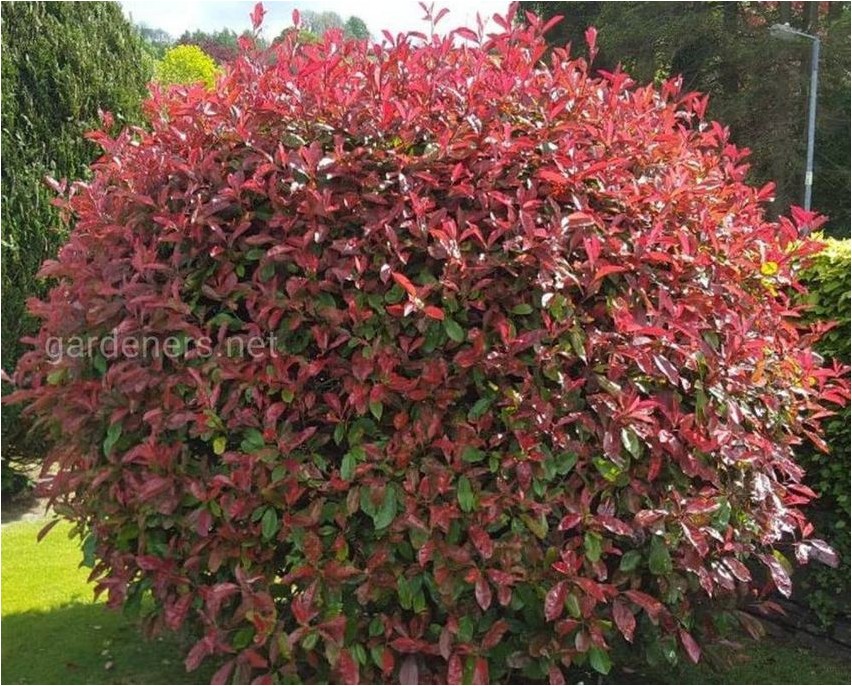
The name of the crop comes from the Greek word “hotinus”, which translates as “shiny” and refers to the shiny, glossy surface of the leaves. There are about 40 species. American botanists claim that photinia is a close relative of Michurin chokeberry, which is known among gardeners and gardeners as chokeberry.
Characteristics of culture
Photinia is an evergreen or deciduous shrub or tree up to 5 m high. The leaves are elongated, entire, alternate, short-petioled, glossy, finely serrated edges, pinnate venation, equipped with stipules.
The flowers are small, actinomorphic, white in color, with a double perianth, collected in complex corymbose or simple bunch-shaped inflorescences, located at the ends of the branches. The calyx is tubular, with five short lobes, in the lower part fused with a strongly concave receptacle.
The fruit is apple-shaped, small, round in shape, red or orange-red in color, up to 4-6 mm in diameter, contains 1-4 seeds. Photinia blooms in April-May and begins to bear fruit in June. Photinia is thermophilic, can withstand frosts down t o-12C, and freezes completely at lower temperatures. Among photinias, only two species have proven themselves to be winter-hardy.

Growing conditions
Photinia accepts both open sunny and semi-shaded areas. The crop is not picky about soil conditions; ordinary garden soil is suitable for growing it. Photinia does not tolerate calcareous and saline soils, as well as low-lying areas with stagnant melt water and cold air.
Reproduction and planting
Photinia is propagated by seeds, layering, cuttings and grafting. Seeds are sown in the fall under cover in the form of a thick layer of peat, or in the spring with preliminary stratification of the seeds for 2-3 months. Seeds are stratified at low temperatures, mixed with coarse wet sand and stored in a cool room (in a cellar, for example). You can also germinate at home. Photinia does not take cuttings well. Semi-lignified cuttings are cut in July — August, and lignified cuttings — in October. The second ones take root in the spring. It is not forbidden to graft photinia onto chokeberry or hawthorn.
Care
As is already known, photinia is a heat-loving plant, which means it has drought-resistant properties. However, during prolonged drought it requires moderate watering. It has been proven that watering affects the decorativeness of photinia as a whole. In summer, watering should be more intense, in autumn — as necessary. Sanitary pruning is carried out in the spring; it consists of removing frostbitten, diseased and broken branches.
Fertilizers for crops play an important role. Fertilizing is carried out during planting and transplantation, as well as in early spring and autumn a couple of weeks before the onset of stable frosts. Mineral complex fertilizers are used for fertilizing. Organic matter is added in the fall. Since most types of photinia are not particularly cold-resistant, they require shelter.
Very often, photinia are affected by various diseases caused by microorganisms. As a result of their actions, dark red or grayish spots appear on the leaves, and subsequently the bushes and trees may remain completely bare. This is why it is extremely important to regularly monitor the condition of the foliage. When the first signs are detected, a whole range of measures should be taken, otherwise photinia will infect nearby crops. Infected foliage is removed and burned, and the soil in the tree trunk zone is treated with approved preparations.
Usage
Photinia is a highly ornamental plant, especially in autumn. Can participate in seasonal compositions and is welcome in autonomic events. It looks harmonious in solitary and group plantings on the lawn, as part of a hedge, as well as under the through canopy of tall trees with a beautiful crown. But it should not be planted in close proximity to a dense fence, since the shrub will not receive enough air.