Chamomile
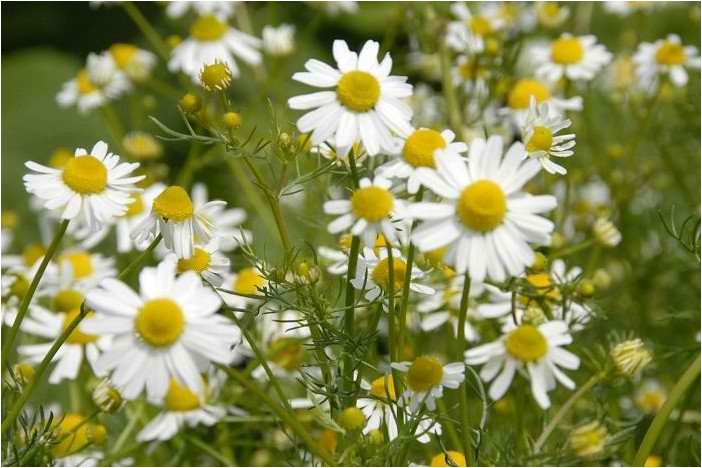
Chamomile is one of the plants of the family called Asteraceae or Asteraceae; in Latin the name of this plant will be as follows: Chamomilla officinalis L.
As for the name of the chamomile family itself, in Latin it will be like this: Asteraceae Dumort. (Compositae Giseke).
Description of chamomile
Chamomile is an annual fragrant herbaceous plant, the height of which can reach thirty centimeters. The stems of this plant are branched, straight and extending from the rhizome itself. The leaves of chamomile will be double-pinnate and endowed with thread-like lobes. The baskets of this plant are quite large in size, they are solitary and endowed with tubular bisexual yellow flowers, as well as white reed flowers. The fruit of chamomile is an achene without a tuft.
This plant blooms from June to August. Under natural conditions, chamomile is found in the south and west of the former Soviet Union. It is worth noting that now this plant has become quite rare and it is most often grown for medicinal purposes. As a weed, this plant will grow at the edges of forests, in meadows, fields and along roads.
Description of the medicinal properties of chamomile
Chamomile is endowed with very valuable healing properties, and it is recommended to use the flower baskets of this plant for medicinal purposes. The presence of such valuable healing properties is recommended to be explained by the content of choline, bitterness, essential oil, apigenin, tannins, organic acids, salicylic acid, umbelliferone and various trace elements in the flower baskets of this plant.
It should be noted that chamomile will be used in combination with valerian roots, marshmallow roots, wormwood herb, yarrow and mint leaves. Medicine uses the medicinal raw materials of this plant for the preparation of herbal preparations, including infusion, tea and decoction, as well as for the preparation of special preparations and for the production of essential oils. The composition of chamomile essential oil will contain azulene, which has the ability to provide anti-allergic effects. Chamomile has an astringent, carminative, anticonvulsant, sedative and disinfectant effect.

It’s worth noting that chamomile improves appetite and promotes digestion. An infusion made from this plant can be used to treat blepharitis: this remedy should be taken morning and evening.
In France, an infusion made from chamomile is recommended for poor health and colds, digestive disorders, tobacco and coffee overload, and physical overexertion.
For cleansing emulsion enemas, take one tablespoon of vegetable oil and a chamomile decoction at a rate of six grams per glass. These enemas are recommended for paraproctitis and hemorrhoidal inflammation. As for medicinal microclysters, you’ll need about thirty to fifty milliliters of a warm decoction of this plant, or an infusion of yarrow, calendula, and chamomile. These therapeutic microclysters are indicated for inflammation of hemorrhoids, flatulence, colitis, paraproctitis, and proctitis. It’s important to take the decoctions warm, which will ensure the most effective results.





