Catnip grandiflora
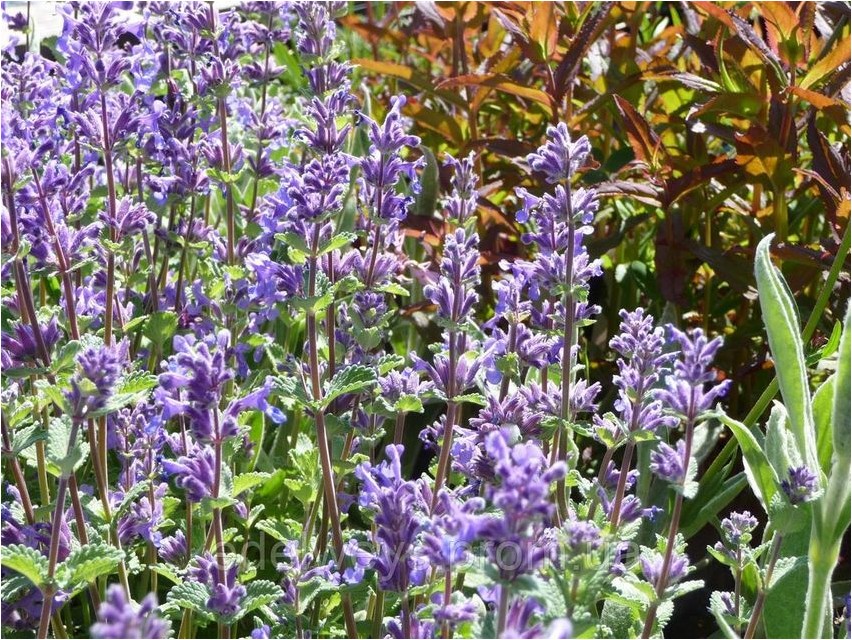
Catnip grandiflora is one of the plants of the family called Lamiaceae; in Latin the name of this plant will be as follows: Nepeta grandiflora Bieb.
As for the name of the catnip grandiflora family itself, in Latin it will be: Lamiaceae Lindl.
Description of catnip grandiflora
Catnip grandiflora is a perennial herbaceous plant whose height will vary between fifty and one hundred and fifty centimeters. The stems of this plant are not numerous and can even be single, and they are also tetrahedral and straight; under the inflorescences they will be densely and short-fluffy. Below, such stems can be either almost bare or endowed with sparse hairs. The leaves of this plant are stalked and thin, their length reaches eight centimeters and their width is four and a half centimeters. Such catnip grandiflora leaves will be either oblong-ovate or ovate. The flowers of this plant are in multi-flowered semi-umbrellas, which will be located at the very ends of the stem and even the upper axillary branches like loose brushes. The bracts are colored blue-violet and are short-ciliated. The length of the corolla is about sixteen to eighteen millimeters, it will be fluffy and colored in purple-blue tones. The nuts are dark brown in color and will be triangular.
Catnip grandiflora blooms in the second half of June, and fruit ripening begins in the first half of July. Under natural conditions, this plant is found in the Crimea, the European part of Russia in the Volga-Don and Ladoga-Ilmen regions, as well as in the Dnieper region of Ukraine, the Baltic states and the Caucasus. For growth, catnip grandiflora prefers edges, meadows, forests, grassy slopes up to the upper mountain belt.
Description of the medicinal properties of catnip grandiflora
Catnip grandiflora is endowed with very valuable healing properties, and it is recommended to use the herb of this plant for medicinal purposes. The term grass includes flowers, stems and leaves. It is recommended to harvest such raw materials throughout the entire flowering period of the catnip grandiflora.
The presence of such valuable healing properties of this plant should be explained by the content of iridoids and essential oil in its composition. The aerial part of catnip grandiflora contains tannins, steroids, flavonoids and essential oil. The leaves of this plant contain essential oil, and the seeds contain fatty oil, as well as oleic, stearic, palmitic, linoleic and linolenic acid in the hydrolyzate.

An infusion prepared from the catnip grandiflora herb is recommended for use as an anti-inflammatory and expectorant, and in the form of tea such an infusion should be drunk for anemia as a general tonic.
As an expectorant and anti-inflammatory agent, it is recommended to use the following remedy based on this plant: to prepare such a remedy, you will need to take two tablespoons of crushed dry catnip grandiflora herb per half liter of boiling water. The resulting mixture should be infused for about thirty to forty minutes, and then this mixture should be filtered very carefully. Take the resulting product based on catnip grandiflora three to four times a day, one-third of a glass. It should be noted that such a healing agent is characterized by a fairly high degree of effectiveness.
🌸Catnip🌿Perennial unpretentious plant for your garden
https://www. youtube. com/watch? v=Qfh5BS16nKM