cat’s paw
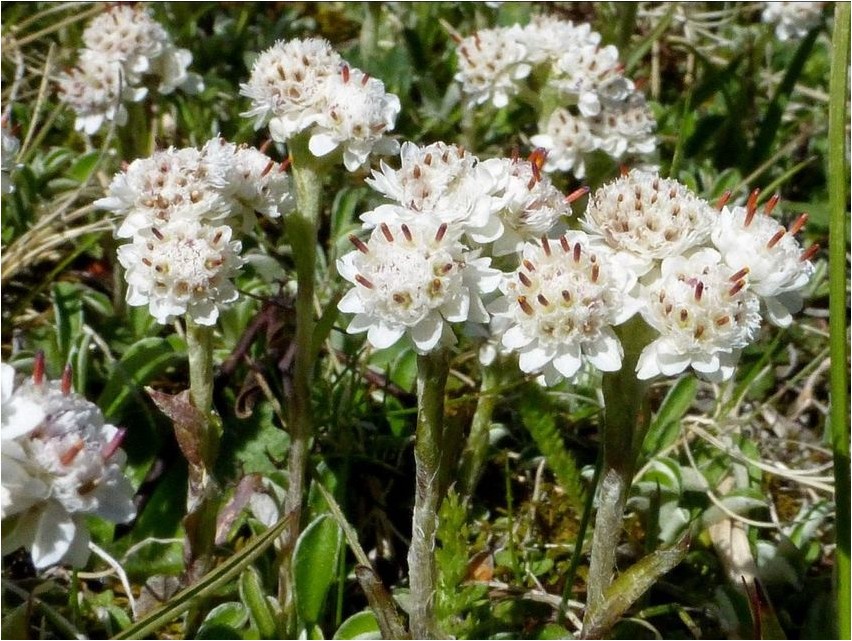
Cat’s foot is one of the plants of the family called Asteraceae or Asteraceae; in Latin the name of this plant will be as follows: Antennaria dioica L. Gaertn.
As for the name of the cat’s paw family itself, in Latin it will be: Asteraceae Dumort.
Description of a cat’s paw
The cat’s paw is known by the following popular names: anika’s tears, babik, pansy, womanizer, immortal, beluga whale, gourd, breast grass, toad grass, hare’s paw, chubby and skochiki. Cat’s foot is a perennial herbaceous dioecious plant that will reach a height of about eight to thirty centimeters. Such a plant will be endowed with white-tomentose stems and creeping shoots. The leaves of the cat’s paw are colored green on top, they are white-tomentose below, the basal leaves of this plant will be spatulate-reverse, and the stem leaves are sessile, they can be either linear-lanceolate or linear. Cat’s paw flowers are found in baskets, which are collected at the top of the stem into rather dense corymbose inflorescences. In bisexual baskets, the flowers are painted white, while in female baskets they will be pink. The fruits of this plant are oblong achenes endowed with a tuft of jagged hairs.
Cat’s paw blooms from May to June. Under natural conditions, this plant is found in the European part of Russia, the Caucasus, Moldova, Ukraine, the Far East, Siberia, the Urals, as well as in the middle and northern regions of Central Asia. For growth, cat’s paw prefers dry meadows, forest edges, light forests on poor soil, sandy places and places along sandy river banks.
Description of the medicinal properties of cat’s paw
Cat’s paw is endowed with very valuable healing properties, and it is recommended to use the grass and flower baskets of this plant for medicinal purposes. It is recommended to harvest such raw materials from May to June.
The presence of such valuable healing properties should be explained by the content of saponins, resins, sterols, vitamin K, carotene and tannins in the flower baskets of this plant.

An infusion prepared from the inflorescences and herbs of cat’s paw is endowed with hemostatic, choleretic, diuretic, astringent, anti-inflammatory and analgesic effects. This infusion of this plant is recommended for use in cases of cholelithiasis, and also as a choleretic agent for cholangitis, cholecystitis and liver disease.
An infusion of the herb and rhizomes of cat’s paw should be used to gargle, and is also used in the form of poultices, which are applied to both wounds and tumors. An infusion prepared from the herb of this plant should be used internally for whooping cough, bronchitis and sore throat, dysentery, pulmonary tuberculosis, diarrhea, gastritis, leucorrhoea and menstrual irregularities.
As for traditional medicine, an infusion of the herb of this plant is also used as an anti-inflammatory and emollient in the form of poultices and rinses for hardening of the mammary gland, abscesses, bruises, tumors, flu, goiter, eye diseases and syphilitic ulcers. This remedy is also used as a pain reliever for gout. A gruel based on cat’s paw leaves should be applied to the fingers during panaritium. For gonorrhea, an infusion of the herb is used in the form of douches, and the powder of this herb should be sprinkled on fresh wounds. It should be noted that previously the leaves of this plant were chewed for pain that was concentrated in the area of the uterus.





