Elder
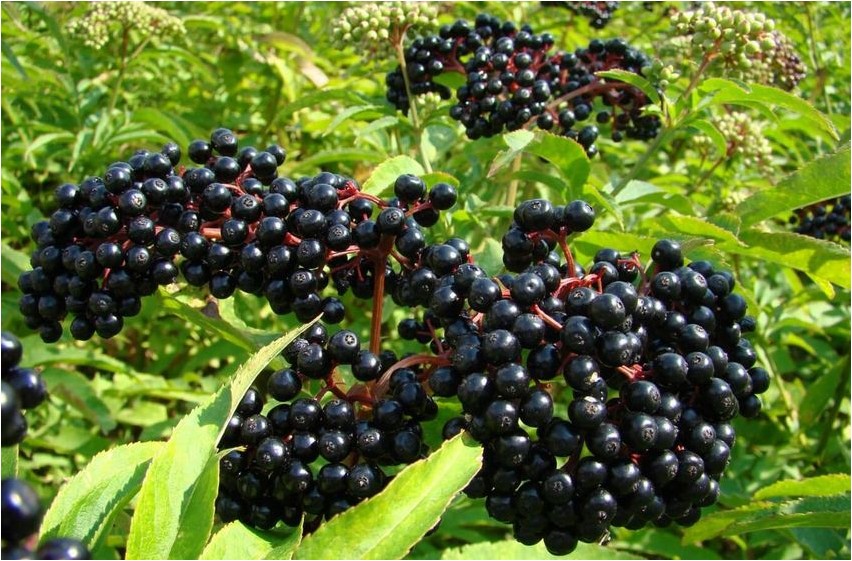
Elder (Latin: Sambucus) is a berry and ornamental plant; a shrub or tree in the Adoxaceae family. The genus was previously classified in the Caprifoliaceae family.
Other names include elder, buzok, and piskalnik. Elder is widespread in the southwestern and central regions of European Russia and Ukraine. In the wild, it grows in the forested zone of the Caucasus.
Crop Characteristics
Elder is a large shrub, or rarely a tree, up to 7 m tall. The trunk reaches 30 cm in diameter. The bark is gray, with longitudinal fissures. Young branches are green, later turning brownish-black with yellow lenticels. The leaves are opposite, compound, odd-pinnate, ovate, with pointed tips, 20-30 cm long, and borne on petioles.
The flowers are small, gathered in terminal inflorescences, and have a pleasant aroma. The outer flowers are sessile. The corolla is wheel-shaped, yellowish-white, with fused petals. The fruit is a berry-like drupe, reaching 3-5 cm in diameter. Flowering occurs in late May — early June. The fruits ripen in the second ten days of August and do not fall until September-October.
Growing Conditions

Elderberry is a sun-loving plant, preferring well-lit areas, but also thrives in shade. Elderberry is smoke-resistant, drought-resistant, and heat-loving, but does not tolerate frosts belo w-25°C (-25°F). Loose, fertile, moderately moist soils with a slightly acidic or neutral pH are preferred for growing elderberry shrubs. Elderberry does not tolerate limed or saline soils.
Propagation and Planting
The plant is propagated by seeds, cuttings, and layering. Seeds are sown in the fall under a thick layer of peat or sawdust. Seedlings emerge the following spring, and the young plants are transplanted to their permanent location a year later. Seed propagation is only effective for species-specific plants.
Elderberries are often propagated by green cuttings. Cuttings are taken between June and August. The planting material must be treated with rooting stimulants. The cuttings are rooted in small greenhouses or in open ground, but under plastic. Propagation by layering is the fastest and easiest method. New shoots are placed in furrows and covered with soil. After a year, the rooted layers are separated from the mother plant.
Seedlings are planted either in the fall (from September 10 to October 10) or in the spring (from April 15 to May 15). Planting holes are prepared 2-3 weeks in advance; their diameter should be about 40-50 cm and depth — 40 cm. The soil taken out of the hole is mixed with river sand, peat, rotted manure and superphosphate. Part of the resulting substrate is poured into the bottom of the hole, the seedling is lowered with the root collar slightly deepened, and carefully sprinkled with the remaining soil. After planting, a small mound 5-7 cm high is formed around the hole and watered abundantly.
Care
Caring for elderberries is not labor-intensive and can be done even by a novice gardener. The main tasks for caring for shrubs are systematic watering, weeding, loosening the tree trunks and fertilizing with mineral and organic fertilizers. Elderberry needs sanitary and formative pruning.
During active plant growth, watering must be combined with fertilizing in the form of ash infusion or liquid manure. The first formative pruning is carried out 3-5 years after planting. Frostbitten, broken and diseased branches are cut out completely, and the rest are shortened by 80-100 cm. The branches quickly recover and produce high yields of berries every year.
Elderberry is often affected by the elderberry moth, elderberry leaf miner and elderberry leaf mite. To combat pests, spray with the drug “Fufanon”. For the winter, the plants are covered with spruce branches, and the tree trunks are mulched with peat or fallen leaves.