Theophrastus’ rope
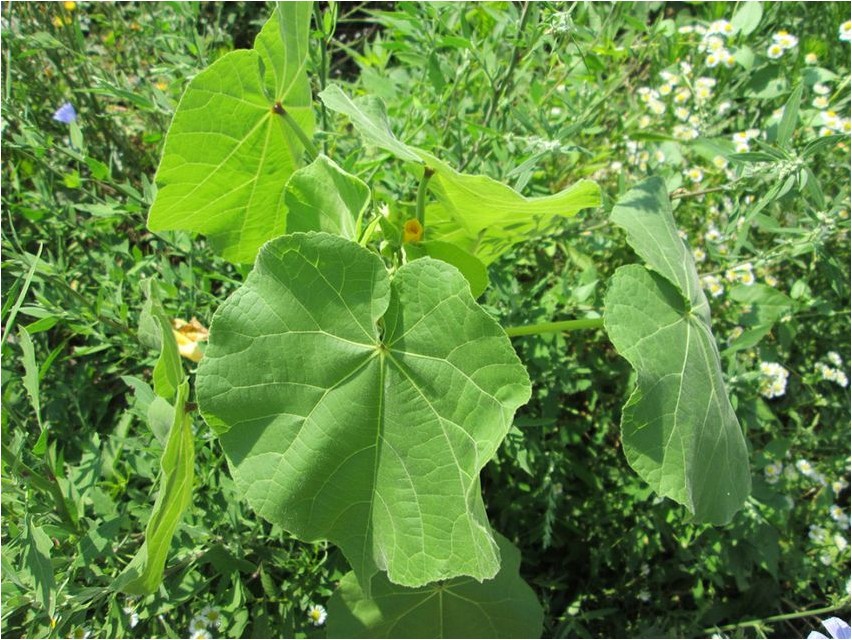
Theophrasti is one of the plants of the family called malvaceae; in Latin the name of this plant is as follows: Abutiium theofrasti Medic.
As for the name of the family of theophrastus rope plant itself, in Latin it will be like this: Malvaceae Juss.
Description of the theophrastus rope
Theophrastus rope is an annual herbaceous plant, the height of which will be about fifteen to twenty-five centimeters. The stem of this plant is straight and cylindrical; it can be either simple or branched at the top with short flowering branches. Such a stem is soft, short and erect, in the upper part it is endowed with dense glandular hairs and is almost velvety. At the bottom of the taller stems it will only be scatteredly hairy and have a regularly reticulated sculpted periderm. The leaves of the theophrastus rope will be long-petioled, the length of their plates reaches fifteen centimeters. Such leaves are broadly ovate in shape, they are deeply heart-shaped, and will be long-pointed at the end. On both sides, the leaves of this plant are green and velvety with rather dense star-shaped pubescence.
Under natural conditions, this plant is found in Primorye in the Far East, in the south of Ukraine and in the Dnieper region, in the Caucasus, in Moldova, in Central Asia, as well as in the following regions of the European part of Russia: in the Trans-Volga, Upper Volga, Black Sea, Lower Volga and Lower Don regions. For growth, the plant prefers places near wells, along roads and ditches, deposits, depressions, river valleys, estuaries, gardens, vegetable gardens and parks. Also, sometimes theophrastus rope is also found as a weed in crops.
Description of the medicinal properties of theophrastus rope
Theophrastus is endowed with very valuable healing properties, and it is recommended to use the leaves, seeds, flowers and roots of this plant for medicinal purposes.
It should be noted that the plant contains mucus. The roots of this plant contain carbohydrates, saponins, flavonoids, uronic acids, methylpentosans, pentoses and pentosans. The leaves of the theophrastus rope contain rutin, vitamin C and the following mucopolysaccharides: uronic acids and amino sugars. It should be noted that the seeds contain fatty oil and alkaloids.

In Tibetan and Chinese medicine, preparations based on this plant are used as a wound-healing, antiseptic, tonic, and disinfectant. These preparations are also used for intestinal ailments, dysentery, cataracts, chronic appendicitis, and numerous eye diseases. A decoction made from the seeds of this plant should be used as a diuretic, laxative, and emollient. In folk medicine, theophrast’s burdock is used as a diuretic and wound-healing agent. It should be noted that this plant can serve as a substitute for both marshmallow and thuringian marshmallow.
A decoction of this plant’s roots can be applied externally and internally: this remedy is effective for various skin conditions, stomachalgia, and diarrhea. It is also worth noting that theophrast’s burdock can also be used as a substitute for mallow. A decoction of the roots, flowers, and leaves of this plant is a valuable expectorant. A decoction of the leaves, seeds, and flowers of this plant is recommended for gonorrhea, and a decoction of the flowers is also used as a valuable diaphoretic.
It should be noted that the oil of this plant has diuretic properties and is also suitable for industrial and food purposes.





