Sow Thistle
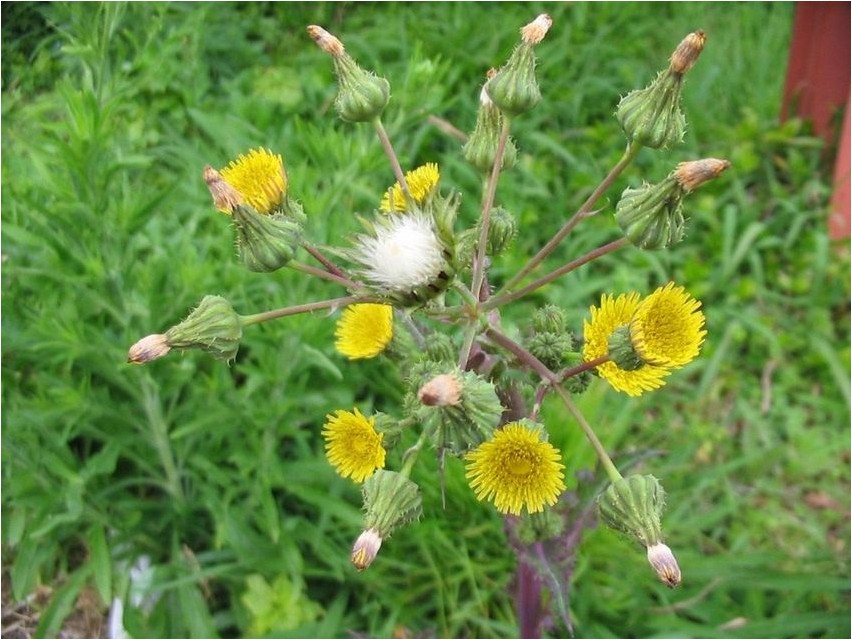
Sow thistle is a member of the Asteraceae family. Its Latin name is Sonchus oleraceus L.
As for the family name itself, the Latin name is Asteraceae Dumort. (Compositae Giseke).
Description of Sow Thistle
Sow thistle is also known by the following common names: chicken thistle, hare’s lettuce, sow thistle, kozelok, spurge, field chicory, hare’s sow thistle, and milk thistle. Sow thistle is an annual herbaceous plant with a white milky sap. The height of this plant ranges between thirty and one hundred centimeters. The stem of sow thistle is hollow, thick, glabrous, and branched. Only the peduncles of this plant are covered with glandular hairs. The lower leaves of the sow thistle are either lyrate or pinnately divided, while the upper leaves are clasping and have very sharp tendrils. Heads of yellow flowers are collected at the very top of the plant’s stem in a corymbose panicle. The fruits of the sow thistle are achenes with a white tuft of simple hairs; these achenes are light brown in color.
The sow thistle blooms from July to September. In the wild, this plant is found in the Caucasus, Ukraine, Belarus, European Russia, Central Asia, the Far East, and Western and Eastern Siberia. It grows as a weed in gardens, fields, and vegetable plots.
Description of the medicinal properties of the sow thistle
The sow thistle has very valuable medicinal properties, and the herb is recommended for medicinal purposes. The term “herb” includes leaves, stems, and flowers. This raw material should be harvested throughout the flowering period.
The plant’s valuable medicinal properties are explained by its content of carotene, traces of akaloids, various narcotic substances, and ascorbic acid.

Sow thistle possesses highly effective galactogogue, choleretic, anti-inflammatory, antipyretic, tonic, diuretic, and laxative properties. An infusion made from this plant is recommended for hemorrhoids, chest pain, jaundice, and inflammatory conditions of the liver, stomach, intestines, and lungs. Sow thistle infusion is used as a thirst-quenching, cooling, antipyretic, and tonic. Furthermore, this remedy has the ability to increase milk production in nursing women.
To remove warts, it is recommended to rub them with juice made from this plant. It is also worth noting that concentrated juice from sow thistle is a very powerful laxative. This remedy was also considered a diuretic for dropsy and was also used as an antidote for opium poisoning. In Chinese folk medicine, the leaves, seeds, roots, and grass of this plant are widely used. Freshly boiled sow thistle herb should be used as a poultice for various inflammatory conditions and indurations. It’s worth noting that the young leaves of this plant are perfectly acceptable for consumption in soups and various vitamin-rich salads.
For asthenia, take one tablespoon of the herb per cup of boiling water, steep for an hour, and strain thoroughly. Take one tablespoon of this remedy three to four times daily.





