Motherwort
Motherwort is one of the plants of the family called Lamiaceae; in Latin the name of this plant will be as follows: Leonurus cordiaca L.
As for the name of the motherwort family itself, in Latin it will be like this: Lamiaceae Lindl. (Labiatae Juss.).
Description of motherwort
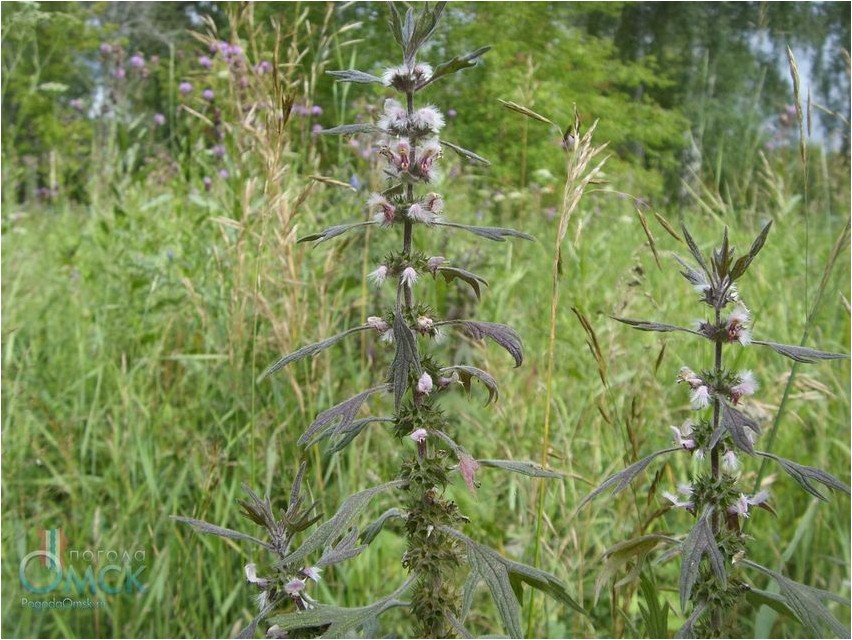
Motherwort common or cordial is a perennial herbaceous plant endowed with a tetrahedral, bare or hairy stem exclusively along the ribs, which will be branched, and the height of such a stem will fluctuate between fifty and one hundred and fifty centimeters. The leaves of this plant are petiolate, slightly pubescent, while below they will be colored in light green tones, and above such tones will be dark green. The lower leaves of motherwort will be ovoid in shape, rounded, five-lobed, and heart-shaped at the very base. The middle leaves of this plant can be either elongated elliptical or lanceolate with elongated serrated lobes. The upper leaves of motherwort are either entire with two teeth directed forward, or three-lobed. The flowers of this plant will be small in size and irregular in shape; they are found in multi-flowered rings located at the very tops of the shoots, and the color of such flowers is light pink.
The flowering of motherwort occurs during the period from June to July. Under natural conditions, this plant is found in the territory of Moldova, the European part of Russia, Ukraine, as well as the Amur region in the Far East. For growth, this plant prefers places along roads, bushes and garbage areas. It should be noted that motherwort is a poisonous plant: for this reason, extreme caution is recommended when handling this plant.
Description of the medicinal properties of motherwort
Motherwort is endowed with very valuable healing properties, and for medicinal purposes it is recommended to use the leafy flowering tops of this plant, the length of which will be about thirty to forty centimeters. It is recommended to harvest such medicinal raw materials exclusively in dry weather throughout the entire flowering period of this plant.
The presence of such valuable healing properties is recommended to be explained by the content of flavonoids, iridoids, diterpenoids, cardenolides and stachydride alkaloid in this plant. The aerial part of motherwort will contain saponins, essential oil, tannins, the diterpenoid leocardine, ascorbic acid and the alkaloid stachydrine.

Preparations created on the basis of this plant are endowed with cardiotonic, sedative, diuretic and anticonvulsant effects. It is noteworthy that it was experimentally proven that preparations based on motherwort will have a calming effect on the central nervous system several times stronger than valerian tincture.
Extract, infusion and tincture based on the herb of this plant are recommended for use as a very effective sedative for angina pectoris, hypertension and neuroses. Practical medicine uses medicinal remedies prepared on the basis of motherwort for psychasthenia, neurasthenia and vegetative-vascular dystonia, and is also used during the climatic period for various functional disorders of the central nervous system. It is noteworthy that this plant is used as part of the preparations throughout pregnancy in order to improve the functioning of the excretory and digestive systems.