Rough Gentian
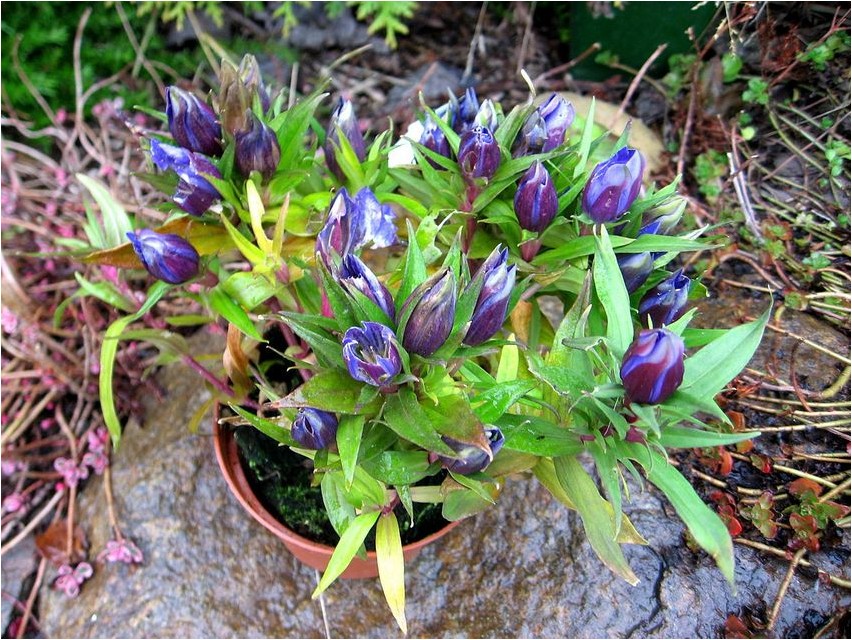
Rough Gentian is a member of the Gentianaceae family. Its Latin name is Gentiana scabra Bunge.
The family name of Rough Gentian is Gentianaceae Juss.
Description of Rough Gentian
Rough Gentian is a perennial herbaceous plant reaching a height of thirty to fifty centimeters. This plant has a fairly robust root system. Rough Gentian stems are sparse, with leaves that are dark green above and lighter beneath. These leaves are also trifoliate, with sharply and finely roughened edges and nerves, oval or ovoid. The leaves of the rough gentian are approximately two and a half to seven centimeters long and seventy millimeters to three centimeters wide. Flowers are borne in clusters at the very top of the stem or in the axils of the upper leaves; these flowers are enveloped by the terminal leaves. The corolla of this plant is dark blue. The fruit is an oblong capsule on a stalk, and the seeds are linear and reticulated, with winged edges along the entire margin.
In the wild, this plant can be found in Eastern Siberia and the Far East. Rough gentian prefers shrubs, stubble fields, and damp, hummocky meadows. Description of the medicinal properties of Gentiana aspera
Gentiana aspera possesses valuable medicinal properties. For medicinal purposes, the rhizomes and roots of this plant should be used, harvested in the fall or early spring. It is recommended to thoroughly clean the rhizomes of soil and cut them into pieces, then rinse them in cold water and let them dry.
These valuable medicinal properties are due to the plant’s content of carbohydrates and related compounds: fructose, glucose, sucrose, gentianose, and gentiobiose. This plant also contains the alkaloid gentioflavine and the iridoid tetraacetate gentiopicroside. Furthermore, the roots and rhizomes of Gentiana aspera contain gentianin, gentiopicroside, scabroside, and triphloroside. Moreover, the stems of this plant contain gentiopicroside, and the leaves contain carbohydrates and related compounds: gentiobiose, gentianose, sucrose, fructose and glucose.
As for traditional medicine, a decoction of the roots and rhizomes of this plant is used as a means to stimulate appetite and improve digestion. It is noteworthy that in Chinese and Korean medicine such drugs can be used as anti-inflammatory and antipyretic for chronic and acute gastritis, as well as for cholangitis, jaundice and hepatitis.

Moreover, in Chinese medicine, a decoction and infusion prepared from the roots and rhizomes of Gentian rougha is used for rheumatoid arthritis, diarrhea, encephalitis, hypertension, dyspepsia, ophthalmia and hyperhidrosis. In addition, such drugs are also used to strengthen memory, and also as a detoxifying, anthelmintic and antifever agent. As for topical use, such products are used for diseases of the scalp and skin diseases. In Korea, preparations based on this plant are characterized by a fairly effective effect on cystitis, as well as conjunctivitis, and in addition to trophic ulcers, and tinnitus, and various epigastric pains.
Gentian rough Zyiko Rindo. Brief overview, description of characteristics of gentiana scabra Zuiko Rindo





