Caladium
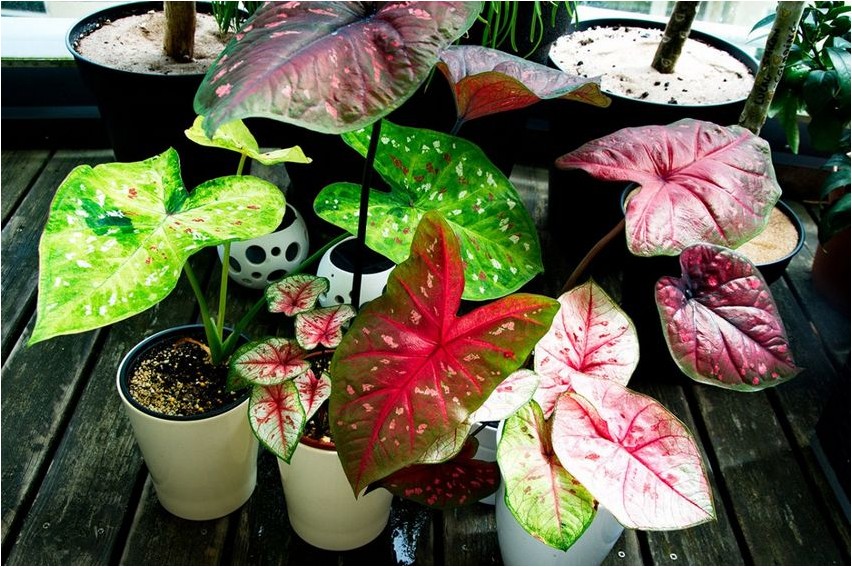
Caladium (lat. Caladium) is a small genus of succulent herbaceous plants that create dense undergrowth in the American tropics.
In its native Penates it is used for food purposes, producing starch from the roots of plants, although the juice that permeates all parts is considered toxic. Our plant is popular for its large, bright leaves that can decorate any flower garden or add a special charm to the interior of a room.
What’s in your name
The origin of the Latin name of the genus is unknown. Most likely, similar to the name of the genus “Calla”, which also belongs to the Araceae family, it was drawn from the works of Pliny the Elder without additional comments.
Due to the picturesque shape of the leaves, plants of the genus have many popular names. Everyone sees in them their own image, close in spirit, giving rise to such names as “Angel Wings”, “Heart of Jesus”, “Elephant Ears”.
In the tropics there grows a very warlike representative of the Sedge family, whose name is very similar to the beautiful Caladium, but which has lost the first letter “a”, that is, the name of the plant sounds like “Cladium”. Therefore, you should be careful when buying seeds so that instead of the luxurious soft leaves of Caladium, you do not grow sharp-edged leaves of Cladium that pierce living tissue. Although Caladium is usually propagated by dividing the rhizome rather than by sowing seeds.
Description
The Almighty did not skimp on paints and put in maximum imagination when creating Caladium leaves. When it came to the flowers, the colors and imagination dried up, and therefore the flowers turned out to be inconspicuous, gathering into yellow inflorescences-cobs. The inflorescence is hidden behind a covering greenish leaf so as not to disturb the beauty of the leaves.

After all, it was precisely because of its luxurious leaves that people liked this perennial tropical herbaceous plant. Despite the toxic sap running through the vessels of the plant, Caladium has gained recognition and is widely used in decorating gardens and indoors. The unusual shape of the arrow-shaped, heart-shaped leaves with a wavy edge is complemented by bright colors, combined on one leaf in the most incredible way. These can be bright red veins that stand out clearly against the white-green background of the leaf. Or the pink surface of the leaf is enclosed in a green frame, flowing with a wavy border along the edge. The usual green color of the leaves is enriched with white, pink, purple, and red.
True, the rhizomatous plant likes to take a break from the activity of its above-ground parts, indulging in a state of rest for almost six months. But the holiday that Caladium creates during the second half of the year more than makes up for such a long absence of the plant from this world.
Varieties
* Caladium bicolor (lat. Caladium bicolor) – on the green or white surface of the leaves, respectively, white or red spots.
* Caladium schomburgii (lat. Caladium schomburgii) green veins on the pinkish-red surface of the leaves.
* Humboldt caladium (lat. Caladium humboldtii) – silvery-white patterns on the dark green surface of the leaves.
Growing
Like many tropical plants of the lower tier, Caladium loves diffused light, moist (but not damp) air and soil, warmth (but not heat), fertile acidic soil and the absence of drafts. Excess moisture, called “dampness”, provokes fungal diseases, so you should be aware of the difference between “damp” and “damp”.
When the plant retires, the extracted roots are stored at plus 15 degrees in boxes filled with peat. With the beginning of a new life cycle, the roots are moved back into the soil, not filling them completely, but only two-thirds of their thickness.
Caladium produces offspring that are used for plant propagation. In addition, propagation can be carried out through division of the overgrown rhizome.
When working with the plant, care is required and the use of protective equipment is required to avoid becoming a victim of its toxicity.