Hawkweed bitterweed
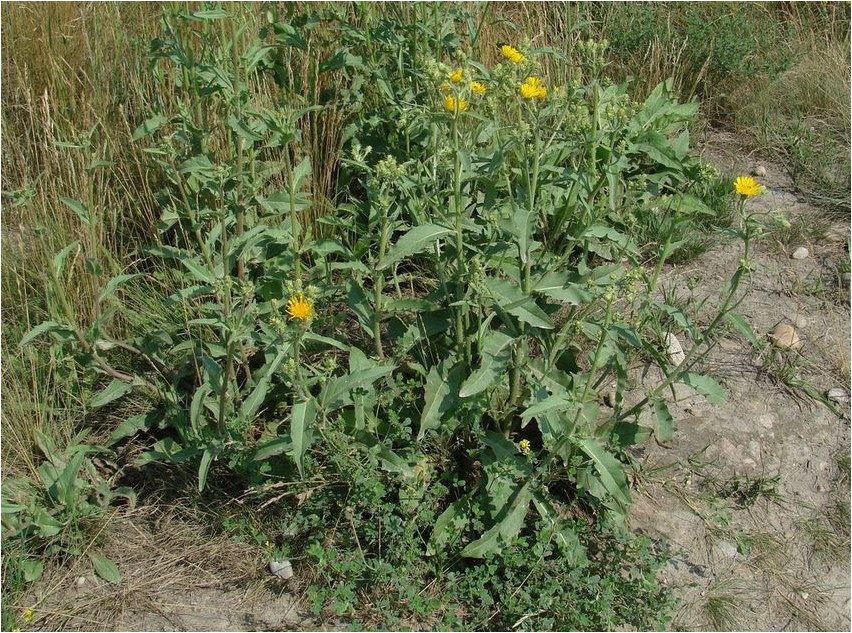
The bitterweed is one of the plants of the family called Asteraceae or Asteraceae. In Latin, the name of this plant will be as follows: Acroptilon hierocioides L.
As for the Latin name of the hawkweed family itself, it will sound like this: Asteraceae Dumort. It is noteworthy that hawkweed bitterling is also known as yellow bitterling. As for the popular names of this plant, it is also known under the following names: milkweed, hawkweed, bobilnik, bitter grass, tree, snake and bobilnik.
Description of bitterling hawkweed
Hawkweed is a biennial, stiff-haired plant, endowed with a branched stem; when cut, a milky sap is released from such a stem. The length of such a stem will be about thirty to one hundred centimeters. The basal leaves are oblong-lanceolate and notched-toothed, while the stem leaves will be toothed, sessile, lanceolate and semi-stem-encompassing. The flowers of the bitterling hawkweed are dark yellow in color, they are endowed with a tuft and are collected in baskets. The flowering of this plant begins in June and continues until August.
Under natural conditions, hawkweed bitterling can be found in numerous regions of Russia, Ukraine and Belarus. At the same time, this plant prefers shrubs, meadows, clearings and places along roads to grow.
Description of the medicinal properties of bitterling hawkweed
Hawkweed is endowed with very valuable healing properties, and it is recommended to use the leaves of this plant for medicinal purposes. It should be noted that the chemical composition of bitterling hawkweed has not yet been fully studied.
This plant is endowed with diuretic, choleretic, emollient, analgesic and mild laxative effects. As for traditional medicine, an aqueous infusion of bitterling leaves is used for jaundice of various origins, as well as for cholecystitis. Also, an aqueous infusion of the leaves of this plant can be used as a laxative for constipation and pain that arises from bruises of internal organs.

The following remedy is also quite effective: namely, the use of crushed leaves of bitterling hawkweed in the form of poultices. It is recommended to apply such leaves to dense inflammatory foci, which include carbuncles and boils. This remedy turns out to be very effective and contributes to both softening and complete resorption of such dense inflammatory foci. It should be noted that the young leaves of this plant are even acceptable to eat.
For constipation, the following remedy based on bitterling hawkweed is effective: to prepare it, it is recommended to take one tablespoon of dry herb of this plant to one-third of a glass of boiling water. The resulting mixture should be infused for twenty minutes, and after that the mixture should be filtered very carefully. It should be noted that in order to achieve the greatest effectiveness from the use of such a product based on hawkweed, it is recommended not only to follow all the rules for preparing this product, but also all the conditions for its use. This remedy based on bitterling hawkweed should be taken one or two tablespoons three to four times a day in order to cure constipation. It is noteworthy that due to insufficient knowledge of the chemical composition of this plant, it can be assumed that in the near future new ways of using the medicinal properties of hawkweed bitterling may appear.





