Wormwood
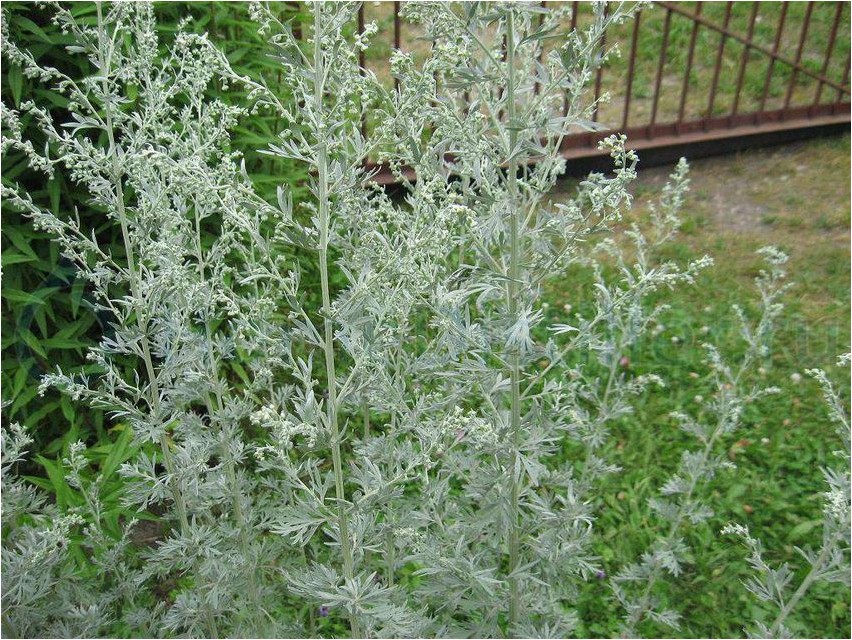
Wormwood is a member of the Asteraceae or Compositae family. Its Latin name is Artemisia absinthium L.
The Latin name for the wormwood family is Asteraceae Dumort. (Compositae Giseke).
Description of Wormwood
Wormwood is a perennial herbaceous plant that can reach a height of one meter. This plant has a very intense scent. Its stems are ribbed and branched upward, while the leaves themselves are grayish-tomentose and silky. The basal and lower leaves are lobed secondary and are bipinnate, also incised. The upper leaves of wormwood are linear and trifoliate. The flower heads of this plant are quite small, gathered in a panicle at the very top of the stem, and drooping, located in the axils of the terminal leaves. All the flowers of wormwood are tubular, with the inner flowers being bisexual, while the marginal flowers are female.
Burning of wormwood occurs from July to August. In the wild, this plant is found throughout Ukraine, Belarus, and the European part of Russia. It prefers railway embankments, weedy areas, hillsides, fence posts, roadsides, and fields.
Description of the medicinal properties of wormwood
Burning wormwood has very effective medicinal properties, and the leaves and flowering tops of this plant are recommended for medicinal purposes. The presence of such valuable medicinal properties is believed to be explained by the resins, protein, vitamin C, salts of various acids, essential oil, absinthin and anabsinthin glycosides, and tannins found in this plant. It should be noted that the main components of this plant’s essential oil are azulene, the lactones arabsin and artabin, the terpene alkaloid thujol, and the ketone thujone. In addition, wormwood contains phytoncides.
This plant is recommended for use in the form of tea, pills, infusions, and extracts, as well as as a bitter-spicy drink as a choleretic, for intestinal gas, fever, to improve digestive function, and to stimulate the appetite.

As for traditional medicine, here this plant is very widespread. Traditional medicine recommends using wormwood juice as a very effective wound healing agent. This drug is indicated for use in cases of gas accumulation in the intestines and fever, and is also used as an anthelmintic. The essential oil of this plant is used for eczema, bronchial asthma, rheumatism and burns, especially for radiation therapy.
For insomnia and kidney stones, it is recommended to use fresh wormwood juice mixed with alcohol. In addition, this healing agent is also indicated for use as a wound healing agent.
For articular rheumatism and gout, it is recommended to use the following very effective remedy based on this plant: to prepare such a healing remedy, you will need to take a kilogram of wormwood herb and boil it in a full bucket of water. Then such a healing remedy should be infused and poured into the bath. Then such a filled bath is used for about fifteen to twenty minutes, and the water temperature should not exceed thirty-seven degrees.