Chokeberry
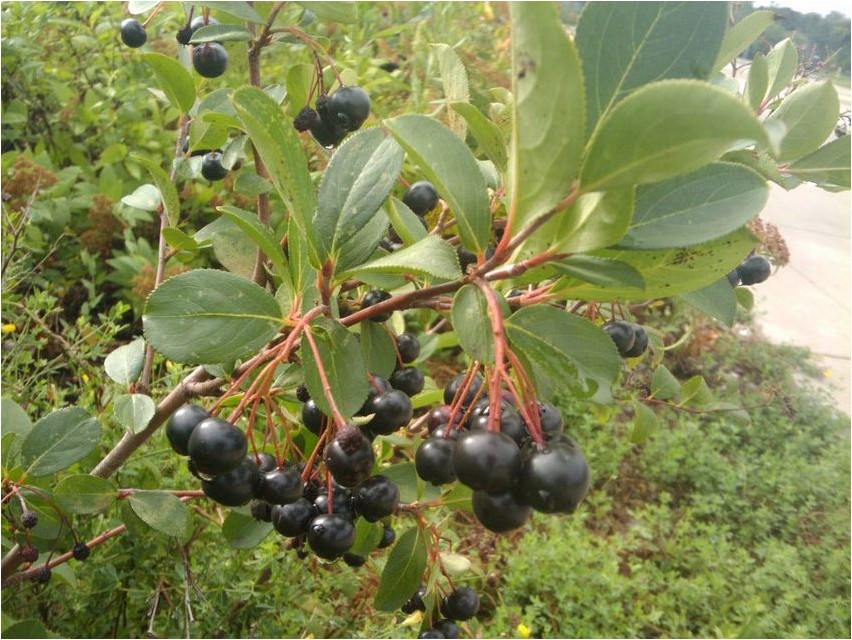
Chokeberry (lat. Aronia) — berry crop; perennial shrub of the Rosaceae family. The name of the plant comes from the Greek word “aros”, which means help, benefit.
Characteristics of culture
Chokeberry is a deciduous, highly branching shrub 2-4 m high, less often 6 m. In young plants the crown is compressed, becoming spreading with age. Shoots at a young age are reddish-brown, later dark gray. The root system is powerful, highly branched, the main part of the roots lies at a depth of 40-60 cm. The leaves are wide, petiolate, oval or ovoid, reach 5-9 cm in length, 5-6 cm in width, and are arranged alternately. The edges of the leaf blade are crenate or serrate. In summer, the leaves have a rich green color, in autumn — purple.
The flowers are small, five-petaled, collected in racemes or corymbose inflorescences of 15-30 pieces, and can be white or pale pink. Flowering occurs in late May — early June. The fruits are spherical, reach 1-2 cm in diameter, red or black in color with a bluish bloom, and have a pleasant sweet taste with notes of tartness. The weight of one berry is 1-1. 3 g. The seeds are small, wrinkled, dark brown, up to 2 mm long. The berries ripen in late August — early September and stay on the branches for a long time. Chokeberry begins to bear fruit at 4-5 years of age.
The eastern states of America are considered the birthplace of the culture. In Russia, the plant began to be cultivated only at the beginning of the 20th century. Chokeberry gained particular popularity among gardeners in the 1950s. Currently, chokeberry, or as it is also called, chokeberry, is widespread in Russian gardens; it is mostly grown in the Non-Black Earth zone, the southern regions of Siberia and the Urals. It attracted gardeners with its medicinal properties, high productivity and unpretentiousness. It’s hard to imagine, but the crop produces high yields for 20-30 years.
Growing conditions

Chokeberry is a light-loving crop; in shaded areas, plants practically do not bear fruit. The crop is not picky about soil; it grows well even on soddy-podzolic soils, but it does not tolerate places that are too waterlogged. Chokeberry also has a negative impact on rocky, saline soils, as well as thickening of bushes; otherwise, plant productivity is significantly reduced.
Reproduction and planting
Chokeberry propagates by seeds, layering, green cuttings, root suckers and dividing the bush. Before planting, the seeds are subjected to stratification, the duration of which must be at least 90 days. The seeds are planted for stratification in early January, they are scattered into 300 g bags and soaked in warm water for 24 hours. Then the seeds are kept at a temperature of 12-14C for a week, all this time carefully monitoring to ensure that the bags are wet.
Next, the bags of seeds are placed in boxes with ice so that they do not come into contact with the walls, and kept in this state for a week. The cooled bags are again placed in a room with a temperature of 12-14C. This alternation is carried out until more than 60-70% of the seeds of the crop hatch.
Store prepared seeds in a snow pile until sowing. There, the seeds are covered with mucus, which prevents further germination. Periodically, the seeds are rinsed in clean water on a sieve, then put back into bags and placed in a snow pile. A week before planting, the seeds are kept at a temperature of 18-20C. Sowing is done in early spring, planting depth is 1-1. 5 cm. When the seedlings have 3-4 true leaves, the plants dive to a permanent place.
Among gardeners, the method of planting rooted woody and summer green cuttings is also common. They are planted at the beginning of summer in previously prepared, well-drained and fertilized soil. Immediately after planting, the plants are covered with special material or jars. The cuttings are shaded for the first two months, after 25-30 days the covering material is removed and covered again at night. This is necessary in order to accustom the seedlings to the open air.
Care
There are no particular difficulties in caring for chokeberry. Every year, in early spring, thickening and unproductive shoots are pruned, as well as old, dry, damaged and frostbitten branches are removed. When the bush is 13-15 years old, anti-aging pruning is performed.
Fertilizing with mineral and organic fertilizers is carried out once every 2-3 years. Chokeberry is not prone to diseases and pest attacks. For the winter, the plants are bent to the ground or covered with spruce branches.