Sparmannia
Sparmannia (lat. Sparmannia) is a beautiful flowering plant belonging to the Linden family (according to one of the classifications it is classified as a member of the Malvaceae family). Some gardeners even call Sparmannia indoor linden.
Description
Sparmannia is a very showy shrub that, after some time, turns into a lovely compact tree. Sparmannia leaves look very much like linden leaves — they are all covered with the most delicate fluff and painted in pleasant light green tones.
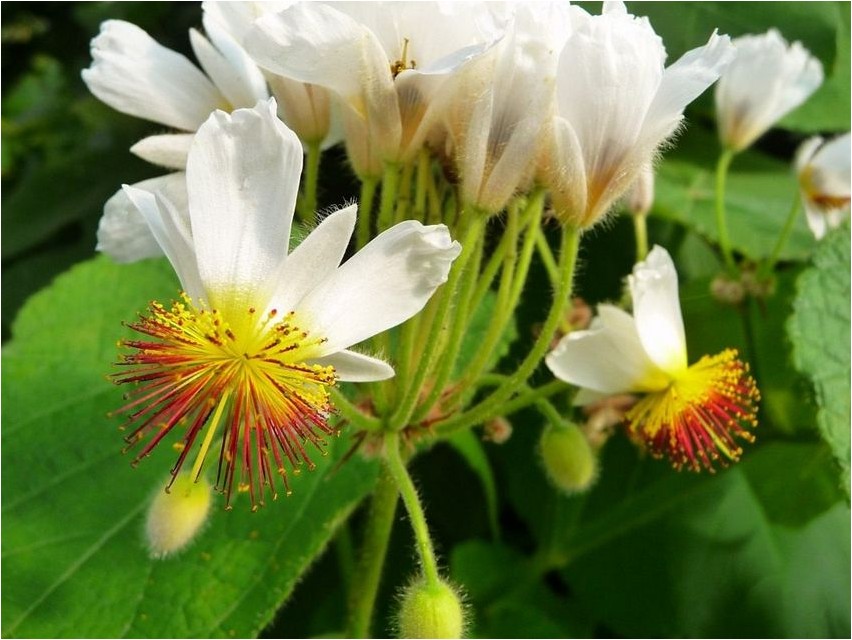
Sparmannia flowers boast an extremely pleasant smell — its inflorescences are soft white, very similar in shape to funny umbrellas, and sit on fairly high peduncles. And each flower is generously decorated with bright yellow or purple small stamens. And sometimes you can even find varieties with luxurious double flowers!
In total, the genus Sparmannia includes about six or seven species of beautiful fast-growing shrubs, which are characterized by a special structure of flower corollas.
Where does it grow
Under natural conditions, Sparmannia can be seen in the South African subtropics or tropics.
Usage
Sparmannia is characterized by a very high decorative effect, which is why it is quite actively used as interior decoration.

Growing and care
It is recommended to grow Sparmannia in fairly cool rooms, in their western, eastern or southern parts. This plant is very light-loving, but it still needs protection from direct sunlight. And the winter temperature of its maintenance should be in the range from thirteen to twenty-two degrees. Ideally, in summer Sparmannia should be kept at a temperature of sixteen to eighteen degrees, and in winter — from seven to ten degrees. And this beauty needs to be placed in draft-free, but at the same time, well-ventilated areas. By the way, in the event of sudden changes in temperature, parmannia can sometimes shed its leaves.
It is best to plant Sparmannia in a mixture of turf soil with good humus soil and a small amount of sand (2:1:1). Ready-made mixtures are also quite suitable for these purposes.
In summer, watering sparrmannia should be frequent and quite abundant (the soil should never be allowed to dry out!), and in winter they are carried out much less frequently, spending much smaller volumes of water. Also in the summer, the plant needs systematic spraying, but it should be done very carefully, as water can sometimes leave small spots on the leaves. And the water must be at room temperature!
As for fertilizing, whether to apply it or not depends to a large extent on the general condition of the sparmannia. Typically, feeding is given during the period of active growth of shoots and leaves. The addition of fertilizers to water for irrigation is especially welcome — many gardeners do this manipulation weekly. The only thing is that all fertilizers intended for fertilizing Sparmannia should have a reduced content of potassium chloride. It is not forbidden to alternate such preparations with organic matter, in particular with mullein solution.
Sparmannia is most often propagated by semi-lignified cuttings (both summer and spring), in addition, it requires fairly strong pruning before it begins to grow. And this incredibly attractive plant should be replanted annually, as a rule, this is done by transshipment. If there is a need to slightly restrain its too active growth, then the young shoots are simply pinched lightly.
With good care, Sparmannia growing at home can grow as much as sixty centimeters annually.