Kruknek
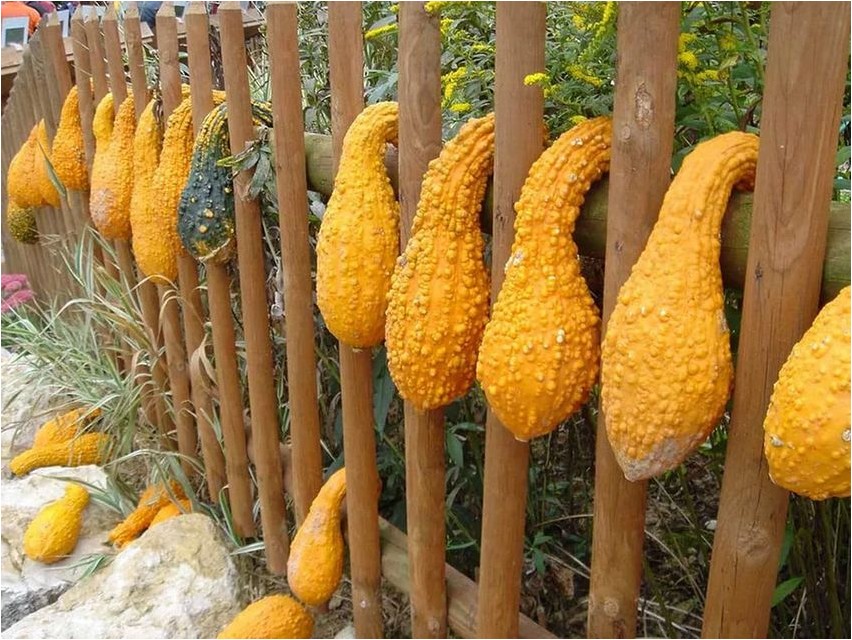
Crooknek (lat. Cucurbita pepo L. var. giraumonas) is a vegetable crop; annual plant of the Cucurbitaceae family. Kruknek is a type of hard pumpkin. Another name is torticollis.
In terms of the content of nutrients and vitamins and nutritional value, kruknek is superior to pumpkin, zucchini and squash. The culture is widespread in Europe, Southeast Asia, North and South America. Kruknek was brought to Russia at the beginning of the 19th century, and today it is grown only on personal plots. Kruknek can safely be called a promising crop, since it easily and quickly adapts to the conditions of the middle and southern zone.
Characteristics of culture
A characteristic feature of crooked neck is the unusual shape of its fruit. They can be club-shaped, elongated or pear-shaped, often elongated with an intercepted neck and thickened at the other end. Externally, the fruits are similar to pears, curved at the top. The average fruit weight is 0. 3-0. 4 kg. The surface of the fruit can be smooth or warty, from light yellow to bright orange in color. The flesh of the kruknek fruit is juicy, tender, white, yellow or bright orange. The seeds are oval or ovoid and remain viable for 5-7 years.
Growing conditions
Kruknek develops best on light, well-aerated, moderately moist, fertile soils. Sandy and loamy soils with a neutral pH reaction are optimal. Crooknek should not be grown in heavy clay, acidic or heavily waterlogged soils. It can be grown after all vegetables except those from the pumpkin family. The location is sunny; the culture has a negative attitude towards shade. The best predecessors are carrots, potatoes, cabbage, beets, onions, legumes and herbs. It is not recommended to grow torticollis after representatives of the Pumpkin family.
Plants are demanding regarding the presence of organic matter and mineral fertilizers. For autumn digging, compost or humus (4-8 kg per 1 sq. m), phosphorus-potassium fertilizers (30 g each) and wood ash (100-150 g) are mandatory; in the spring, nitrogen fertilizers (15-20 g) are added during loosening. Kruknek is demanding of heat, seeds germinate at a temperature of 13-14C, the optimal temperature for development and growth is 25-28C. Frosts have a detrimental effect on plants; even adult specimens cannot tolerate low temperatures. The crankshaft does not tolerate sharp vibrations; this often leads to the leaves turning pale and the formation of ovaries stopping.
Growing
In the conditions of central Russia, kruknek must be grown in seedlings. Seeds for seedlings are sown at the end of April in seedling boxes filled with well-moistened and fertile substrate. The ridges for the crop are insulated; to do this, a groove 40 cm deep is dug in the middle of the ridge and filled with manure and leaves, and its surface is covered with fertile soil about 20 cm thick, where the seedlings are planted. If you have a small amount of organic matter, you can limit yourself to holes measuring 40*40*40 cm, which should be filled with manure and compost and covered with a soil layer, forming mounds on which seedlings are planted.

At first, the ridges are covered with black film stretched over wire arches. Before planting seedlings in the ground, they are hardened off. Seedlings are planted at the age of 30-35 days, to be more precise, when the seedlings have 2-3 true leaves with a short, squat stem. It is impossible to keep seedlings at home, otherwise the seedlings will not take root. The main thing when planting is not to change the position of the plant in relation to the sunlight in which it grew on the windowsill. Sowing seeds in open ground is not prohibited; in this case, the procedure is carried out in the third ten days of May, after the threat of frost has passed. To reduce the likelihood of damage to young plants by frost, you need to sow crookneck in three periods with an interval of 3-4 days.
Care
Three weeks after planting, add a small layer of humus or peat under the plants. Some gardeners instead hill up the plants, thereby exposing the root system, which is strictly prohibited. Crooknecks do not need to be formed, however, if during the flowering period the vegetative mass becomes too voluminous to the detriment of the fruits, 2-3 central leaves are cut off. It is important to systematically remove rotten fruits and yellowed leaves.
Watering is carried out regularly, using warm and settled water for these purposes. Water should not get on the flowers and ovaries, otherwise they will begin to rot. In the evening, the flowers of the crop are artificially pollinated; for this, a cotton swab is used to collect pollen from one flower and transfer it to another. You can spray the plants with sweet water, this way you can attract insects. Feeding has a positive effect on the development of crookneck; two feedings per season are enough. The first feeding is carried out before flowering (ammonium nitrate, superphosphate and potassium sulfate), the second — during fruiting (with a solution of mullein or bird droppings).





