Witch hazel
Witch hazel (lat. Hamamelis) is a genus of deciduous shrubs of the Hamamelis family. Under natural conditions, witch hazel grows along the banks of reservoirs and in forests in North America, Eastern Asia and the Caucasus.
Witch hazel is a very valuable medicinal plant, so in many European countries it is grown in “pharmaceutical gardens”. The plant is popularly called “witch nut”, “magic nut”, “witch hazel” and “witch nut”. The culture received such names due to late flowering and ripening of fruits.
Characteristics of culture
Witch hazel is a deciduous shrub up to 5 meters high with brown, star-shaped, pubescent shoots. The leaves are dark green, wide, oval-shaped, smooth on the outside, pubescent on the bottom, sit on short petioles, bloom in early to mid-May (depending on climatic conditions). In autumn the leaves turn bright yellow and fall off in October.
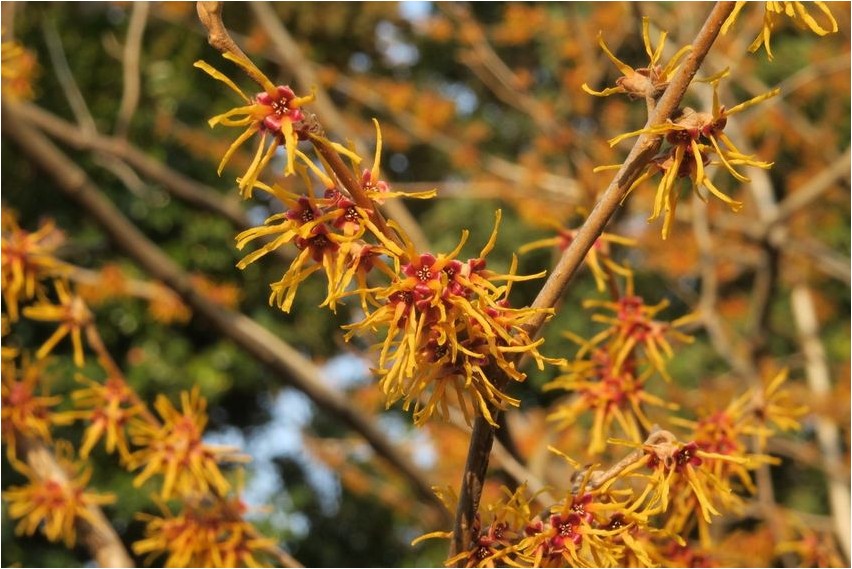
After this, yellow spider-like flowers appear on the bare branches, which have a pleasant aroma. The flowers consist of four elongated petals of yellow or orange color. Witch hazel blooms within three weeks. The fruit is a woody capsule containing two shiny black seeds. The fruits form eight months after flowering.
Most witch hazels are not cold-resistant, but the species Virginian witch hazel and spring witch hazel cannot be grown in central Russia. In nature, both species, under favorable conditions, produce flowers of reddish shades. Seedlings of many varieties and hybrids of witch hazel grown in Russian nurseries are unstable; in the winter, the branches and root system freeze heavily and eventually die after the first or second winter.

Growing conditions
Areas for growing witch hazel are preferably light, intensely lit or slightly shaded, without stagnation of cold air and melt water. The crop is undemanding to soil conditions; it can grow even on rocky river banks, but plants develop best on fertile soils with good drainage. Structured loams rich in humus are optimal.
Reproduction and planting
Species witch hazels are propagated by seeds and cuttings, and hybrid ones by cuttings and grafting. Freshly harvested seeds are sown in the fall (October-November) in seedling boxes, which are mulched with a thick layer of peat or sawdust, and subsequently with snow, until spring. Shoots appear only in the second year, usually in April-May.
The annual growth of witch hazel seedlings is about 20 cm; shrubs reach medium size only by 8-12 years. Cuttings of the crop are carried out in mid-summer. Cuttings are cut from the tops of the shoots. The cuttings are rooted under a film cover, because young plants need high air humidity. The cuttings take root after 4-6 weeks, after which they are transplanted to a permanent place.
Care
A distinctive feature of witch hazels is that they form a permanent skeleton; to be more precise, the plants do not renew themselves naturally due to the growth of shoots from the lower part of the crown. So, to evenly distribute the shoots, incorrectly located and unnecessary branches are cut into a ring. The shrubs do not require further pruning.
The crop needs fertilizing with complex mineral fertilizers, weeding and loosening. It is advisable to mulch the tree trunk area with garden compost; the mulch is changed twice a season — in spring and autumn. The crop is practically not affected by pests and diseases. Only cinnabar-red nectria, which appears through damage to the bark or open wounds, is dangerous for witch hazel.
Application
Witch hazel looks best in single plantings, especially near beautiful architectural structures and other buildings. Witch hazel is used in group plantings with maple, oak, birch or pine. Plants fit harmoniously into plantings located on the banks of artificial and natural reservoirs. Witch hazel is used to create seasonal flower beds, for example, autonalia.
Witch hazel wood has not found practical use because it is easily biodegradable. But the leaves, bark and shoots of the crop are widely used in perfumery and folk medicine. These plant parts contain oil, which is included in creams, balms and lotions. In pharmacology, the same oil is added to suppositories and various ointments. An infusion of witch hazel leaves is used as an anti-inflammatory agent.