Garmala, or Burial Ground
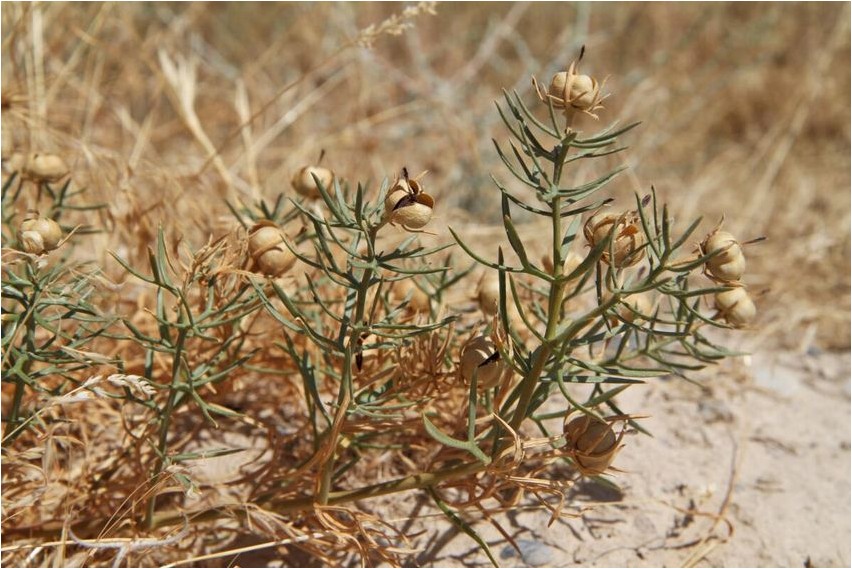
harmala, or Burying Ground (lat. Peganum) is a small genus of herbaceous flowering plants of the saltpeter family (lat. Nitrariaceae).
Some botanists attribute the genus to the family Zygophyllaceae (lat. Zygophyllaceae), so in the literature one can also find such affiliation of the genus. Today there are only four plant species in the genus. All of them are very hardy representatives of the plant world of our planet, growing in arid areas. Perhaps it was the harsh living conditions that turned at least one species into a unique creation of nature, whose abilities were noticed by people in very distant historical times.
What’s in your name
The Latin name of the genus “Peganum” is based on the ancient Greek consonant word that was used to call the plant “Rue”. This was due to the fact that when Garmala seeds were used for religious rituals, leaves and seeds of the “Rue” plant were mixed with them, apparently to improve the smell and enhance the psychotropic effect.
The Russian name of the genus “Mogilnik” may be associated with the specific smell of the plant.
Description
In the wild, plants of the genus Garmala are found in arid soil conditions, which forced them to acquire a multi-headed powerful root that plunges into the soil to a depth of two to six meters. Such a root allows the plant to endure drought for a long time, since its long shoots reach aquifers underground, providing the plant with the moisture necessary for growth and development.
The root produces green, bare, branched stems on the surface that do not tend to break away much from the surface of the earth, growing, as a rule, no higher than thirty centimeters in height. If the plant’s living conditions are more favorable, the stems can grow up to eighty centimeters in height.

The leaf blade of short-petioled or sessile leaves is divided by nature into linear pointed lobes in the amount of three to five. Which is also due to the dry environment. This leaf shape more effectively conserves leaf moisture from evaporation.
Single, relatively large, flowers have five white oval-oblong petals and fifteen stamens, forming a yellow flower core. The corolla of the flower is protected by a calyx, composed of five almost separate sepals, which remains when the fruits ripen.
The crown of the growing season is a tricuspid, three-lobed fruit capsule filled with numerous seeds.
Varieties
Today, the genus includes four plant species, the most important of which is the species Peganum harmala, or common graveyard grass. Another species known as Peganum nigellastrum is also more or less well known.
Plant Seeds in Spiritual Practice
Plants of this genus are interesting because their seeds have been used by humans in rituals across many cultures and religions for thousands of years. This concerns the seeds of a plant of this genus, Peganum harmala, which have remained a popular tool in both spiritual practices and folk medicine for so long a period of human history on Earth that some historians speculate that Peganum harmala is the very plant whose name has been lost to history, but whose medicinal power is mentioned in numerous ancient Indo-Iranian texts. They tell of a mysterious drink called “soma,” which helped priests establish contact with another world, the world of the gods, becoming intermediaries between them and earthlings.
Healing Powers
The plant “Peganum harmala” was revered as a cure for a thousand ailments, as well as a protector from evil forces.
History confirms that the plant saved people from pathogenic viruses, including the terrible plague and other infectious scourges periodically sent upon human society by evil spirits. Harmala (Guzerlik) is a magical and beneficial herb! Watch the video!





