Wormwood dill
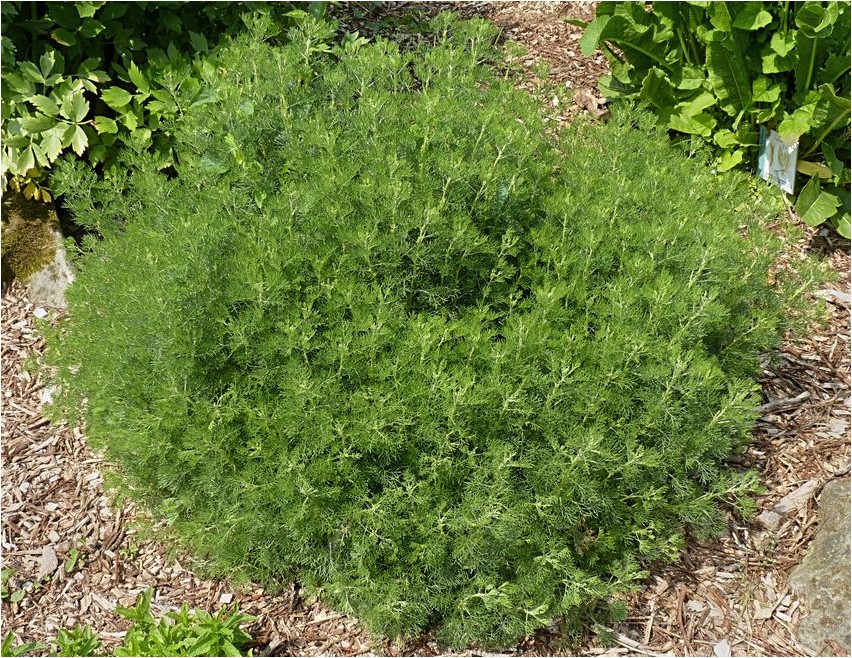
Artemisia dill is one of the plants of the family called Asteraceae or Asteraceae; in Latin the name of this plant will be as follows: Artemisia anethifolia Web. (A. multicanlis Ledeb.).
As for the name of the dill wormwood family itself, in Latin it will be: Asteraceae Dumort. (Compositae Giseke).
Description of wormwood dill
Wormwood dill is an annual or biennial herbaceous plant. The root of such a plant is sometimes relatively thick and will also be vertical. There are only a few stems of wormwood dill, they can be either numerous or single, their height varies between twenty and thirty-five centimeters, all stems will be erect. The baskets of this plant are broadly bell-shaped, their width is two to four millimeters, they will be located on more or less elongated thread-like stalks and in a loose paniculate inflorescence. The corolla of Artemisia dill is narrow-tubular, the disc flowers will be bisexual, and the corolla is conical. The fruits of this plant are oblong-conical achenes, the length of which can reach one and a half millimeters.
Wormwood dill blooms in August. Under natural conditions, this plant is found in Eastern and Western Siberia. For growth, this plant prefers salt marshes, the shores of salt lakes, saline steppes and semi-deserts.
Description of the medicinal properties of wormwood dill
Wormwood dill is endowed with very valuable healing properties, and it is recommended to use the seeds, inflorescences and herbs of this plant for medicinal purposes. The term grass includes stems, flowers and leaves. The presence of such valuable healing properties should be explained by the content of vitamin C, organic acids, essential oil, alkaloids, triterpenoids and the sesquiterpenoid ketopelenolide in the aerial part of this plant. It should be noted that the essential oil of wormwood dill will exhibit antifungal and bacteriostatic activity.
As for traditional medicine, here this plant is very widespread. Traditional medicine recommends using a tincture prepared from the inflorescences and leaves of this plant for various diseases of the nose and throat. In addition, the seeds of this plant can be used as food.

For pulmonary tuberculosis, neurasthenia, bronchitis and pneumonia, Tibetan medicine recommends using both a decoction and an infusion based on the herb wormwood dill. In addition, this remedy is also used as a hemostatic and anthelmintic.
For pneumonia, bronchitis, neurasthenia and pulmonary tuberculosis, it is recommended to use the following very effective healing remedy based on this plant: to prepare such a healing remedy, you will need to take twelve grams of crushed dry herb wormwood dill per glass of water. The resulting mixture should be boiled for about four to five minutes over fairly low heat, after which it is recommended to strain the mixture very carefully. Take the resulting medicine based on wormwood dill three to four times a day after meals, one-third or one-fourth of a glass.
For laryngitis and sore throat, take a tablespoon of inflorescences per two hundred milliliters of boiling water, leave for an hour and filter. Take this remedy based on wormwood dill warm, one-third of a glass. If used correctly, the positive effect will be noticeable quite quickly.





