The series is drooping
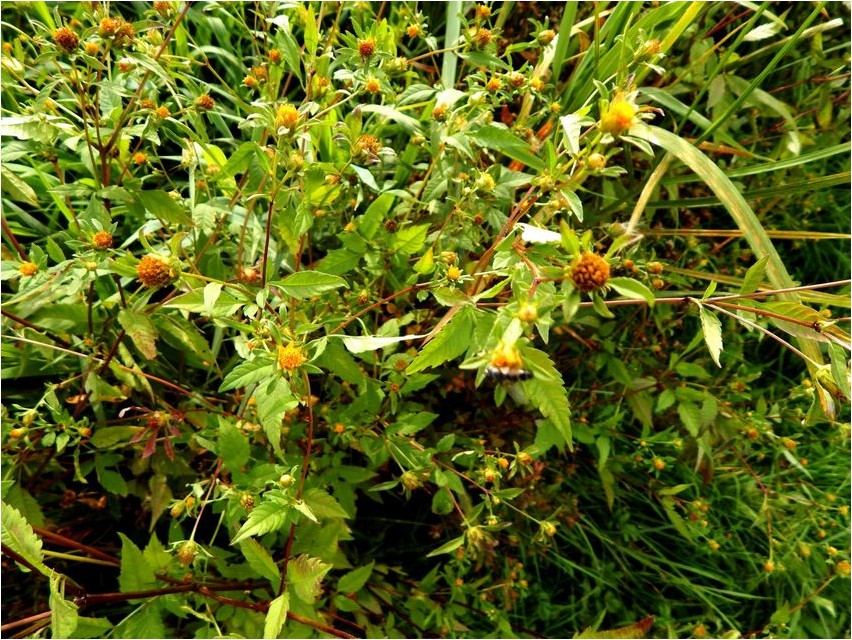
Drooping string (lat. Bidens cernua) – a representative of plants of the genus Bidens (lat. Bidens) that prefers damp places, decorates with its flowering swampy places of swamps, ponds, ditches and rivers in July and August.
The plant’s herbs collected during this period are used in traditional medicine to treat a number of diseases. Suitable for decorating a country pond.
What’s in your name
The Latin word “Bidens”, present in the names of all plant species in the genus, is translated from Latin by two words: “two” plus “tooth”. Botanists assigned this promising name to the genus for the fruits of plants armed with small sharp ends called “awns.” As a rule, there are two awns, sticking out on the achene like two teeth of a newborn baby. But some species decided to compete with the name and armed themselves with a large number of awns. This also applies to the drooping series, which has 3-4 awns.
The adjective “drooping” went to the name of the plant for its sunny baskets of inflorescences, leaning towards the surface of the earth.
Description
Like most plants of the genus “Bidens”, the drooping string is an annual plant in which green and yellow colors predominate. Its erect, branched stem, covered with sparse hairs, depending on the environmental conditions, grows to a height of 15 to 100 cm. In very favorable conditions, the drooping succession can turn into a giant, growing its stem up to 4 meters in height.
Very decorative whole leaves, the edge of which is decorated with a serrated-toothed “braid”, are arranged in pairs on the stem, almost fused with their narrowed bases – winged short petioles. Such leaves are called “sessile”. The lanceolate shape of the leaves gives the bush an elegant appearance.

Typical for plants of the Aster family, the inflorescences are baskets filled with greenish-yellow or pure yellow tubular flowers. Sometimes the central disk of the inflorescence is framed by asexual reed flowers. Since the width of the baskets is almost equal to the height of the tubular flowers, the inflorescence, with its concentrated weight in a lump, bends down the branch at the end of which it is located. This was the reason for botanists to add the adjective “drooping” to the word “Succession”. Flowering lasts just over two months, starting at the end of June and ending with the beginning of the first autumn month.
The fruits are traditional achenes, armed with 3-4 awns. The length of all awns is the same and equal to half the length of the achene.
Healing abilities
The healing properties of Bidens droopingus stem from the rich content of substances beneficial to the human body in its grass. Among the long list of beneficial substances found in the leaves and flowers are ascorbic acid, manganese, carotene, tannins, mucilaginous substances, mineral salts, and essential oil.
An infusion of the dried grass helps improve digestive function, relieve inflammation in the kidneys and liver, and improve heart function. The infusion is used as a diaphoretic and diuretic, and helps relieve yellow-gray greasy crusts in children, a symptom of exudative diathesis, eczema, and skin rashes.
The cucumber-like aroma of Bidens droopingus leaves easily replaces the lack of fresh cucumbers in a salad when they are just beginning to gain strength in the garden.
Cultivation
Popular Bidens droopingus, which prefers moist soils, prefers locations near any body of water in the wild. If your garden has a pond or stream, Bidens cernua will take pride of place near it, adorning it with its graceful leaves with intricate zigzags along the edges.
For two summer months, in addition to its decorative leaves, the plant will produce flower heads of yellow-green inflorescences. These will be followed by the appearance of playful achenes with pointed awns. The ripened seeds will take care of the annual plant’s continued life, saving the gardener time and effort.





