Geranium forest
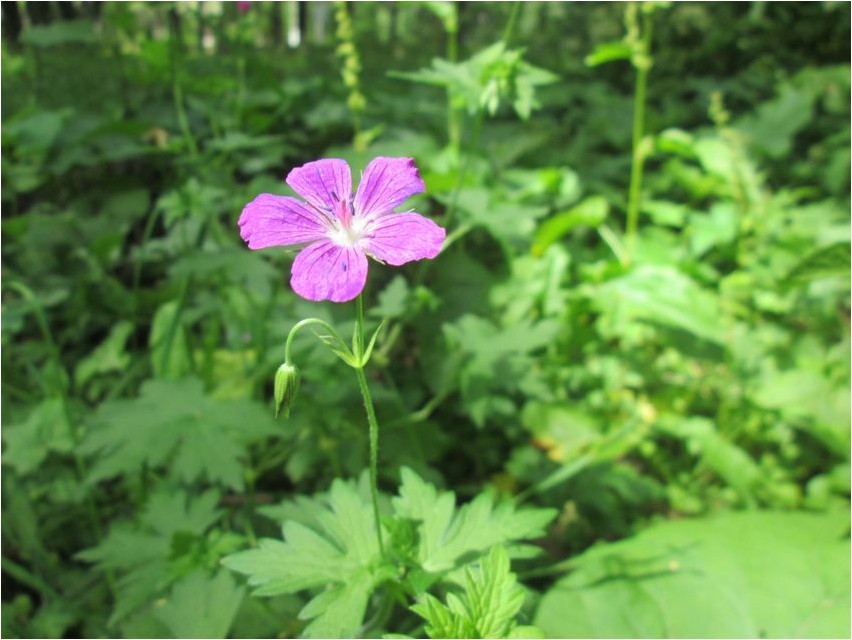
Forest geranium is one of the plants of the family called Geraniaceae; in Latin the name of this plant will be as follows: Geranium silvaticum L.
As for the name of the forest geranium family itself, in Latin it will be: Geraniaceae Juss.
Description of forest geranium
Forest geranium is a perennial herbaceous plant, the height of which will be about twenty-five to sixty centimeters. It is noteworthy that the rhizome of this plant will be almost vertical or oblique, and its length will be about ten centimeters, and at the top the rhizome will be somewhat expanded. The stems of this plant are few in number and they will be straight and bearded. The basal leaves of this plant are on long hairy petioles; they will be shallowly pinnately incised. At the same time, the middle stem leaves of this plant are smaller, they are on shorter petioles, and the upper ones will be opposite or almost sessile. The flowers of the plant are quite numerous, they are in a loose inflorescence, while the peduncles are two-flowered, the flowers of forest geranium are wide open, and in color they can be either violet or lilac-purple, sometimes they can be painted white.
This plant blooms from June to July. The ripening of forest geranium fruits occurs from July to October. Under natural conditions, this plant can be found in Moldova, Ukraine, as well as in all regions of Western Siberia except Verkhnetobolsky and in all regions of Eastern Siberia, with the exception of the Daursky region. The plant is also found in the European Arctic, and throughout the European part of Russia except for the Lower Volga region. For growth, this plant prefers forest edges, meadows, shrubs, forest groves, mountain lawns and meadows, as well as light coniferous and mixed forests.
Description of the medicinal properties of forest geranium
Forest geranium is endowed with very valuable healing properties, and it is recommended to use the roots and grass of this plant for medicinal purposes. The concept of grass includes the leaves, flowers and stems of this plant.
The roots of this plant contain organic acids and their salts, alkaloids, starch, and also tannins. In the aerial part of forest geranium, flavonoids, tannins and the following carbohydrates were found: sucrose, raffionose, glucose and fructose. The leaves of this plant contain phenolcarboxylic acids and their derivatives, namely caffeic and ellagic acid, as well as vitamin C, sucrose, flavonoids: quercetin and kaempferol. In addition, there are also tannins such as ellagitannins and gallotannins. Leukocyanides were found in the seeds of forest geranium.

It is noteworthy that in folk medicine, a decoction of the roots of this plant is used for rheumatism. A decoction and infusion of forest geranium herb is used as an astringent and hemostatic agent for bleeding, as well as for various gastrointestinal diseases in children and adults: namely, dysentery, diarrhea and enterocolitis. In addition, this remedy is also effective for rheumatism, gout, angina pectoris and kidney stones.
For kidney stones, you should use the following remedy: to prepare it you will need to take ten grams of dry crushed roots of forest geranium per glass of water. This mixture should be boiled for about seven minutes over very low heat, after which this mixture is left to infuse for one hour, and then topped up with boiled water to the original volume and strained thoroughly. Take two tablespoons of this remedy approximately four to five times a day before meals.





