Sirenia pods
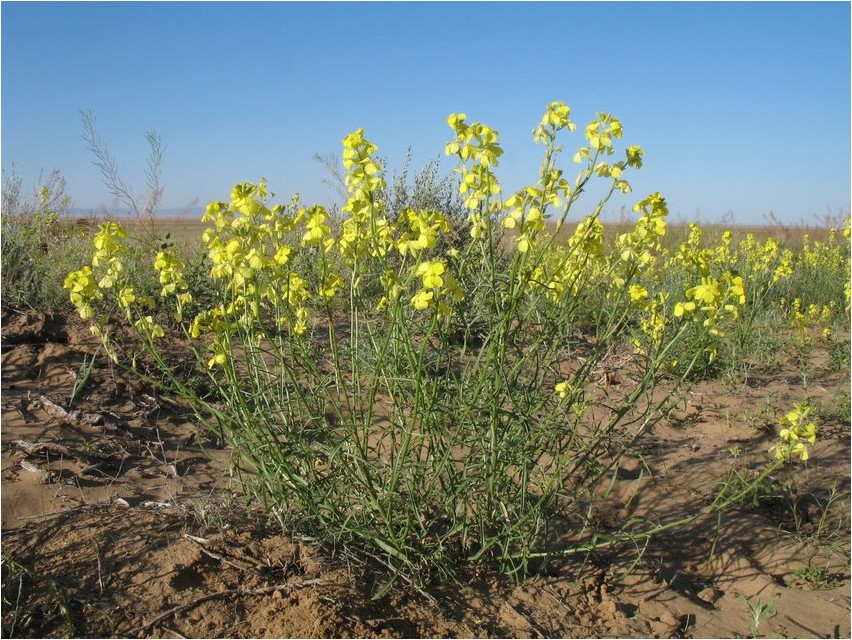
Syrenia siliculosa is one of the plants of the family called cabbage or cruciferous plants; in Latin the name of this plant will be as follows: Syrenia siliculosa (M. V.) Andrz.
As for the name of the lilac family itself, in Latin it will be: Cruciferae Burnett (Brassicaceae Juss.).
Description of lilac capita
Lilac pod is a biennial herbaceous plant, endowed with a straight and branched stem, the height of which will fluctuate between forty and ninety centimeters. The leaves of this plant are alternate, they are covered with pressed bipartite hairs; such leaves can also be oblong or linear. The flowers of lilac pod are painted in bright yellow tones; their calyx will consist of four corolla petals and four sepals. It is noteworthy that the petals of the corolla are arranged crosswise with the sepals. The pistil of this plant is endowed with a superior ovary, and there are only six stamens, while the flowers are collected in racemes. The fruits of lilac capita are pods, the length of which is about four to ten millimeters and the width is two to three millimeters. Such fruits of this plant are endowed with rather dense and compressed pubescence, as well as a persistent style, the length of which will be about five millimeters. The length of the legs of the pods of lilac pods is about four millimeters.
This plant blooms in the summer. Under natural conditions, this plant is found in Ukraine, Central Asia, Kazakhstan, Dagestan, Western Siberia, and the southern and eastern regions of the European part of Russia. For the growth of lilac, the pod prefers sand, dry steppes and chestnut soils.
Description of the medicinal properties of lilac capita
Lilac lilac is endowed with very valuable healing properties, and it is recommended to use the roots, seeds and herbs of this plant for medicinal purposes. The term grass includes stems, flowers and leaves. At the same time, the leaves and flowers of this plant are endowed with the greatest activity. It should be noted that the activity of such medicinal raw materials will decrease from the beginning of flowering and increase again after the end of this period of time.
It is noteworthy that lilac pod is a poisonous plant. For this reason, extreme caution is recommended when handling this plant. It is recommended to harvest such medicinal raw materials immediately before and after the flowering period.

The presence of such valuable healing properties is explained by the content of alkaloids in the roots of lilac capsicum, while the aerial part of this plant contains cardenolides. The flowers of this plant contain the flavonoids desglucopasterioside, pasteroside and flassilin, as well as the following cardenolides: cannogenol and strophanthidin glycosides. The fruits contain flavonoids, and the seeds contain alkaloids and cardenolides.
As for traditional medicine, an aqueous infusion based on the herb lilac capita is widely used as a cardiotonic. An infusion prepared from the flowers and seeds of this plant has the ability to exhibit strophanthin-like effects on the cardiovascular system.
Actually, medicinal products based on this plant will increase systolic volume and increase blood pressure, and can also slow down the heart rate. Preparations based on lilac capita prove to be very effective for circulatory failure in patients with heart defects and other serious chronic diseases.





