Kalanchoe tomentosa
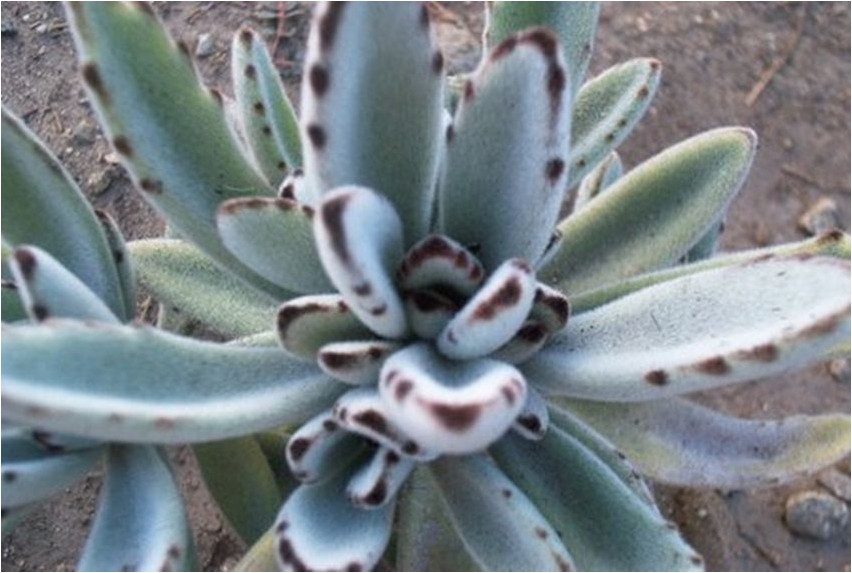
Kalanchoe tomentosa is also known as cat’s ear plant. In Latin, the name of this plant is as follows: Kalanchoe tomentosa.
Kalanchoe tomentosa belongs to the family called Crassulaceae, and in Latin the name of this family is Crassulaceae.
Description of Kalanchoe tomentosa
It should be noted that such a plant can hardly be called quite demanding in care, but it will require compliance with certain growing rules. As for the light regime, the plant should be kept either in the sun or in partial shade. In summer, watering should be maintained at a moderate level, and air humidity should remain average. The life form of Kalanchoe tomentosa is a leaf succulent.
This plant is grown not only in winter gardens, but also in greenhouses. Throughout the summer season, Kalanchoe tomentosa can be used as an advantageous decoration for balconies. Also, the plant is quite often found as part of picturesque groups and compositions, which will include other succulent plants. In addition, plants are very often grown in rooms and in general areas. Under conditions of such cultivation, bright windows should be preferred.
As for the maximum size in cultivation, Kalanchoe tomentosa can reach up to fifty centimeters.
Description of the features of care and cultivation of Kalanchoe tomentosa
It should be noted that it is recommended to replant Kalanchoe tomentosa every two years. When replanting, you should choose pots of standard proportions. As for the composition of the soil mixture, it is recommended to combine one part each of sand, leaf soil and turf soil. The acidity of such soil can be either neutral or slightly acidic.

It is important to remember that in case of insufficient lighting, the plant will stretch quite a lot. If the temperature regime is kept at a low level for a long time, and quite sharp fluctuations in air humidity and even soil occur, then corky growths may appear on the leaves and stems of Kalanchoe tomentosa.
The plant can be affected by rot when the air temperature is kept at an elevated level for a long time, and the soil moisture is also quite high.
Throughout the entire dormant period, it is important to ensure the temperature of Kalanchoe tomentosa is approximately ten to fifteen degrees. The plant will need to be watered infrequently, and air humidity should remain standard. When Kalanchoe tomentosa is grown indoors, the dormant period is forced and lasts from October to February. The occurrence of such a period of rest should be associated with the fact that the illumination is low, and the air humidity also remains low.
Reproduction of Kalanchoe tomentosa can occur through rooting of both leaf and stem shoots. It is important to remember that the specific requirements of this culture include constant bright lighting and fairly moderate watering, which must also remain regular.
The leaves of Kalanchoe tomentosa are very decorative; it is thanks to its leaves that this plant is valued among gardeners. The leaves of this plant are endowed with rather dense pubescence, which will be silver-gray in color. It should be noted that if Kalanchoe tomentosa is grown at home, flowering of this plant turns out to be extremely rare. Nevertheless, this plant remains popular and can add new colors to the interior of literally any room.