Geranium pilosa
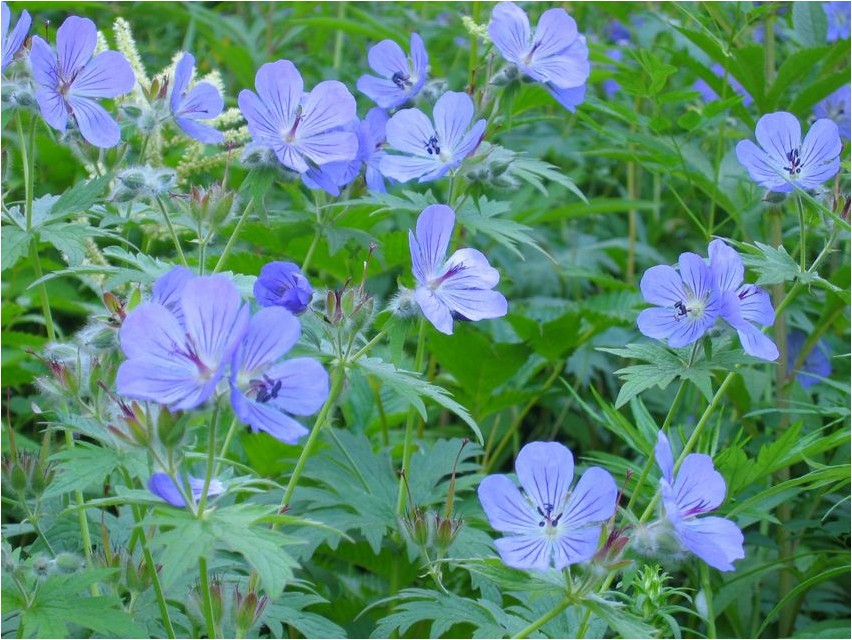
Geranium pilosa is a member of the Geraniaceae family, and its Latin name is Geranium erianthum Fisch.
The Latin name for the geranium family is Geraniaceae Juss.
Description of Geranium pilosa
Geranium pilosa is a perennial herbaceous plant that can reach heights of between twenty-five and seventy centimeters. Its stems are either prostrate or glandular, sometimes densely pubescent. Basal leaves of Geranium pilosa are few in number, and on petioles they are approximately two to three times larger than the blade. These leaves are also prostrate and silky. The stem leaves of this plant are borne on fairly short petioles, the upper ones being sessile and trilobate, and also almost opposite. The leaf blades of the Geranium pilosa are bristly-hairy, divided into five lobes about halfway down. These lobes, in turn, are lobed-dentate, ovate, and quite large. The stipules of the stem leaves are pointed and lanceolate.
The peduncles of this plant are approximately one to five centimeters long, densely covered with prostrate capitate hairs, and bear approximately three to ten twisted flowers. These flowers are borne on very short peduncles, which are also prostrate and glandular-hairy. The bracts are pointed and ovate-lanceolate, hairy along the very edges. The petals of the hairy-flowered geranium are horizontally deflected and can be either reddish-purple or bluish-purple in color. These petals are also broadly ovate and entire, approximately two centimeters long. The seeds of the hairy-flowered geranium are finely reticulate and punctate.
This plant blooms from May to June, with the fruits ripening around July-August. In the wild, hairy-flowered geranium can be found on slopes, forest edges, meadows, and sometimes even on cliffs.
Description of the medicinal properties of hairy-flowered geranium
For medicinal purposes, it is recommended to use the herb of this plant: stems, leaves, and flowers. It is recommended to harvest this raw material while the plant is still in bloom. These valuable medicinal properties are due to the flavonoids found in the above-ground parts of this plant, while the leaves contain phenolic acids and their derivatives, the flavonoid hyperin, and the following tannins: corilagin and geraniin.

It is worth noting that a decoction made from the herb of this plant is quite common in Tibetan medicine. Tibetan medicine recommends this remedy for a variety of chronic female ailments.
The juice of this plant is often used to wash both tumors and wounds. In Kamchatka, a decoction of this plant’s herb is recommended for minor injuries, dysentery, menstrual irregularities, beriberi, tuberculosis of the skin, as well as various joint pains, sciatica, acute gastroenteritis, and even corneal lichen planus, also known as keratitis.
For joint pain, it is recommended to take 110 grams of dry, crushed herb and steep it in a liter of vodka, then let it steep for a week. Take one teaspoon twice daily.





