Chinese Lophanthus
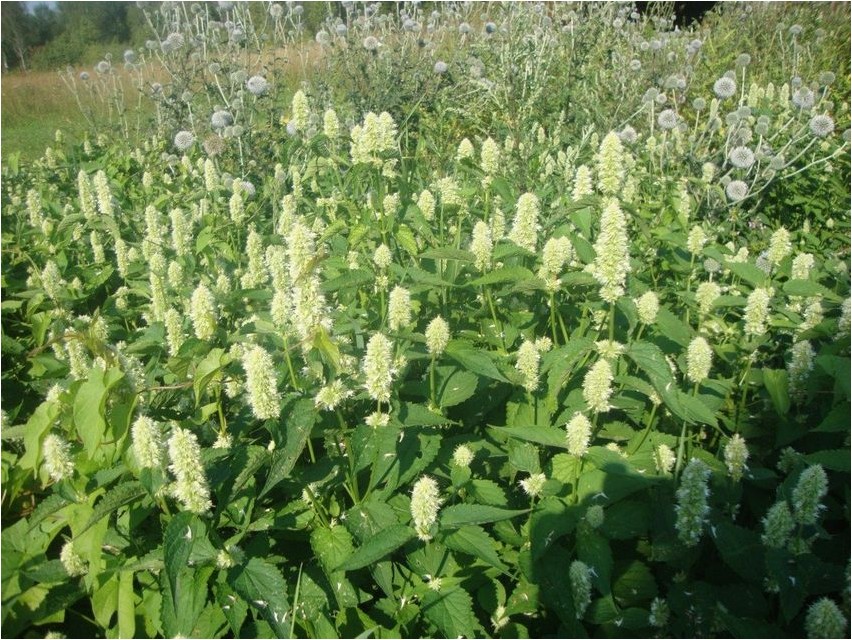
Chinese Lophanthus is a member of the Labiatae family. Its Latin name is Lophanthus chinensis (Rafin.) Benth.
The family name of Chinese Lophanthus is Lamiaceae Lindl.
Description of Chinese Lophanthus
Chinese Lophanthus is a perennial herbaceous plant, reaching heights between twenty and seventy centimeters. This plant is glandular and shortly pubescent, with coloration ranging from green to grayish or whitish-gray, and its leaves are almost felt-like. The stems of Chinese Lophanthus are numerous, ascending or erect, and spreading and branching almost from the base. The leaves of the Chinese Lophanthus are ovate-triangular or ovate, and also crenate-dentate, and are ten to twenty-five millimeters long. The calyx of the Chinese Lophanthus is tubular and straight, also nearly bilabiate, six to eight millimeters long, and has a hairy ring inside. The corolla of this plant is bluish-purple in color, exactly twice the length of the calyx. The nuts of the Chinese Lophanthus are smooth, oblong-oval in shape, and brown in color.
The flowering period of the Chinese Lophanthus begins in June and ends in August. In the wild, this plant is found in the Daurian and Angara-Sayan regions of Eastern Siberia, as well as in Primorye and the Amur region of the Far East. Chinese hyssop prefers cliffs, scree slopes, and rocky steppe slopes.
Description of the medicinal properties of Chinese hyssop
Chinese hyssop possesses highly valuable medicinal properties, and it is recommended to use the herb of this plant for medicinal purposes. The herb includes the flowers, stems, and leaves of this plant.
In Tibetan medicine, a decoction and infusion made from Chinese hyssop is quite common. This remedy is used for gastrointestinal ailments, and in Mongolian medicine, it is used as a general tonic, a metabolic regulator, and a preventative for aging. It is also used for paralysis.

An infusion based on the leaves and flowers of Chinese lofanta is used for various diseases of the liver and stomach, as well as for functional disorders of the digestive tract. In Mongolian medicine, an infusion prepared from the flowers of this plant is used for cuts and paralysis, both internally and externally. It should be noted that the essential oil of Chinese lofanthus flowers is endowed with very significant antibacterial activity.
For peptic ulcers, chronic colitis and gastritis, it is recommended to use the following remedy based on Chinese lofanthus: to prepare such a remedy you will need to take ten grams of the herb of this plant per two hundred milliliters of water. The resulting mixture should be boiled over fairly low heat for about four to five minutes, then this mixture is left to infuse for two hours, after which the volume is brought to the original volume using boiled water and the resulting healing mixture is very carefully filtered. Take this remedy based on Chinese lofant half an hour before meals, one-third of a glass three times a day. If you follow all the rules and regulations for taking such a healing remedy, a positive result will be noticeable quite soon.





