Marshmallow saccharide
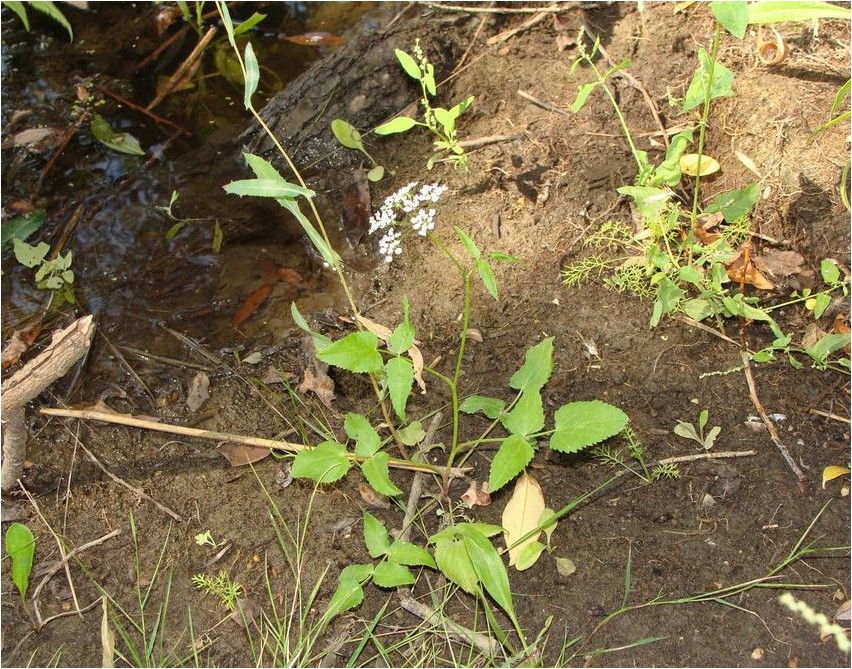
Marshmallow saccharide is a member of the Apiaceae family. Its Latin name is Sium sisaroideum DC. (S. lancifolium auct., non Schrenk.).
As for the family name of Marshmallow saccharide, the Latin name is Apiaceae Lindl. (Umbelliferae Juss.).
Description of Marshmallow
Marshmallow saccharide is a perennial herbaceous plant, reaching heights between fifty and one hundred and twenty centimeters. The plant is bare, and its roots are thin and fibrous, no more than two millimeters thick. The stem of Marshmallow saccharide has creeping underground shoots, which are ribbed and straight. The leaves of this plant are simply pinnate, with two or three pairs of leaflets, which are rarely simple. These leaves have a rounded-cordate blade, with the upper ones being trifoliate, and the lower ones having ovate-lanceolate leaflets. The umbels of the marsh marigold are endowed with smooth, grooved rays, approximately ten to fifteen in number, and are approximately three to five centimeters in diameter. The calyx teeth of this plant are triangular and short, and the petals reach one millimeter in length, are obcordate, and colored white. These petals are notched at the top, and the notch has a recurved tip. The fruits of the marsh marigold are approximately four millimeters long and two and a half millimeters wide. Marshmallow flower blooms from July to August. In the wild, this plant is found in European Russia, Moldova, Central Asia, the Caucasus, all regions of Western Siberia (except the Ob region), Crimea, the Dnieper region, and the Carpathian Mountains in Ukraine. This plant prefers floodplain meadows, as well as the damp banks of swamps, streams, rivers, and canals.
Description of the medicinal properties of Marshmallow flower
The sugar grass is endowed with very valuable healing properties, and it is recommended to use the grass and roots of this plant for medicinal purposes. The term grass includes flowers, stems and leaves. The presence of such valuable healing properties should be explained by the content of the following polyacetylene compounds in the roots: falcarinolone and falcarindiol. The fruits and grass of the sugary porridge, in turn, contain essential and fatty oils, which contain petroselinic acid.
The roots of this plant are endowed with a diuretic effect, and the herb exhibits anti-inflammatory, antibacterial and antiscorbutic properties. A decoction prepared from the herb of the saccharide grass is indicated for use in various acute respiratory infections and digestive disorders.
As a diuretic, it is recommended to use the following very effective remedy based on this plant: to prepare it, you will need to take one teaspoon of crushed roots of the sugar-shaped porridge in about one glass of water. The resulting healing mixture should be boiled over fairly low heat for about four to five minutes, after which this mixture is left to infuse for two hours and filtered very carefully. Take the resulting medicinal product based on the sugary urticaria three to four times a day, two tablespoons. When used correctly, this remedy turns out to be very effective.

Lieutenant.





