Ammi
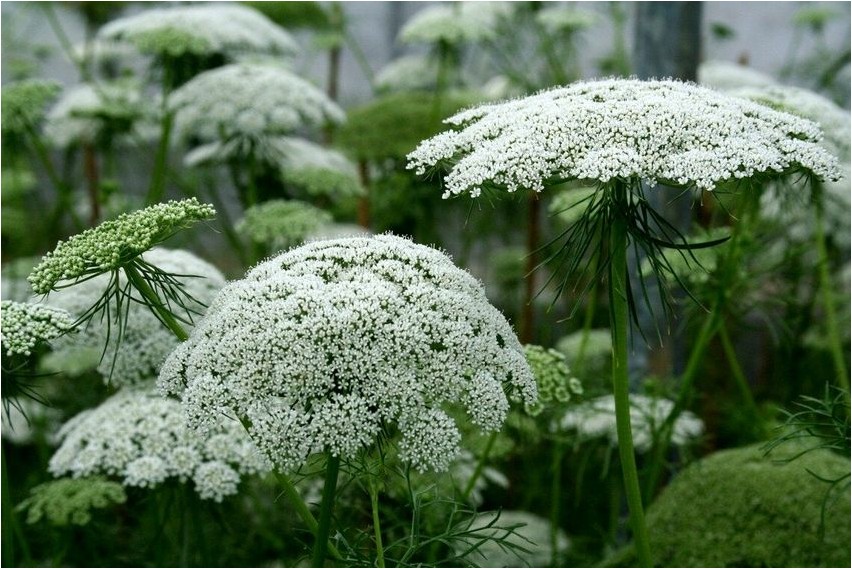
Ammi (lat. Ammi) is a small genus of herbaceous plants of the Apiaceae family. The Mediterranean is considered to be the birthplace of the plant. Currently, the crop is cultivated everywhere.
Characteristics of the culture Ammi is a herbaceous plant with a straight, bare stem up to 1 m high. The leaves are double or triple pinnate, with filamentous or linear lobes, equipped with pinnately dissected involucres. The flowers are small, bisexual, white, collected in spherical umbrellas. The petals are deeply bilobed or obovate-cordate, narrowed at the base into short marigolds. The fruit is smooth, glabrous, broadly ovoid, narrowed at the commissure, laterally compressed. The fruit is divided into semi-fruits with thread-like ribs
Ammi visnaga (lat. Ammi visnaga) – a species formerly known as a noxious weed, was used for medicinal purposes in the Middle East. In nature, it is found in fields among crops, as well as in wastelands. Externally, ammi viznaga is similar to dill. With the onset of warmth, the plant forms a dense bush of finely feathery leaves, differing from dill only in size. The flowers are greenish-white, later turning golden-green. In terms of decorative characteristics, the species is not inferior to the large ammi. It is often used to decorate borders. There are no special requirements for growing conditions and care.
Large ammi (lat. Ammi majus) – the species is represented by large plants with delicate openwork inflorescences. Most often, this type is used to create bouquets of freshly cut flowers. The culture gives flower beds and garden corners lushness and airiness. The large ammi blooms at the end of July, flowering lasts until September. The homeland of ammi is the Mediterranean coast of Africa and Asia. The view, in contrast to the above, puts forward requirements for location. It prefers sunny areas and needs abundant and regular watering. Before flowering, the bushes do not look very attractive; to speed up the flowering process, the crop is grown in seedlings. Seeds are sown in seedling boxes in February or March. Seedlings are planted in open ground at the end of May.
The subtleties of cultivation Ammi accepts almost all types of soil, but when cultivating cultivated species, it is important to take into account the characteristics of their natural habitat. Some species, for example, Ammi dental and Ammi greater, develop best in intensely lit areas, and Ammi viznaga grows well in partial shade. Ammi is drought-resistant and neutral to low temperatures.
Seeds are sown in open ground in late April – early May. You can grow the crop by seedlings. The soil temperature for ammi should be about 6-8C; at elevated temperatures, the seeds do not germinate well. Abundant watering is necessary during active growth of the root system; at the time of flowering, excessive moisture can have a detrimental effect on yield. Winter crops of ammi are not prohibited in mild winter conditions.

The best precursors of ammi are early vegetables, forage and grain crops, poppy and chamomile. The site is prepared after harvesting the predecessor, the soil is dug up and organic fertilizers are applied. Seeds are stratified for a month before sowing. To do this, the seeds are mixed with dry, washed sand, then poured with warm water until they swell and put in the refrigerator. Before sowing, the seeds are dried.
The crop is sown in a wide-row manner. The distance between the rows should be at least 45 cm. The seeding depth is 2-3 cm. To increase crop yield, granulated superphosphate should be added to the furrows.
Care and harvesting
Caring for ammi crops involves systematic loosening of row spacing; plants do not tolerate compaction. When two true leaves appear on the seedlings, they are thinned out. Water the crop during drought, in the initial period – once every 2-3 days. During flowering, watering is reduced.
Ammi harvesting is carried out during the period of mass seed ripening, when most of the umbrella inflorescences curl up and the stems acquire a yellowish color. After collection, the ammi fruits are dried and cleaned.





