Itea
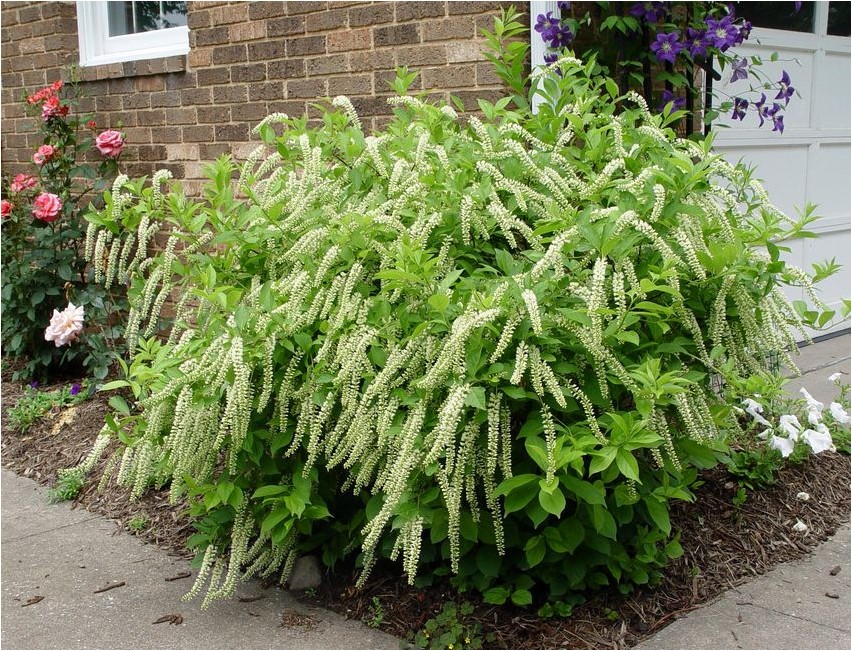
Itea (lat. Itea) is a genus of ornamental shrubs of the Escalloniaceae family. The genus includes 10 species. Natural range — North America and East Asia.
Characteristics of culture
Itea is an evergreen or deciduous shrub with unusual foliage color and exotic flowers. The leaves are serrated, opposite, similar in appearance to the leaves of representatives of the Holly genus. The flowers are small, white, cream or greenish-white, collected in multi-flowered racemes that form at the ends of the branches. In autumn, itea is especially attractive; its foliage acquires unique shades. The culture easily adapts to the harsh conditions of the middle zone, despite the fact that in nature it is found mainly in warm countries. The hardiest species is Itea virginiana.
Itea virginica (lat. Itea virginica) is an unusual deciduous shrub about 1. 5 m high with a specific compact crown. The shoots are arched. The leaves are dark green in summer and purple-red in autumn, oblong-elliptic, serrated, tapered towards the end, up to 10 cm long. The flowers are very fragrant, white-cream, collected in dense racemes. Itea virginiana blooms in July. Withstands frosts down t o-20C, needs shelter for the winter, otherwise flowering should not be expected.
The species is resistant to drought, tolerates light partial shade, but develops better in sunny areas. Looks great in group plantings. Popular varieties of Itea virginiana are “Henry”s Garnet” (a cold-resistant and decorative species with large racemose inflorescences of white color), “Henry”s Garnet” (a hardy species with large racemose inflorescences and colorful foliage in the autumn) and “Sarah Eve” (a cold-resistant species with a compact crown).
An equally interesting species is Itea ilicifolia. It is represented by evergreen shrubs up to 5 m high with a wide crown. The branches are curved. The leaves are jagged, green, glossy, oval-elliptic, up to 10 cm long. The flowers are small, greenish-white, collected in hanging earrings. Itea holly blooms in July.
The Yunnan Itea species (lat. Itea yunnanensis) is an erect, evergreen shrub up to 5 m high with a wide crown. The branches are curved. The leaves are glossy, dark green, elliptical, tapered towards the end, up to 10 cm long. The flowers are white, collected in earring-shaped racemes, up to 17 cm long. Blooms in May-June.

Growing conditions
Itea feels good in open sunny areas. It also blooms well in semi-shaded areas. The crop makes special demands on soil conditions; it needs well-moistened, fertile, drained soils with a slightly acidic pH reaction. Alkaline soils are no longer suitable. Sandy or loamy soils are optimal for itea.
Reproduction
Itea is most often propagated by cuttings. Cuttings are taken in spring or summer. Planting is done in special greenhouses or mini-greenhouses.
Care
Itea is unpretentious in care and needs shelter for the winter (especially in regions with harsh winters). Itea blooms on last year”s branches, so preserving these shoots is one of the most important care tasks. A few days before the onset of cold weather, the bushes are tied and covered with spruce branches or any other non-woven material. The soil in the tree trunk zone is mulched with a thick layer of dry leaves. In winter, the plants are covered with snow. The crop is not afraid of spring frosts. Watering the itea should be moderate but regular. It is important to maintain stable soil moisture in the tree trunk, especially during dry periods. The culture has a positive attitude towards fertilizing; 1-2 fertilizing with full mineral fertilizers per season is sufficient. Preventive pruning is not prohibited.
Usage
Itea looks harmonious in single and group plantings. Can perform as a soloist. Shrubs are suitable for creating rockeries, rock gardens and other rocky gardens. Itea can be planted near a terrace, gazebo or supporting wall. Plants are spectacular against the background of large stones and on the lawn.





