Kiwano
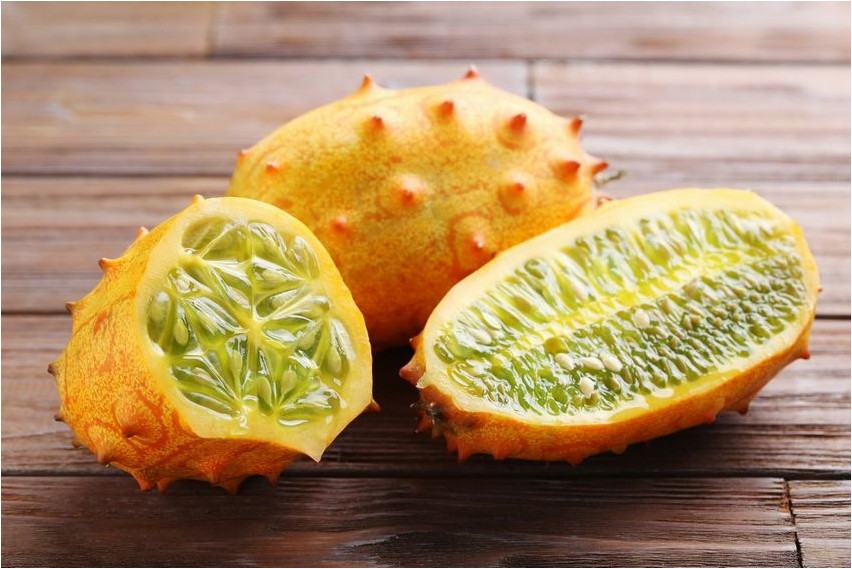
Kiwano (lat. Cucumis metulifer) is a herbaceous vine belonging to the Pumpkin family, the fruits of which are called horned melon or African cucumber. This crop is considered both a vegetable and an ornamental crop.
Description
Kiwano can grow up to three to six meters in length and is an elegant vine capable of branching into a huge number of faceted thin stems. Despite the fact that these stems are very thin, they are truly incredibly durable.
Kiwano leaves are similar to cucumber leaves, only their size is usually slightly smaller. All leaves have characteristic hard pubescence and five lobes. When growing this crop, special nets are stretched around, which over time are actively filled with foliage.
Flowering kiwano bushes are abundantly covered along their entire length with miniature yellow flowers. In the morning these flowers open, but you can only admire them until noon.
The fruits of this plant have the appearance of a miniature oval melon, the leathery, hard and inedible peel of which is covered with soft thorns. They can be reddish, orange or yellow. The jelly-like pulp of this fruit is colored in greenish tones and is densely dotted with pale green or white seeds, the length of which can reach one centimeter. And the length of the fruits themselves usually does not exceed fifteen centimeters. By the way, their internal parts are divided into several sectors using soft veins and partitions.
Kiwano fruits taste like bananas, as well as cucumbers or melons. True, some gourmets claim that these fruits taste like avocado and kiwi with lime. And in appearance they are somewhat similar to chestnuts. If you provide the kiwano thickets with proper care, you can collect about a couple of hundred fruits from one plant per season.

Where does it grow
Kiwano is cultivated mainly in Israel, New Zealand, Central America and California. Also, the main distribution area of this culture is the tropical and subtropical countries of distant South America and hot South Africa.
Application
Kiwano can be eaten both sweet (in compotes, jams, etc.) and salty (these fruits are pickled in almost the same way as cucumbers). These fruits are an excellent addition to salads — they are especially good if you mix their pulp with pepper and salt in lemon juice. In a word, kiwano can be safely used not only as a fruit, but also as a vegetable. And the interesting appearance of the fruit makes them an excellent decoration for a wide variety of dishes.
Kiwano is often added to all kinds of fruit drinks, as well as milk or fruit cocktails. By the way, this fruit itself contains quite a lot of water — for every 100 g of its weight there is approximately 88. 97 g of water.
And since this fruit is low in calories, it is actively used in various diets aimed at weight loss, as well as in therapeutic dietary nutrition. As a rule, the calorie content per 100 g of fruit does not exceed 44 kcal.
Kiwano is very rich in various microelements and vitamins, so it is rightfully considered an excellent source of beneficial compounds. This fruit is especially useful in cold seasons. Thanks to the presence of B vitamins and vitamin C, kiwano is an excellent tonic. It would also not hurt to consume these fruits for people suffering from gastrointestinal and cardiovascular diseases. As for kiwano juice, it is an indispensable aid in healing wounds and burns.
Kiwano is no less widely used in cosmetology: it is an integral part of many masks for the body and face. Kiwano juice has proven itself especially well, which is often combined with yogurt, as well as honey and other ingredients that are no less beneficial for the skin.