water pepper
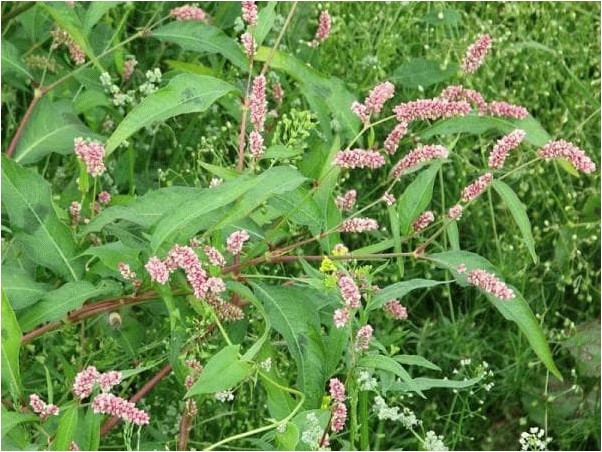
Water pepper is one of the plants of the buckwheat family; in Latin the name of this plant will be as follows: Poligonum hydropiper L.
As for the name of the water pepper family itself, in Latin it will be: Poligonaceae Juss.
Description of water pepper
Water pepper is an annual herbaceous plant, the height of which will be about thirty to sixty centimeters. The stem of this plant is bare and reddish, it is usually erect, and from the very base it will be branched. The leaves of this plant are alternate and have wavy, solid edges. Water pepper flowers are small in size, and their glandular perianth can be either whitish or pinkish. The flowers of this plant are collected in narrow but sparse clusters at the very tops of the stem. The fruits of water pepper are triangular matte nuts, painted in dark brown tones. The flowering of this plant occurs in the period starting from approximately June and ending with the month of August, while the ripening of the fruits will occur already in August-September. All parts of water pepper are endowed with a rather pungent peppery taste. It is noteworthy that the plant is poisonous, for this reason special care should be taken when handling water pepper.
Description of the medicinal properties of water pepper
For medicinal purposes, it is recommended to use the herb of this plant, which should be harvested while water pepper is flowering. Such grass should be dried either in the shade or in a dryer. The grass contains a fairly high content of essential oil, tannin, pectin, vitamins C and K, tannins, wax, mucus, sugar, phytosterol, flabophen, vitamins D and E, carotene, as well as calcium oxalate and the following acids: malic, formic, acetic, paracoumaric, valeric and chlorogenic. In addition, the grass also contains flavonoids: quercetin, hyperoiside and avicularin, as well as many trace elements, including magnesium, titanium, silver and manganese. It is noteworthy that the roots of this plant contain antiglycosides.
As for scientific medicine, here water pepper has found its use as a gentle laxative for spastic and atonic constipation, and also as a hemostatic agent for uterine and hemorrhoidal bleeding, and in addition also for chronic inflammatory processes in the uterus and fibroids.
Preparations based on water pepper have the ability to increase blood clotting and tone the uterus and intestines. In addition, such drugs constrict blood vessels, but do not increase blood pressure, and also increase the activity of the heart. Such drugs cause shrinkage of hemorrhoids, and also have analgesic and diuretic effects.

As for traditional medicine, water pepper preparations have become widespread as a laxative for spastic and atonic constipation, as well as diuretics and analgesics. Also, preparations based on this plant are also used to treat hemorrhoids. Infusions of this plant are recommended to be used to stop uterine bleeding, the nature of which can be either inflammatory or atonic. The infusion is also effective for very heavy and prolonged menstruation, as well as in the treatment of inflammatory diseases of the female genital area.
In addition, preparations of this plant are also used for diarrhea, kidney stones, varicose veins, dysentery and various skin diseases. As for fresh leaves, they can be applied to wounds, but the herb is recommended to be applied to the head for severe headaches.





