Cyphomandra
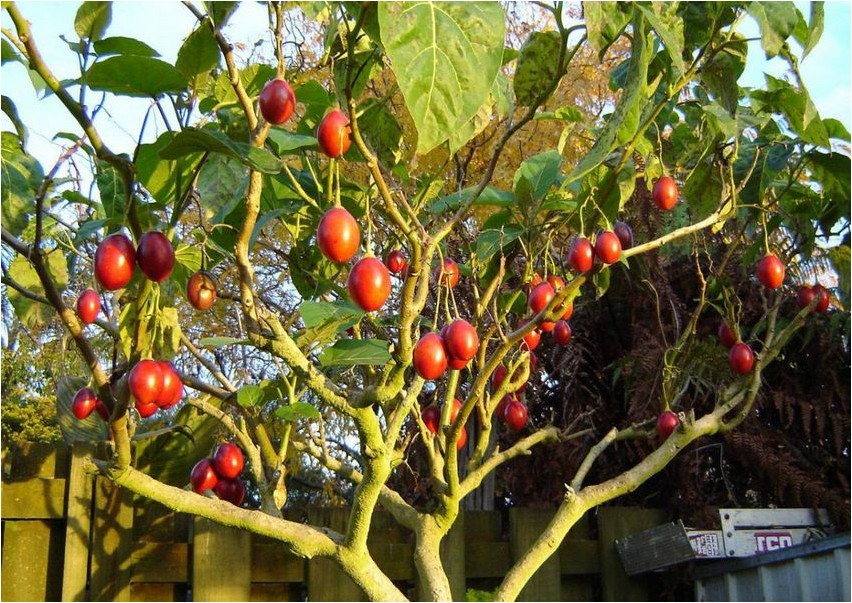
Cyphomandra (Latin: Cyphomandra betacea) is an exotic vegetable crop; a plant in the Solanaceae family. Other names include tamarillo, tamarillo, or tomato tree.
The plant”s native land is believed to be Peru, Ecuador, Bolivia, and Chile, although its exact origin remains uncertain. It is widely cultivated in Venezuela, Argentina, Brazil, Colombia, as well as in the mountainous regions of Guatemala, Haiti, Puerto Rico, and Costa Rica.
Crop Characteristics
Cyphomandra is a low-growing evergreen shrub or tree up to 3 meters tall. The leaves are large, alternate, oval or heart-shaped, slightly pubescent, and glossy. The flowers are white with a pinkish tint, with a five-lobed calyx, gathered in large inflorescences of 30-50, and have a pleasant, rich aroma. The fruit is a two-chambered, ovoid berry, approximately 5-10 cm long, collected in clusters of 3-12 fruits.
The skin is quite hard, orange, orange-red, yellow, or rarely purple, with a slightly bitter taste. The flesh is golden-pink, sweet, sour, and salty, reminiscent of tomato juice with a tropical aroma. The seeds are similar in appearance to tomato seeds, differing only in size and the presence of a gray coating. A single bush or tree can live up to 15 years. Cyphomandra begins bearing fruit in the second year after planting. The annual yield of cyphomandra fruits from a single bush is 15-20 kg.
Growing Conditions
In central Russia, cyphomandra can only be grown in heated greenhouses, hothouses, and indoor spaces. In the Moscow region, this plant adapts quite easily to new conditions, so it can also grow outdoors, provided it is kept in a greenhouse during the winter. Cyphomandra is not considered cold-hardy, although some specimens can easily withstand temperatures as low a s-4°C. Even if the leaves die, shoot growth resumes from buds located in the leaf axils. The plants are demanding in terms of light and do not tolerate shade. They prefer well-drained, moisture-retentive soils with a rich mineral composition. They do not tolerate waterlogged, marshy, or acidic soils.

Propagation and planting
In indoor conditions, cyphomandra is propagated by seeds and cuttings. The seeds are collected from the pulp of the fruit, washed thoroughly, dried on gauze and placed in the refrigerator for a day. Then the seeds are sown in nutrient soil or fertilized garden soil; fine-grained sand can be added to the substrate. Seeds germinate at a temperature of 25C, usually in 15-20 days. At first, seedlings develop very slowly; plants begin to actively develop after 1. 5-2 months. After about a year, the plants reach a height of 90-100 cm. Once every three months, the size of the container is increased by 2. 5-3 m.
When propagating a crop by cuttings, planting material is cut from fruiting shoots. Each cutting must have at least three buds. The cuttings are planted in a 1-liter container, leaving one bud above the soil surface. Immediately after planting, the soil is watered abundantly, covered with polyethylene and placed on a windowsill or any other intensely lit place without direct sunlight. As soon as the cuttings take root, they are planted in a permanent place, slightly buried in the soil.
Care
Digitomandra needs regular feeding — at least once a month. Watering is carried out moderately, waterlogging is extremely undesirable, drying out should also not be allowed. In winter, watering and fertilizing are reduced, as plants stop growing, but additional lighting is provided.