Elecampane British
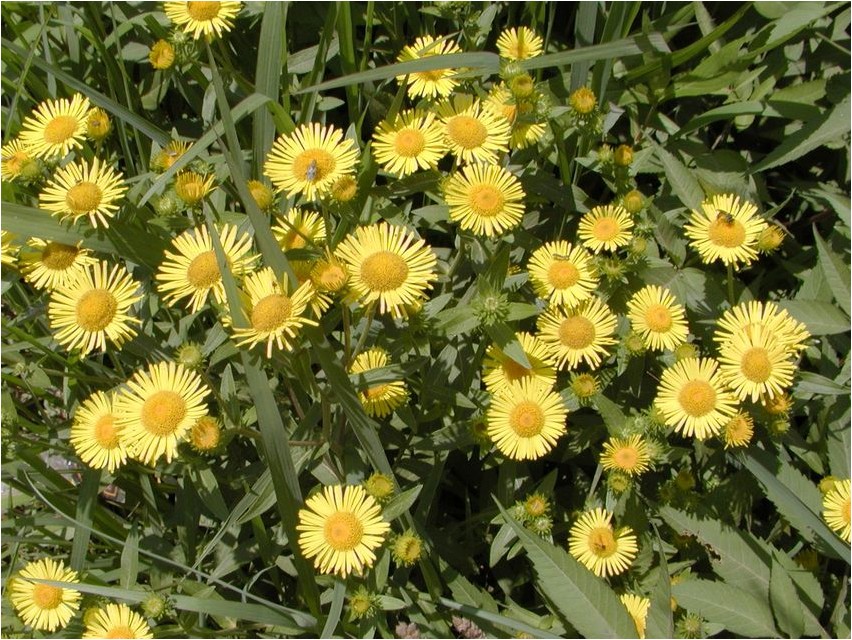
Elecampane is one of the plants of the family called Asteraceae or Asteraceae. In Latin, the name of this plant will be as follows: Inula britanica L.
As for the very name of the British elecampane family, in Latin it will be like this: Asteraceae Dumort.
Description of the British elecampane
Elecampane British is a biennial herbaceous plant endowed with a very thin rhizome. The stems of this plant are single and erect, their height will vary between twenty and sixty centimeters. Such stems of this plant are covered with soft hairs. The leaves of the British elecampane are alternate, the lower ones will be elliptical in shape, and the upper ones will be oblong-lanceolate, and they can also be obtuse or pointed. The flowers are in fairly large baskets and are painted in golden-yellow tones. In diameter, the length of such flowers will be about three to four centimeters; such flowers will be collected in a shield of two to five pieces, or they can be single. The marginal flowers are ligulate and endowed with five denticles, while the middle flowers will be funnel-shaped. The fruit of the British elecampane is a fragrant achene, which will consist of a single row of rough hairs.
British elecampane blooms in summer and autumn. Under natural conditions, this plant can be found in the European part of Russia, Ukraine and Belarus. For the growth of elecampane, the British prefers places along river banks, along the coastal slopes of rivers and lakes, in coastal thickets of bushes, as well as in forests, in wet water meadows, in addition, occasionally this plant can be found along roads and in weedy places.
Description of the medicinal properties of British elecampane
British elecampane is endowed with very valuable healing properties, and it is recommended to use the herb of this plant for medicinal purposes. The concept of grass includes flower heads, leaves and stems. It is recommended to harvest such raw materials during the flowering of this plant.
It is noteworthy that the chemical composition of British elecampane has not yet been fully studied. However, it has been proven that the plant contains essential oils. It is noteworthy that this plant is characterized by a rather weak garlic odor.

Elecampane is endowed with very effective diaphoretic, anti-inflammatory, antiseptic, diuretic and wound-healing effects. An aqueous infusion of the herb of this plant is recommended for use against dysentery, bleeding and scrofula.
Crushed fresh leaves of this plant are recommended to be applied to bleeding ulcers and purulent wounds, as well as to places where rabid animals have bitten. It is noteworthy that earlier in some areas the healing properties of this plant made it possible to use elecampane instead of yeast.
As for traditional medicine, a decoction prepared from the leaves of this plant is recommended for use for various gastric diseases, as well as for colitis. In addition, a decoction prepared from this entire plant along with the roots can be used against worms and alcoholism. For internal bleeding and diseases caused by heavy lifting, it is recommended to take one flower basket of elecampane and pour one glass of boiling water over it. A decoction of the herb of this plant can be used to wash wounds, and a water decoction is recommended for use for a variety of female diseases: for the same purpose, it is permissible to use a tincture of elecampane prepared with vodka.





