Sea mustard
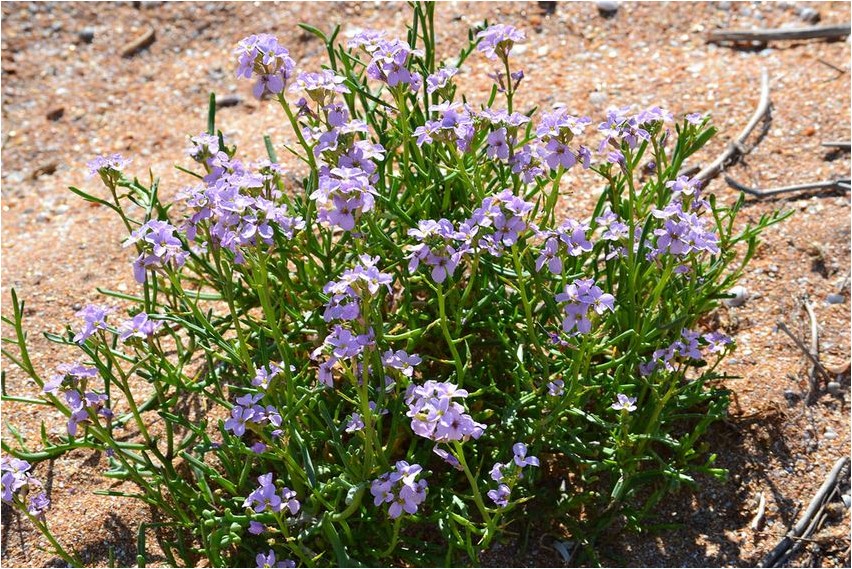
Sea mustard (lat. Cakile) is a genus of herbaceous annual plants belonging to the Brassicaceae family.
This is not at all the same plant from the seeds of which people produce mustard powder, which adds a piquant aroma to meat dishes and cures colds. And it does not grow in the sea, but, like most terrestrial plants, on the ground. But the plant prefers to settle on the seashore, rustling its leaves in time with the sea waves rushing onto the shore. The sea helps the plant travel around the globe, carrying its seeds to new shores.
Description
Plants of the genus Sea mustard are annual herbaceous plants, the stem of which is straight or lying on the surface of the ground. Species common to Europe and North America grow on sea coasts, often hiding in coastal dunes. The height of plants, depending on living conditions, varies from fifteen to sixty centimeters.
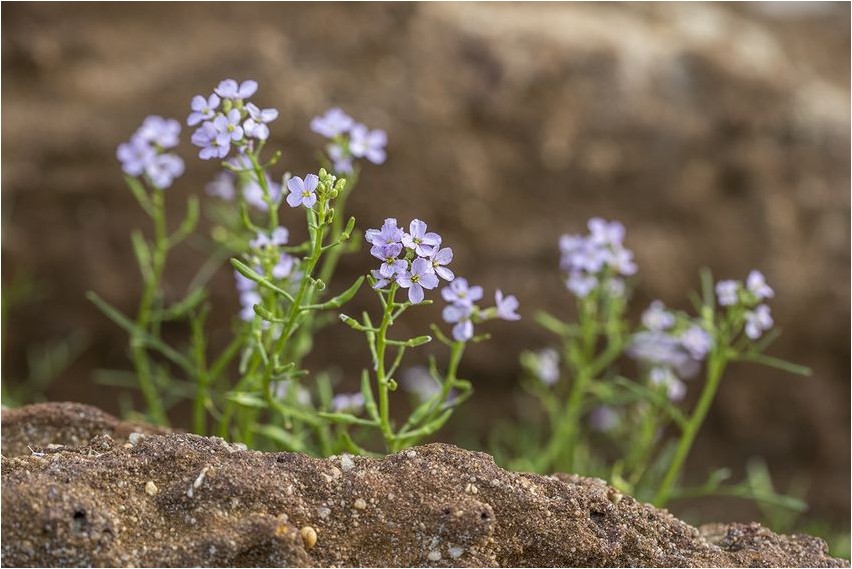
The stems of the plants are covered with fleshy bluish-green leaves, which can be whole, with a large oval-elongated leaf blade and a wavy beautiful edge, tapering towards the base into a short petiole, or pinnately dissected, very decorative. This beautiful bush grows in North Africa, in the southwest of Morocco:
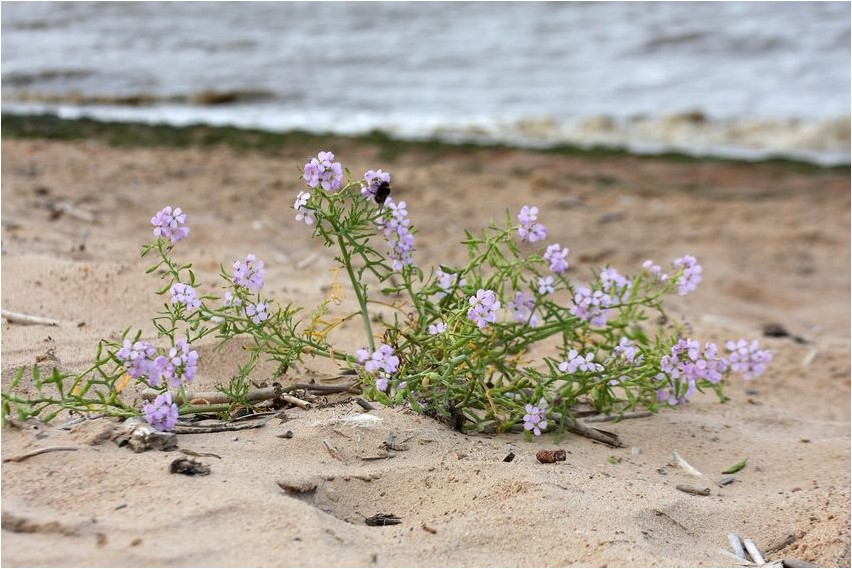
Sea mustard flowers have a traditional form for plants of the Brassica (or Cruciferous) family in the form of a miniature cross of four petals. The color of the petals is usually from lavender to white. The length of the petals is about one centimeter. The flowers form apical racemes. The sepals of the flower are not similar to each other, since the lateral sepals have a slight swelling at the base. Six stamens, equipped with glands, are located in the center of the flower.

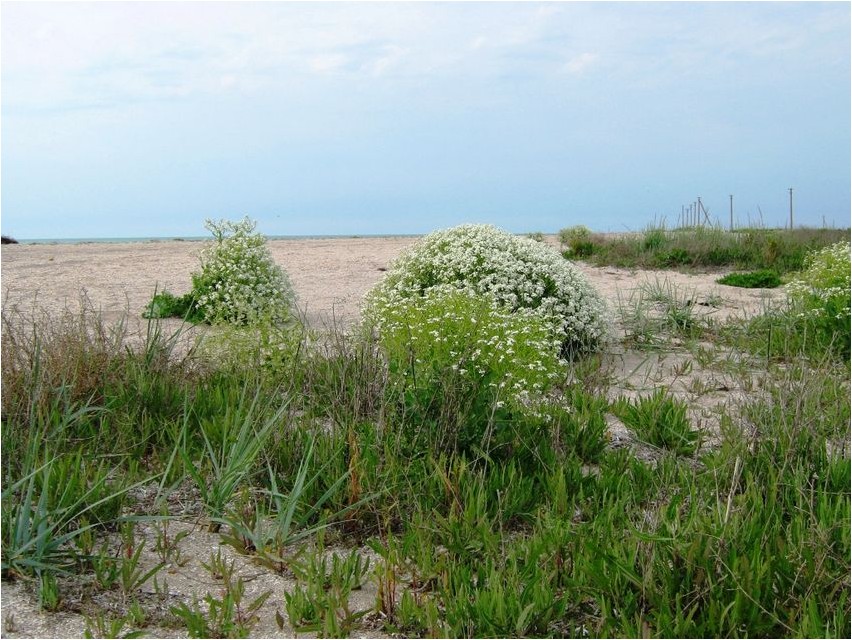
The fruit of the Sea Mustard is a pod with two sections, one of which (lower) remains attached to the plant, and the second (upper) breaks off and is given over to the will of wind and water.
Varieties
There are at least seven species in the genus:
* Arabian sea mustard (lat. Cakile arabica)
* Arctic sea mustard (lat. Cakile arctica)
* Toothless sea mustard (lat. Cakile edentula)
* Black Sea sea mustard (lat. Cakile euxina)
* Sea mustard (lat. Cakile geniculata)
* Lanceolate sea mustard (lat. Cakile lanceolata)
* Coastal sea mustard (lat. Cakile maritima).
Sea mustard in the human diet
Young stems and leaves are used fresh by people as vitamin greens.
Oil obtained from mature seeds of the plant is used as food additives.
The healing powers of Sea Mustard
For medicinal purposes, mature Sea Mustard seeds are used, from which oil containing many useful components is extracted. It contains: glycosides, phytosterols, phytoncides, chlorophyll, essential oils and a number of vitamins (“A”, “B3”, “B4”, “B6”, “D”, “F”, “E”, “K”, “P”).
Traditional healers use Sea Mustard oil as a general tonic.