Thuja
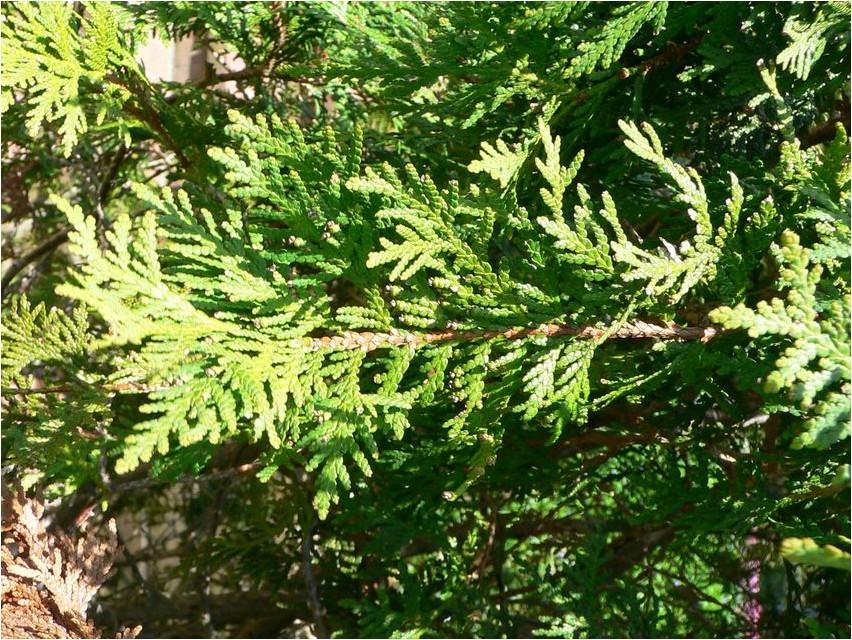
Thuja (Latin: Thuja) is a genus of evergreen coniferous shrubs and trees in the Cupressaceae family. Other names include arborvitae or the tree of life. The genus includes five species native to East Asia and North America.
Cultivation Characteristics
Thuja is a monoecious shrub or tree up to 70 m tall with a dense, symmetrical, conical crown. Trunk diameter varies from 0. 5 to 6 m. The needles are scale-like, dense, arranged crosswise, opposite, and clinging to the shoots. Young needles are needle-like and soft. The cones are small, oval or oblong, covered with leathery scales.
The seeds are flat, equipped with two narrow wings. The fruits ripen in the first year. Thuja is wind- and gas-resistant. Trees and shrubs transplant easily, propagate easily, and are undemanding in terms of growing conditions. They are widely used in ornamental gardening and topiary.
Growing Conditions
Thuja is an easy-to-grow plant, but thrives in well-drained, moist, neutral or slightly acidic soils. The plant has a shallow root system, so it can withstand even mild waterlogging and short-term flooding. Prolonged waterlogging inevitably leads to death.
Thuja is shade-tolerant, tolerating light partial shade. In dense shade, trees become very sparse and lose their attractive appearance. Brightly lit areas with diffused sunlight are ideal for growing thuja. Soil fertility plays a significant role in the intensity of needle color. A distance of 3 to 5 meters between plants is recommended.
Propagation and Planting
Thuja is propagated by seeds, horizontal layering, cuttings, and division. Sowing is done with freshly collected seeds in the fall or spring after preliminary stratification. Unfortunately, seeding does not guarantee the production of specimens with clear maternal characteristics, but the resulting plants are always strong, healthy, and have a very attractive and harmonious appearance.

Vegetative propagation is preferable. Cuttings are effective for almost all thuja species, but rooting rates vary. Cuttings are taken in early spring (before the sap begins to flow). Summer cuttings are also possible, but not recommended, as the cuttings do not always have time to root before the onset of persistent cold weather. For the winter, cuttings are covered for insulation. The use of growth stimulants before planting is encouraged.
The simplest method is propagation by horizontal layering; however, you should not expect a beautiful conical crown on future plants. Shrubs and trees often turn out lopsided, but with regular care, formative pruning and pruning, they acquire the correct crown. Layings are laid in spring or summer and separated the following spring. Division is used only for multi-stemmed compact specimens. To do this, the bushes are hilled, periodically moistened, and after the formation of additional roots, the plants are divided.
Planting of seedlings is carried out immediately after the soil thaws, the deadline is the beginning of July. Planting material needs a lot of time to go through an adaptation period and prepare for future cold weather. It is not recommended to plant thuja seedlings starting from mid-August. For the winter, the seedlings are covered with spruce branches, and the soil in the tree trunk zone is mulched with organic material in a layer of at least 20 cm.
Care
In the first year after planting, plants need more careful care. In addition, they require light shading from direct sunlight, otherwise young shrubs or trees will get burned. For shading, it is recommended to use a special reflective non-woven material, in no case kraft paper. Watering, fertilizing and pruning are important for thuja.
Pruning and trimming can be done in spring or early summer. The first feeding is carried out immediately after the soil thaws, the second — during the active growth of shoots, the third — at the end of August. Preventive treatments against pests and diseases are not prohibited. Possible pests of the crop are bark beetles, cypress and thuja aphids, scale insects, and false scale insects; Among the diseases, bacteriosis and fungal diseases are common.





