Zucchini
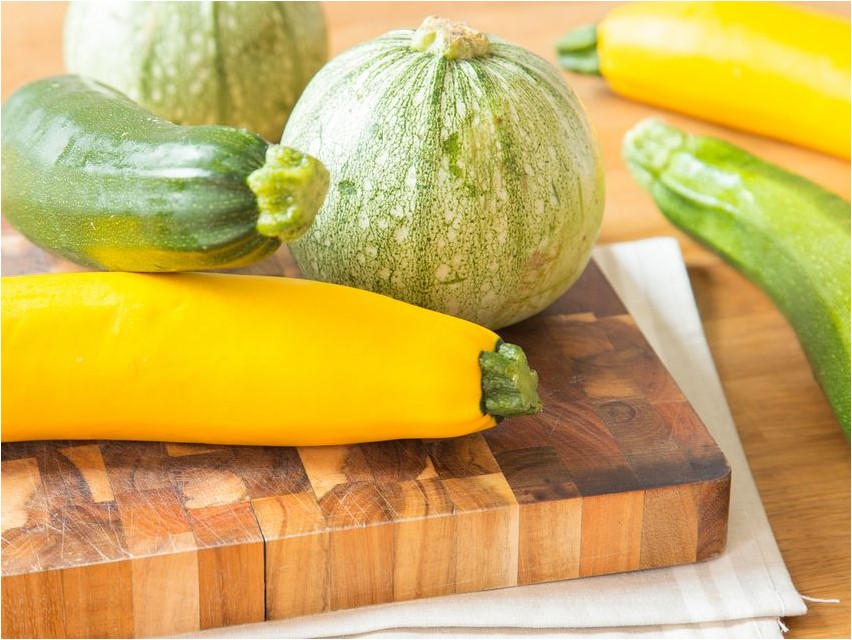
Zucchini is an early ripening vegetable; a herbaceous annual plant, popularly called “Italian squash” and is one of the subspecies of pumpkin.
History
In America, zucchini have been known since ancient times, as evidenced by numerous archaeological finds. True, despite the fact that zucchini was grown back in the third millennium BC, local residents believed for quite a long time that they were inedible and ate only their seeds.
Approximately in the 16th century, this colorful vegetable was brought to Europe, where it was also used mainly as an ornamental plant. Only its flowers were considered edible, and zucchini fruits began to be eaten only in the 18th century.
Description
The zucchini plant looks like fairly compact bushes with slightly pubescent and completely non-thorny leaves. Flowers on the bushes are formed mainly by female flowers, and accordingly, all plants are distinguished by fairly high yields.
And the fruit of zucchini is a zucchini, characterized by a cylindrical oblong shape. All of them have delicate flesh and are distinguished by a not very pronounced watery taste. By the way, the skin of these fruits does not harden as quickly as those of their closest relatives, zucchini. In addition, its color can vary — zucchini can be either dark green or pale greenish or yellow.
Young fruits, the size of which does not exceed fifteen centimeters, are quite acceptable to eat raw, together with the peel. By the way, such fruits are considered the most valuable and delicious. And larger specimens usually have a harder peel, and the flesh is much coarser.

Growing and care
The basic rules for growing zucchini are almost completely the same as the rules for cultivating cucumbers. You can get a high-quality and abundant harvest on light loamy soils filled with humus or manure, or on non-acidic chernozem soils. However, virgin and fallow areas are also quite suitable for cultivating zucchini. If this crop is planned to be grown in the northern regions, then zucchini should be placed either on the southwestern or southern slopes, reliably protected from the wind and well warmed by the sun. And to prevent zucchini from being affected by various ailments, it is not recommended to cultivate them in the same area for more than two years in a row. It is especially undesirable to grow them after cucumbers or melons, since they are all affected by the same diseases. It is best to sow this crop after green crops, root crops or cabbage. And in the middle zone it is allowed to sow zucchini along with potatoes.
Immediately before sowing, it is recommended to warm the seeds for two to three days, after which they are soaked in soft and fairly warm water and germinated for several days. It would also be useful to harden the seeds, which is carried out at temperatures from zero to two degrees for two days. These measures will help not only speed up the hatching of seedlings by a few days, but also significantly increase the yield. And they begin to plant sprouted seeds in the ground in May, as soon as the soil warms up to ten to thirteen degrees. All seeds are planted to a depth of three to five centimeters.
To prevent tender zucchini seedlings from being pecked by jackdaws or rooks, it is recommended to hang paper strips or install scarecrows in the areas.
The main care for this crop consists of two or three loosening of the soil (including weeding in the rows), three to four treatments of row spacing with the removal of weeds, as well as fertilizing with breaks of one and a half to two weeks. If dry weather sets in, additional watering is also necessary, and at the stage of mass fruiting, it is not forbidden to fertilize with potassium sulfate — as a rule, they give a very good effect.