Savory
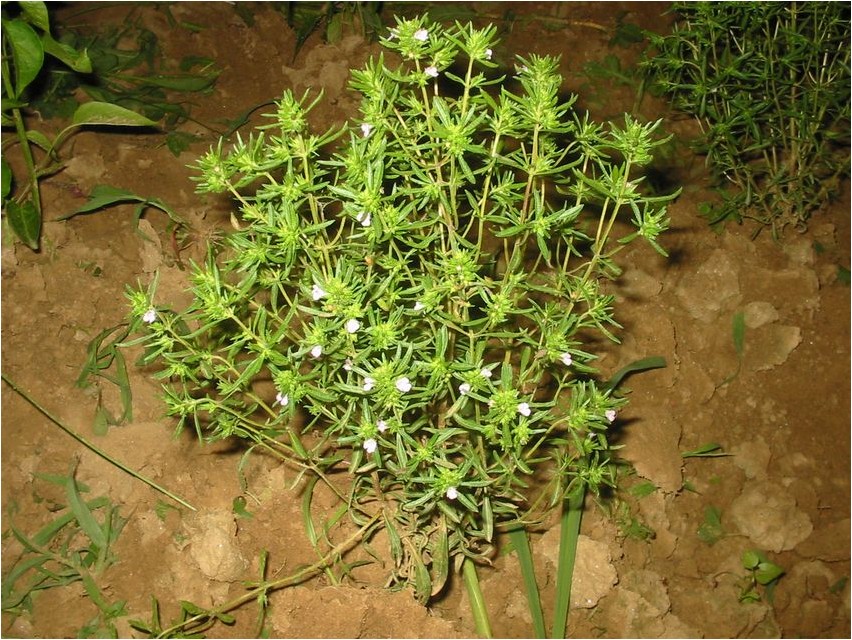
Savory (lat. Satureja) is a genus of annual and perennial plants, subshrubs and shrubs of the Lamiaceae, or Lamiaceae family.
The genus has about 30 species, of which the most common species in cultivation is garden savory, or garden savory, or fragrant savory. All types of savory are characterized by continuous long flowering. The natural habitat of savory is the Mediterranean and Asia.
Characteristics of culture
Savory is a herbaceous plant, subshrub or shrub up to 70 cm high with a stem covered with short hairs over its entire surface. The leaves are entire, lanceolate, opposite, gray-green, located on short petioles. The flowers are small, light purple, bluish-white or pinkish, 4-15 cm long, collected in whorled or loose elongated inflorescences, sitting in the axils of the leaves.
The flowers of the plants attract many bees to the garden with their bright aroma. The calyx is regular or two-lipped, bell-shaped, five-toothed. The corolla is two-lipped, with purple spots in the throat. The fruit is a round or ovoid nut of dark brown or black color. Savory blooms in July-August, the fruits ripen in September.
Growing conditions

Savory is a heat-loving plant that prefers well-lit areas. The crop is not demanding on soil conditions, but produces low yields on poor, waterlogged, acidic and saline soils. Fertile, light, well-drained soils with a neutral pH are optimal. Lowlands with stagnant cold air and melt water, as well as areas unprotected from northern winds, are not suitable for growing savory.
Sowing
Even a novice gardener can grow savory. The seeds of the crop have good germination and do not require preliminary preparation. Moreover, if all the rules of care are followed, plants can develop freely both in open ground and in pots indoors. Currently, there are no breeding varieties of savory, so local varieties are cultivated in each region. They all differ from each other in color, size, foliage and ripening time.
Sow the seeds in early spring, sprinkle with a thin layer of soil and water. Planting depth is 0. 5-1 cm. For the first time, it is advisable to cover the crops with plastic wrap. It is not forbidden to sow the crop with other annual herbs, for example, basil, coriander, watercress, purslane and snakehead. You can grow savory in close proximity to beans. Young plants can withstand light frosts without any problems. In central Russia, winter sowing is encouraged.
Care and harvesting
With the emergence of seedlings, the crops are thinned out. If necessary, re-thinning is carried out after a couple of weeks. The culture has a positive attitude towards fertilizing. The first fertilizing is carried out before sowing; for this, humus or compost, ammonium nitrate, potassium salt and superphosphate are used. In the future, it is necessary to carry out a couple more feedings. Savory also needs weeding, loosening and watering.
In the first year, harvesting is limited to one cutting, in subsequent years – 2-3 times per season. Cutting is carried out before flowering. Young shoots with leaves are dried under a canopy.
Application
Savory is widely used in cooking and folk medicine. In some countries, savory is used to prepare sauces that go perfectly with meat and fish dishes. Savory is often added to sausages, pork and potato pies, as well as turkey and veal rolls. Nowadays, savory is used in the preparation of beans, peas and beans. The plant is also included in Bulgarian ketchup.
As a medicinal plant, savory has been used since ancient times. It is useful for tachycardia, headache, dizziness, cystitis, diseases of the gastrointestinal tract, flatulence, acute respiratory infections and rhinitis. In Germany and France, savory is used as an anthelmintic, antifungal and antibacterial agent. The essential oils contained in the plant are used in aromatherapy.





