Asclepias
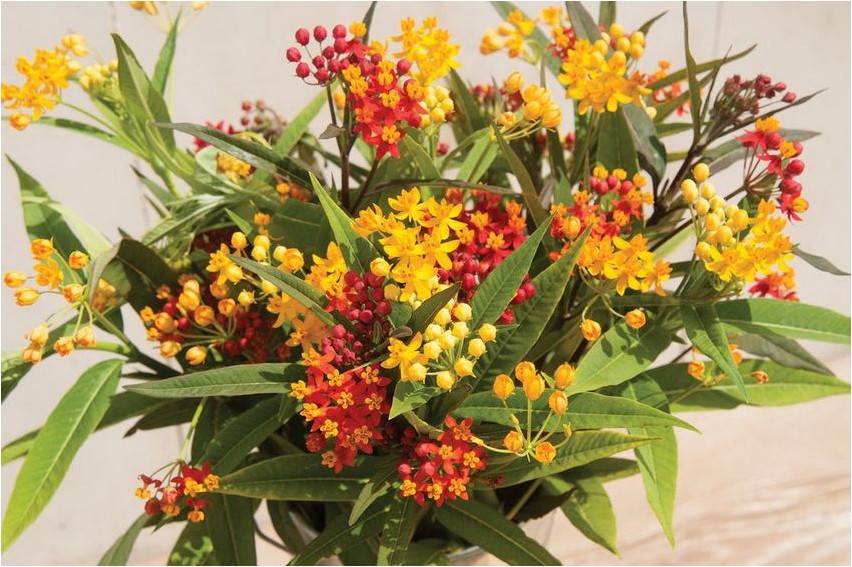
Asclepias (Latin: Asclepias) is a sun-loving, beautifully flowering perennial plant from the Apocynaceae family. Other names include milkweed and swallowwort.
Description
Asclepias is a medium-sized shrub with fairly sturdy, unbranched shoots and hairy, oval-shaped leaves. Typically, this plant ranges in height from half a meter to eighty centimeters. It can be either deciduous or evergreen!
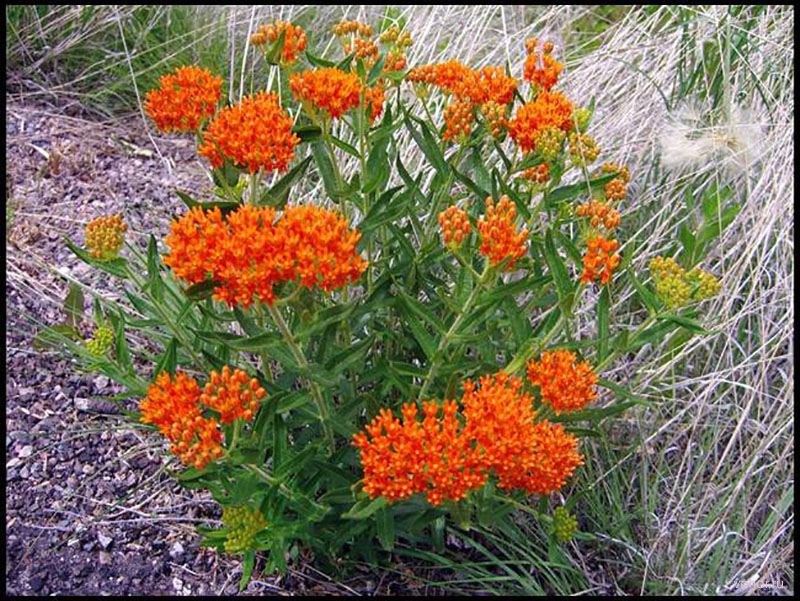
Small pink flowers of Asclepias are collected in stunningly beautiful paniculate inflorescences. And these flowers are very pleasantly scented! After some time, seed pods begin to form in their place, surrounded by white seeds (when open), abundantly covered with numerous “cotton-like” fibers—hence the Russian name of the plant (vatochnik).
The genus Asclepias contains approximately one hundred and twenty species. Where it grows
Asclepias is most often found in the steppe zone.
Uses
Some varieties of Asclepias are successfully cultivated as beautifully flowering ornamental plants—a real find for landscape design!
The milky sap of Asclepias, despite being poisonous, has found its use in folk medicine—like celandine juice, it is used to remove warts. Asclepias is also an excellent honey plant. The strong and distinct scent of this beauty invariably attracts a wide variety of insects—monarch butterflies are especially fond of Asclepias.
Cultivation and Care
It is best to plant asklepias in sunny areas, in garden soils characterized by normal moisture with a neutral or slightly acidic reaction. By the way, this amazing plant can be grown not only in open ground, but also in pots placed on terraces or balconies. If asklepias is planned to be grown in pots, the substrate for these purposes is prepared from leaf or turf soil (50%), as well as from sand (25%) and peat (25%). It is also necessary to add high-quality long-acting mineral fertilizers to this substrate (thirty to forty grams of fertilizer are usually taken for each bucket of soil). And, importantly, a drainage layer from three to seven centimeters thick must be laid on the bottom of each pot (this can be either pebbles or thoroughly washed expanded clay). As for the diameter of the pots, it should ideally range from fourteen to fifteen centimeters to eighteen to twenty centimeters.
Asklepias should be watered abundantly (ideally with soft water), but it is necessary to constantly ensure that the water does not stagnate. However, the soil must be constantly moist! Also, during the flowering period, about once a month, asklepias should be pampered with good fertilizers.
For the winter, it is recommended to cover the asklepias with spruce branches — in this case it will be much easier for it to overwinter. This beautiful plant is usually replanted in the spring, and for each replanting you should take a more spacious pot.
Asklepias is usually propagated either by sowing seeds, which is carried out before winter, or by dividing the bushes — this is done in late summer or spring. It is quite acceptable to resort to propagation by cuttings.
Sometimes Asclepias can be attacked by whiteflies, but this scourge can usually be controlled with the help of fungicides. Also, with insufficient watering, Asclepias buds and leaves may begin to fall off, and a lack of lighting sometimes leads to exposure and stretching of its stems.
Vochnik (asklepias): planting and care — 7 dachas
Asklepias
Asclepias
asklepias photo[/caption]
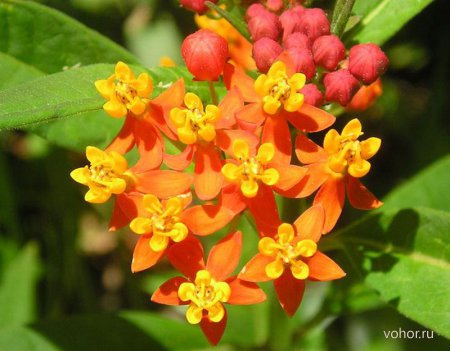 asklepias, or popularly known as swallowtail, is a member of the swallowtail family. Its natural conditions are the tropics of Africa and America.
There are many known species of this family; some perennials are grown as
medicinal plants , but most are decorative asclapias kurasava is a beautifully flowering subshrub, up to a meter high, the leaves are dark green, and the flowers are orange with a strong odor that attracts insects. Therefore, it is not advisable to place it on open balconies.

It feels good on southern windows, because asklepias is a light-loving plant, and if it is placed on the north or east side, then the windows should be large. There are no special requirements for temperature; it blooms quite well even at normal room temperature. The soil mixture for the plant should consist of turf soil, humus and leaf soil, with the addition of sand and peat in a ratio of 2:1. Mixtures repurposed for beautiful flowering plants are also suitable.
watering should be moderate, you need to constantly ensure that the soil does not dry out and a crust does not form. Asclapias also reacts positively to spraying, although it is not necessary. But to wash away dust, you can use it once a week.
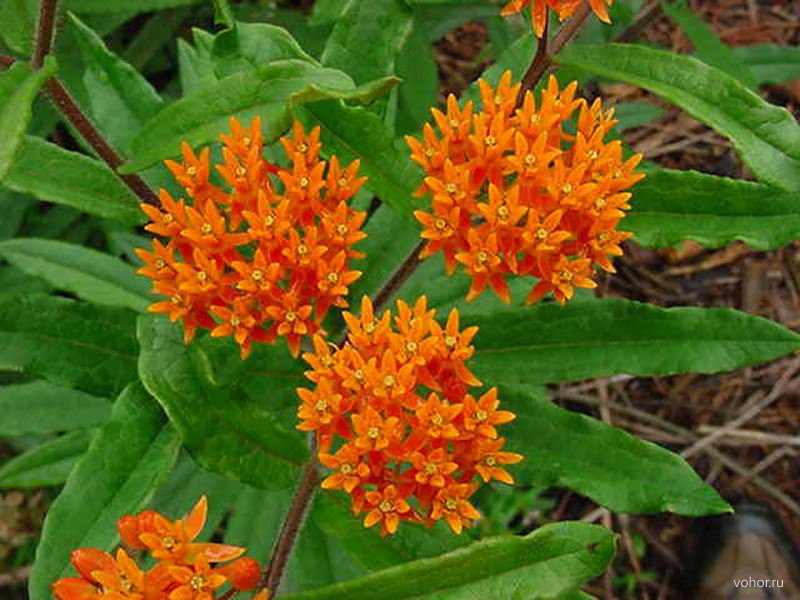
the plant needs to be fed with mineral fertilizers, but with frequent transplants and changes in the soil mixture, no fertilizers can be applied. When yellow spots appear, which then turn brown, the plant is fed with fertilizer containing one useful element — nitrogen; if the leaves acquire a purple or reddish tint — this is a symptom of magnesium deficiency. If the plants were fed with mineral fertilizers, then its effect can be enhanced with a small amount of monofertilizer needed for the treatment of this disease. This is the name of a fertilizer that consists of only one element. The plant can be replanted only after it has completely recovered into a large container.
Asclepis propagates by cuttings from young shoots.
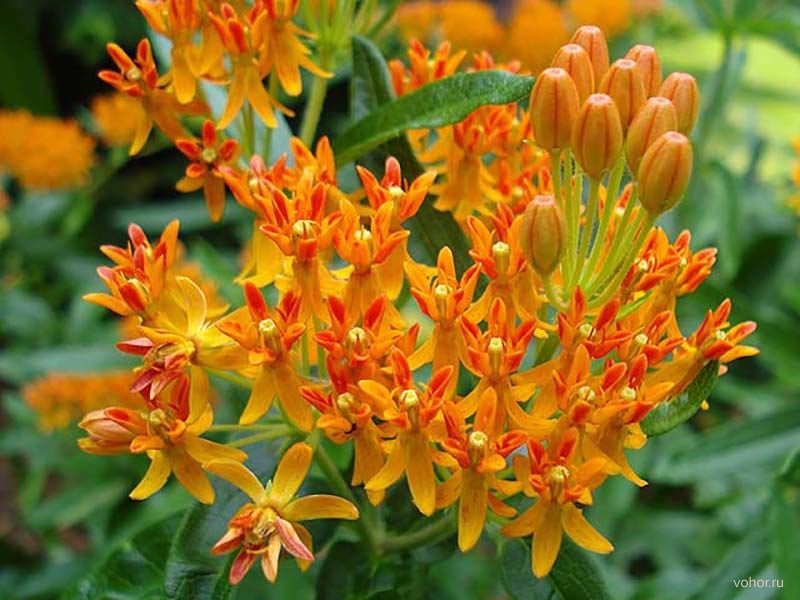
if the crown has grown too much, then it is advisable to thin it out by pruning. Over time, the plant ages, the stems become coarser, blooms less often, and it loses its decorative effect. It is advisable to replant young shoots more often and replace old plants with them. Caring for Asclepias is simple; it does not require the creation of special conditions.
The juice of all plant species is poisonous and is used in folk medicine.
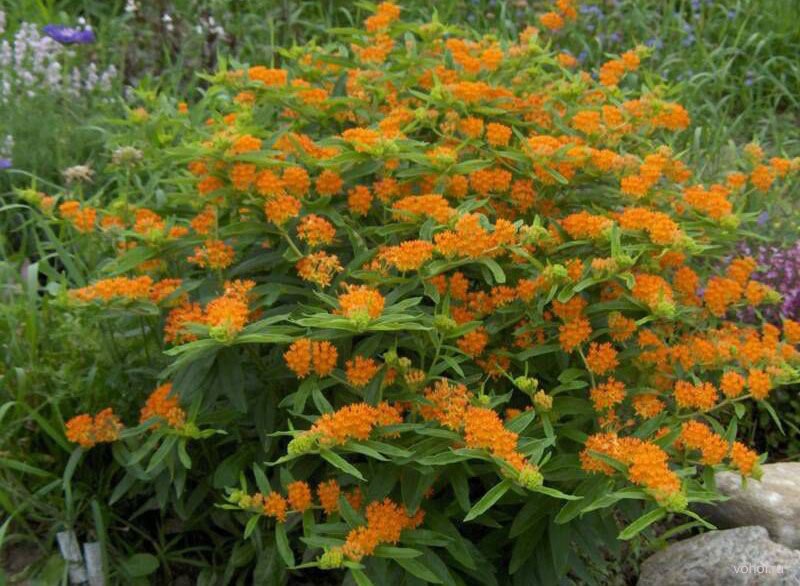
asklepias asklepias