Elecampane
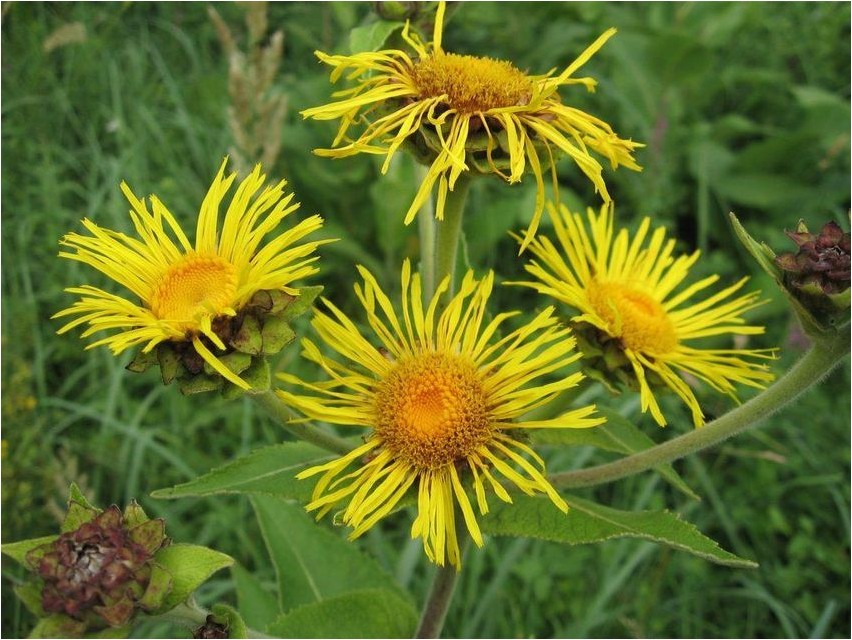
Elecampane is one of the plants of the family called Asteraceae or Asteraceae; in Latin the name of this plant will be as follows: Inula vulgaris DC.
As for the name of the elecampane family itself, in Latin it will be like this: Asteraceae Dumort.
Description of the common elecampane
Elecampane is a biennial plant whose height will be about forty to one hundred and twenty centimeters. The rhizome of this plant is knotty and woody, the stem is colored green, it is straight, and in the upper part it will be branched. The leaves are elliptical in shape, the length of the lower leaves will be about ten to thirteen centimeters, and their width is three to four centimeters. The length of the upper leaves of this plant is six to eleven centimeters, and their width will be about two to four and a half centimeters. The diameter of the baskets of the common elecampane will be about half a centimeter, such baskets will be numerous, they are collected in a branched corymbose panicle. The length of such a panicle is ten centimeters, and the width will be about twelve centimeters. The achenes of this plant are cylindrical, they are colored brown, their length is two to two and a half millimeters. Elecampane blooms during the period from June to July.
Under natural conditions, this plant can be found in the European part of Russia, as well as in the Caucasus and Ukraine. For the growth of elecampane, the common elecampane prefers limestone and rocky slopes, clearings, deciduous forests and places along river banks.
Description of the medicinal properties of elecampane
Elecampane is endowed with very valuable healing properties, and it is recommended to use the leaves, stems and flowers of this plant for medicinal purposes. The presence of such valuable properties of elecampane is explained by the rubber content of this plant.
A decoction and infusion prepared from the herb of this plant is recommended for use against flatulence and jaundice, and also as a wound-healing and diaphoretic agent. The smoke produced by burning the leaves of this plant is an excellent insecticide for bedbugs, fleas, mosquitoes and flies.

For jaundice, as well as as a diaphoretic, it is recommended to use the following remedy based on elecampane: to prepare it you will need to take one tablespoon of crushed dry grass per glass of water. It is recommended to boil the resulting mixture for three to four minutes, and then leave this mixture to infuse for one to two hours, after which this mixture is carefully filtered. Take one or two tablespoons of this remedy three times a day before meals. It is important to remember that in order to achieve the best results, you must strictly follow not only all the rules for preparing such a product, but also all the rules for its administration.
In the form of lotions and compresses, as well as as a wound healing agent, it is recommended to use the following very effective remedy based on elecampane: to prepare it you will need to take three tablespoons of crushed herbs of this plant per three hundred milliliters of boiling water. It is recommended to infuse the resulting mixture for two hours, after which the mixture must be thoroughly strained. It should be noted that in order to achieve the greatest effectiveness of such a product based on elecampane, all conditions for the preparation of such a product must be strictly observed.





