Eyebright hairy
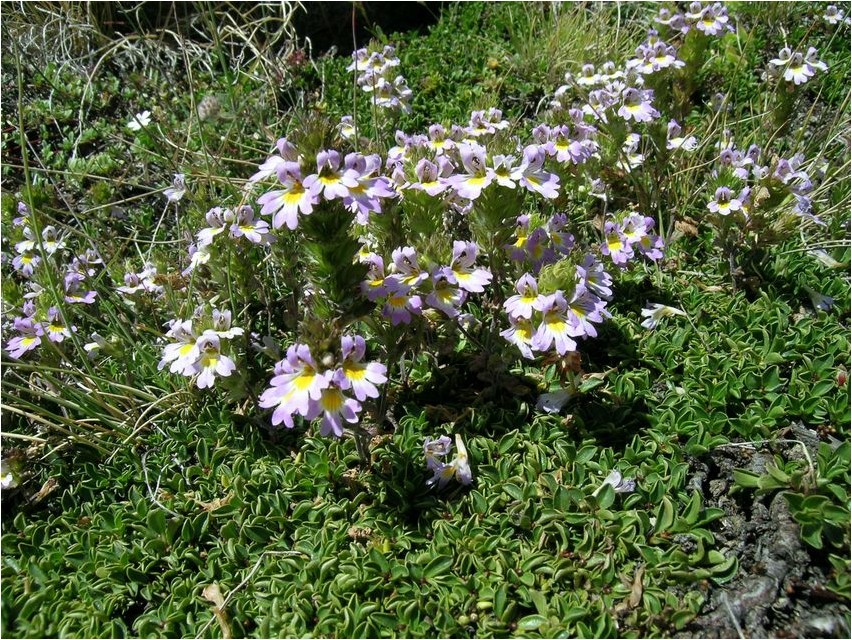
Eyebright is one of the plants of the family called Noricaceae; in Latin the name of this plant will be as follows: Euphrasia hirtella Jord. ex Reut.
As for the name of the hairy eyebright family itself, in Latin it will be like this: Scrophulariaceae Juss.
Description of hairy eyebright
Eyebright hairy is an annual herbaceous plant, the height of which will fluctuate between three and forty centimeters. It is noteworthy that this plant is a semi-parasite. The stem of the eyebright will be straight and most often slender, it will be pale in color or may have varying degrees of redness. Such a stem of this plant will be covered with rather long curly hairs. The lower leaves of this plant are obtuse, wedge-ovate, while the upper stem leaves can be either broadly ovate or narrowly ovate. At first, the inflorescence of this plant will be dense, and subsequently it becomes more or less spread out, and also elongated. The corolla of the hairy eyebright will be small, its length is four to six millimeters. Such a corolla will be whitish or endowed with a pale purple upper lip, and also complemented by dark purple stripes and a yellow spot, which is located on the lower lip. The capsule of the hairy eyebright itself is ovoid.
This plant blooms from June to August. Under natural conditions, hairy eyebright can be found in Central Asia, the European part of Russia, as well as the following regions of Eastern Siberia: Yenisei, Daur and Angara-Sayan regions. For growth, this plant prefers meadows, gravelly and rocky slopes from mid-mountain to high-mountain zones.
Description of the medicinal properties of eyebright
Eyebright is endowed with very valuable healing properties, and it is recommended to use the herb of this plant for medicinal purposes. The term grass includes leaves, stems and flowers. It is recommended to harvest such raw materials throughout the entire flowering period of this plant.
It should be noted that the experiment proved that a tincture based on the herb of this plant has a hypotensive effect. For this reason, this tincture is recommended to be taken for hypertension.

The presence of such valuable healing properties should be explained by the content of coumarins, the iridoid aucubin, flavonoids, vitamin C, bitterness, carotenoids, fatty and essential oils, resins and other useful substances in the aerial part of this plant. As for traditional medicine, here this plant is quite widespread. Traditional medicine recommends the use of eyebright as an anti-inflammatory and cardiovascular remedy for stroke and angina. In addition, such products are indicated for use as tonics for colds, and are also used for weak vision, various eye diseases, sore throat, bronchitis, bronchial asthma, abscesses, tumors, diathesis, childhood eczema, conjunctivitis, indigestion and increased acidity of gastric juice.
For bronchial asthma, it is recommended to use the following very effective remedy based on this plant: to prepare such a remedy, take twenty grams of crushed dry herbs per half liter of boiling water. This mixture is first infused and then filtered. Take this remedy three times a day, one third of a glass.





