Ezhemalina
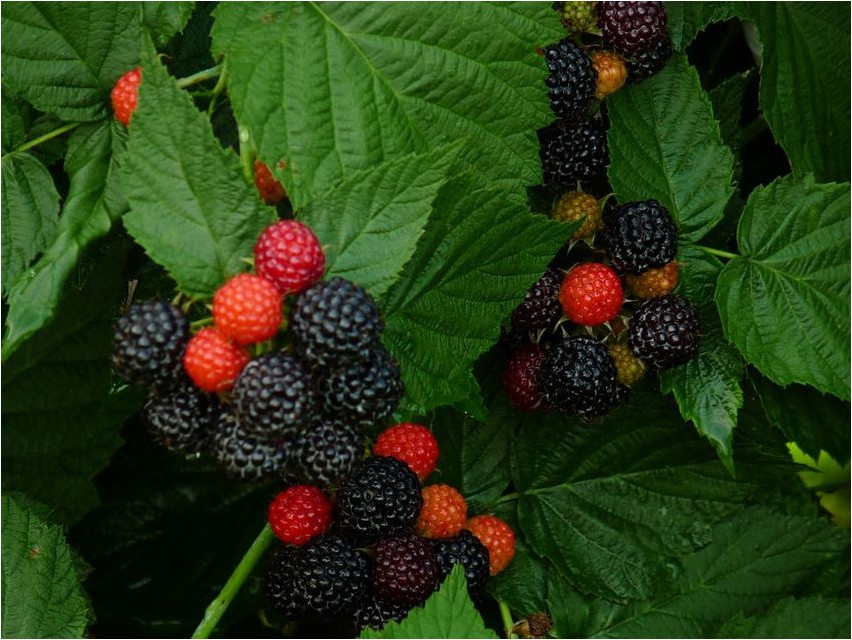
Ezhemalina (lat. Rubus ursinus) is a berry crop from the Rosaceae family, which is characterized by larger fruits and higher yields compared to ordinary raspberries.
Description
Ezhemalina is a more than successful hybrid of blackberries with the beloved raspberry. Mature plants are equipped with flexible long stems, and their rather large berries are collected in incredibly spectacular clusters.
Most common varieties
These are:
Texas. It is a rather prickly creeping bush, and the size of the shoots often reaches five meters. It boasts the presence of elongated berries, the weight of which can reach twelve grams. The taste of the berries is sweet and sour, somewhat reminiscent of raspberries. This variety is considered the most frost-resistant.
Loganberry. These are creeping bushes without thorns, on which sour red berries ripen (by the way, such berries ripen early), gradually darkening as they ripen. At the same time, they ripen extremely unevenly. The length of such berries can reach up to three and a half centimeters, and their weight is about five grams. Suitable for cultivation in central Russia.
Tayberry. One of the last early ripening hybrids, characterized by impressive productivity. The bushes of such raspberries are always covered with soft thorns, and its large berries are colored in juicy dark red tones. But the berries from the stalks, just like blackberries, will be separated extremely poorly.

Boysenberry. Creeping bushes that can be either thorny or thornless. The oval large berries are colored in pleasant brownish tones, and their taste is as close as possible to the taste of blackberries.
Darrow. And behind this name lies an upright variety, the length of its stems can reach three meters. All bushes are very prickly and incredibly frost-resistant — they can easily withstand frosts down to minus thirty-four degrees. One bush that has reached the age of five can easily produce up to ten kilograms of sweet and sour berries weighing up to four grams each.
Growing and care
Propagation of Ezhmalina can be carried out in several ways: through seeds (the rarest method, since seedlings obtained in this way are not able to retain their parental properties), root suckers or root cuttings, as well as layering (both horizontal and apical) or lignified and green cuttings.
As a rule, seedlings are planted in autumn or spring. First, a small handful of earth is poured onto the bottoms of dug holes about forty centimeters deep, and only then each seedling is placed on it. Having carefully straightened the roots, the holes are immediately filled with the top layer of soil combined with humus. And in order not to inadvertently provoke too intense growth of young shoots and thereby cause significant damage to the winter hardiness of the bushes, you should not apply too much organic fertilizer.
Since Ezhmalina needs proper support, it is customary to grow it on trellises. It is important to take into account the fact that each mature bush occupies a fairly large area, therefore, when planting seedlings, it is recommended to maintain a distance of at least one meter between them, and if you plan to plant ejaculina in several rows, the distance should be even greater — from one and a half to two meters.
Despite the relative unpretentiousness of every raspberry, it is best to plant it in sunny and at the same time slightly shaded areas. Ideally, plants should be provided with reliable protection from piercing winds. As for soils, the most suitable option in this case would be fertile and well-aerated soil, in which under no circumstances should moisture stagnate.