breadfruit
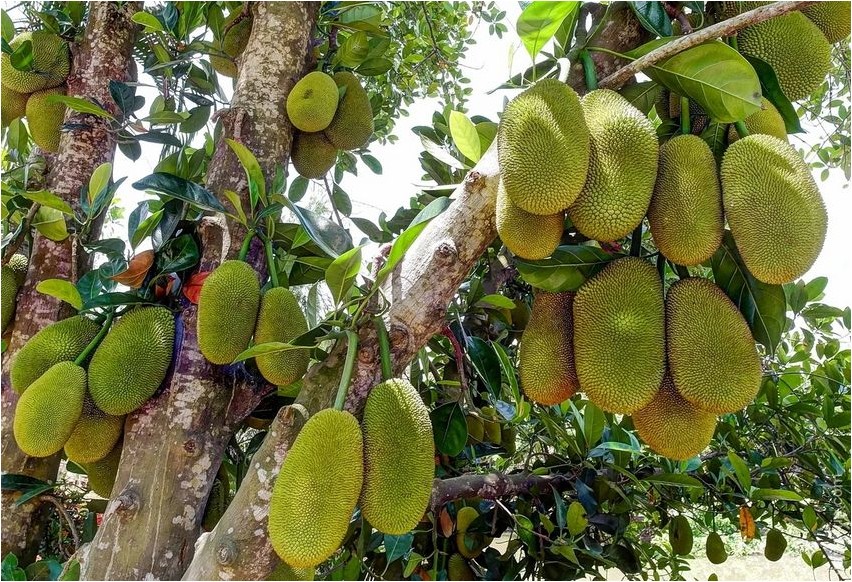
Breadfruit (lat. Artocarpus altilis) is a fruit plant that is a representative of the rich Mulberry family.
Description
Breadfruit is an incredibly powerful tree, the height of which can reach up to twenty-six meters. Outwardly, it is very similar to oak, and this tree also boasts surprisingly fast growth. Each tree is covered with gray and fairly smooth bark. A certain part of its branches is much thicker than most other branches — this is due to the presence of leafy side branches. And the bulk of the branches are quite long and very thin, with fancy tufts of leaves at the tips.
Breadfruit leaves are incredibly varied. By the way, this feature is a rare occurrence in the world of flora. On the same plant it will not be difficult to see both pinnately dissected and whole leaves, which will be older than the first. And young leaves can boast of an unequal degree of pubescence. And one more interesting point — depending on climatic conditions, breadfruit can be either evergreen or deciduous.
The small and rather inconspicuous flowers of this plant are painted in greenish tones that are pleasant to the eye. Male flowers, folded into fairly long racemose inflorescences, always begin to bloom earlier than female ones, and female inflorescences form beautiful and rather large buds. Such flowers are pollinated by fruit bats. And after the ovary, the female flowers gradually begin to grow together with each other, forming huge fruits, the shape of which by the time they ripen begins to resemble a knobby melon. At the same time, fruits can form not only one at a time — sometimes you can see very impressive clusters at the tips of the branches.
It is noteworthy that all parts of this culture, without exception, are characterized by the content of sticky latex, which has a milky color.
Unripe breadfruits have a green color, and as they ripen, they first turn into pleasant yellowish-greenish tones, then become completely yellow, and finally acquire a characteristic yellowish-brownish color. The diameter of one fruit can easily reach thirty centimeters, and their weight often varies between three and four kilograms. Until the moment of final ripening, the fruits are always hard, with starchy and fibrous white pulp. And fully ripe fruits gradually soften, and their flesh becomes sweet and turns yellowish or creamy.

Where does it grow
Under natural conditions, breadfruit can most often be found on the territory of New Guinea — it was from here that savvy Polynesians subsequently transported it to the picturesque islands of Oceania, where it turned into one of the most important sources of food. And now it is not difficult to see this culture in most countries located in the tropical zone.
Application
The pulp of ripened fruits is not only eaten raw — it is no less often candied, dried, baked and even boiled. And from the thoroughly mashed and thoroughly mashed pulp, a rather unique dough is prepared, from which very tasty pancakes are obtained.
Unripe fruits are also eaten. And if breadfruit is fried, it tastes like fried potatoes. However, seeds are often used — they are fried or boiled, and then sprinkled with salt.
Breadfruit fruits also have beneficial properties — their high fiber content makes them excellent helpers for normalizing the functioning of the gastrointestinal tract, and if you eat these fruits systematically, you can significantly reduce the risk of developing all kinds of cardiovascular diseases, normalize metabolism, strengthen teeth and bones, and also improve the condition of nails, hair and skin. But that’s not all — among other things, these fruits are an excellent preventative against colorectal cancer.
Contraindications
Individual intolerance cannot be ruled out, but in general, breadfruit fruits do not have any serious contraindications.