Belladonna
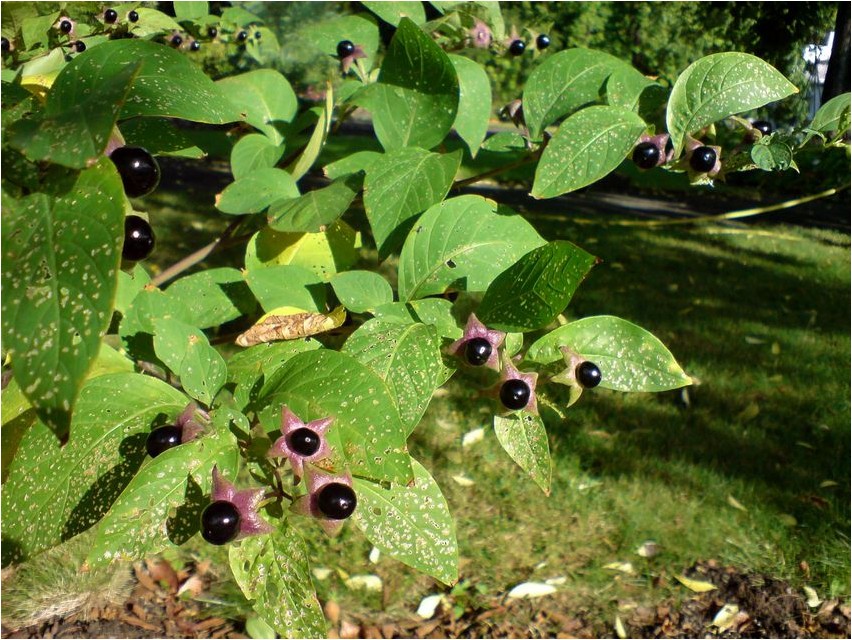
Belladonna is a member of the Solanaceae family of plants. Its Latin name is Atropa belladonna L.
As for the family name itself, the Latin name is Solanaceae Juss.
Description of Belladonna
Belladonna is a perennial herbaceous plant with a multi-headed rhizome and numerous thick, branched roots. Its stems are branched, succulent, and thick, occurring singly or in multiples, reaching a height of approximately one to two meters. Belladonna’s leaves are dense and pointed, ranging in shape from ovate-oblong to ovate, and are dark green in color. The lower leaves of this plant are singly arranged, while the upper leaves are arranged in pairs, with larger leaves interspersed with smaller ones. Approximately fifteen to twenty of the larger leaves are present. The flowers are drooping and solitary, axillary, and borne on glandular-pubescent peduncles. The corolla of this plant is colored dirty purple, and this corolla also contains purple juice. The fruit of the belladonna is a shiny, multi-seeded berry, colored purple-black.
In the wild, this plant is found in Crimea, the Caucasus, and the Carpathians. It is noteworthy that belladonna is cultivated in many European countries, the Americas, and Asia. The plant prefers forest edges, clearings, and mountain forests. It should be remembered that this plant is highly poisonous, so extreme caution is required when using any belladonna-based products.
Description of the Medicinal Properties of Belladonna
Belladonna possesses highly valuable medicinal properties, and its roots and herb are recommended for medicinal use. The herb should be harvested throughout the flowering period, as well as at the very beginning of fruiting. This medicinal raw material should be air-dried immediately after harvesting, either in the shade or under a canopy. Belladonna roots should be collected from plants that are at least two years old, and this should be done in the fall. It is noteworthy that all parts of this plant contain the alkaloid hyoscyamine.
It should be noted that the main alkaloid will be levorotatory atropine, which will turn into a racemate when released. In this case, hyoscyamine will have a more intense effect than atropine. In addition, the alkaloid scopolamine will also be contained in small quantities. The leaves and roots of this plant contain tannins and the coumarin derivative scopoletin, while the leaves will also contain flavonoids.

The alkaloids of this plant are endowed with antispasmodic and analgesic effects, and also have the ability to improve and enhance the activity of the heart. In addition, such alkaloids will regulate the tone of the gastrointestinal tract, dilate the bronchi and pupil, increase intraocular pressure, regulate the tone of the biliary and urinary tract, and in addition, they will also suppress the secretion of the glandular apparatus to a very significant extent.
Preparations based on this plant are recommended for use in stomach ulcers, spastic conditions of the gastrointestinal tract, bronchial asthma, gastritis with high acidity, cholelithiasis and kidney stones, vasoneurosis, vegetative dystonia and in the treatment of patients with parkinsonism.