Anchusa
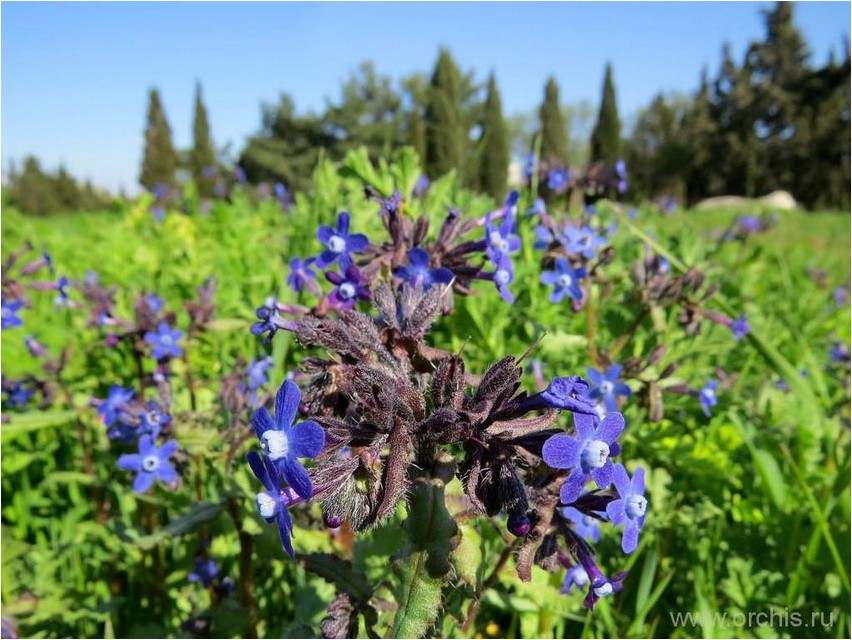
Anchusa (Latin: Anchusa) is a genus of flowering herbaceous plants in the Boraginaceae family. Its clusters of small, blue-green flowers are very similar to the delicate flowers of the Forget-Me-Not.
This isn’t entirely surprising, as both plant genera belong to the same family, making them quite closely related. In English-speaking countries, the plant even has a name, “Cape-forget-me-not,” which Google Translate translates as “Cape Forget-Me-Not.” In Russia, the plant is considered a weed and is called “Bolewort” (with the stress on the “i”). However, among the 40 (forty) plant species in the genus “Anchusa” on Earth, there are medicinal plants. Description
Anchusa, or Cape Forget-me-not, can be found in various parts of the world: in Europe, including the European part of Russia, in the north and south of sultry Africa, and in the countries of Western Asia, where it grows naturally. It can also be found in the United States, where it was artificially introduced.
The plant can be an annual or perennial, including biennial, depending on the surrounding conditions. These are typically herbs, the stems and leaves of which are covered with protective bristly hairs, which distinguishes them from plants of the Forget-me-not genus.
The long, narrow, simple or wavy leaves appear soft, but when touched, you feel the roughness of the hairy, bristly covering. Each plant has numerous stems, growing up to a meter in height. Young stems are often a beautiful deep red. In spring and summer, the stems are covered in spiraling whorls, forming a racemose inflorescence of numerous bright blue flowers. The small size of the flowers is offset by their number and the blueness of the petals, which mimic the blue of the sky. Florists have bred varieties with white flowers, but they are not as vibrant as the natural bright blue. The flowers are pollinated by bees and butterflies, which love to visit the plant on sunny days.
Five sepals, united, form a small green cup, inside which three seeds are hidden. Because of the large number of flowers, each plant produces hundreds of seeds, which, falling into the soil, easily germinate around the parent plants, ensuring the long life of the plant in one place.
The roots of the Anchusa tinctoria species are used as a dye base for cosmetic paints. This use of the plant is the basis for the genus name, Anchusa, as the Greek word “anchousa” derives the name of the red-brown resinous dye, “anchusin,” found in the plant’s roots. This substance is insoluble in water but soluble in ether, chloroform, and alcohol.

Uses
The leaves and flowers of the Anchusa capensis species are eaten by people living in southern Africa. The leaves are a good substitute for vitamin-rich spinach, and the flowers are added to salads and desserts for their beauty and exotic appeal.
A red dye is extracted from the roots of Anchusa tinctoria and added to pharmaceutical ointments. An oil-based paint is used by woodworkers to transform less valuable woods into mahogany or simply impart a pink color.
The flowers and roots of some species are used by folk healers to treat skin inflammations, kidney stones, measles, and smallpox. Although many aspects of this use are questioned by mainstream medicine, the Anchusa plant is recognized as a miracle herb.
Some ancient knowledge about the healing properties of certain species of the plant is still recognized today. These include diuretic, diaphoretic, and antitussive properties. However, doctors warn against taking these medications internally, as the herb contains a substance with a paralyzing effect.
Bugloss (Anchusa officinalis) is used to treat stomach and duodenal disorders, and also as an expectorant and sedative. Anchusa or bugloss: growing and care. Popular varieties. Photos.
Anchusa anchusa
Anchusa anchusa





