Red bladderwort round-leaved
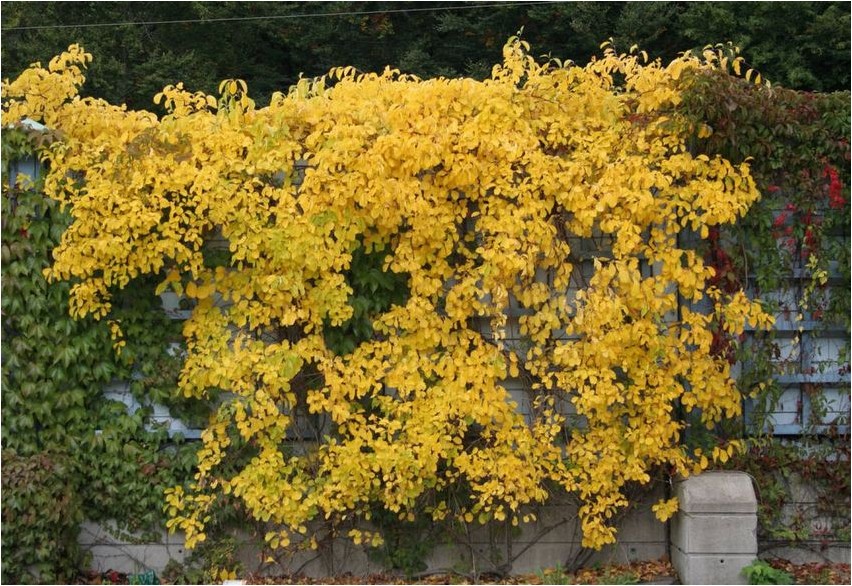
The red bladder is one of the plants of the family called Euonymus; in Latin the name of this plant will be as follows: Celastrus orbiculata Thunb.
As for the name of the red bladder, in Latin it will be: Celastraceae R. Br.
Description of red bladder leaf
Red bladderwort round-leaved is a creeping or weakly climbing shrub, the length of which will reach fifteen meters. Such a plant will be endowed with brownish bark. The leaves of the red bladder can be either round-elliptic or obovate-elliptic in shape, and can also be almost round or large-serrate. The leaves of this plant are leathery and slightly shiny; they will be yellow-olive in color, which actually makes the leaves of the red bladder round-leaved similar to the leaves of arguta and actinidia. The stipules of this plant will not be spiny and ciliated. The inflorescences are simple and umbellate, they will be two to seven flowered. The flowers are quite small in size and have greenish petals. The fruits of the red bladder are spherical capsules, their diameter will be about four to six millimeters, such fruits will be arranged in bunches of five pieces. The seeds of this plant are endowed with a wrinkled roof, colored in orange tones.
The flowering of the red bladder roundifolia occurs in the month of June, and on Sakhalin the plant will bloom in the month of July. Fruit ripening will occur in the period from August to September. Under natural conditions, this plant is found in the Far East. In terms of general distribution, red bladderwort is found in Northeast China and Japan. The plant will grow in thickets along rivers flowing into the sea and along the seashore. However, sometimes the plant can be found near placers and rocks.
Description of red bladder leaf
Red bladderwort round-leaved is endowed with very valuable healing properties, and it is recommended to use the leaves, fruits, creeping stem and root of this plant for medicinal purposes.
The presence of such valuable healing properties should be explained by the content of catechins, sucrose, tannins, cyclitol dulcitol and flavonoids in this plant. The seeds of this plant contain the following sesquiterpenoids: cerolbecol and isocerolbecol ether.

This plant has the ability to exhibit antitumor activity, and in addition will suppress the growth and development of Staphylococcus aureus. It should be noted that such properties of this plant will be very effective, and the result will be noticeable literally in the first days after using such healing agents.
As for traditional medicine, the roots and stems of the red bladder are quite widely used here. Such parts of this plant should be used for rheumatic inflammation of the joints, amenorrhea, various types of injuries and pain in the lumbar and pelvic area. The fruits of this plant should be used for severe agitation, redness of the eyes, sclerosis and mental retardation. Finely crushed leaves of the red bladder should be applied to sore spots for pustules, poisonous snake bites and injuries. It should be noted that it is extremely contraindicated for pregnant women to use any drug that contains any elements of red bladder rotundifolia. This contraindication is absolute and must be strictly observed.





