Tamarillo
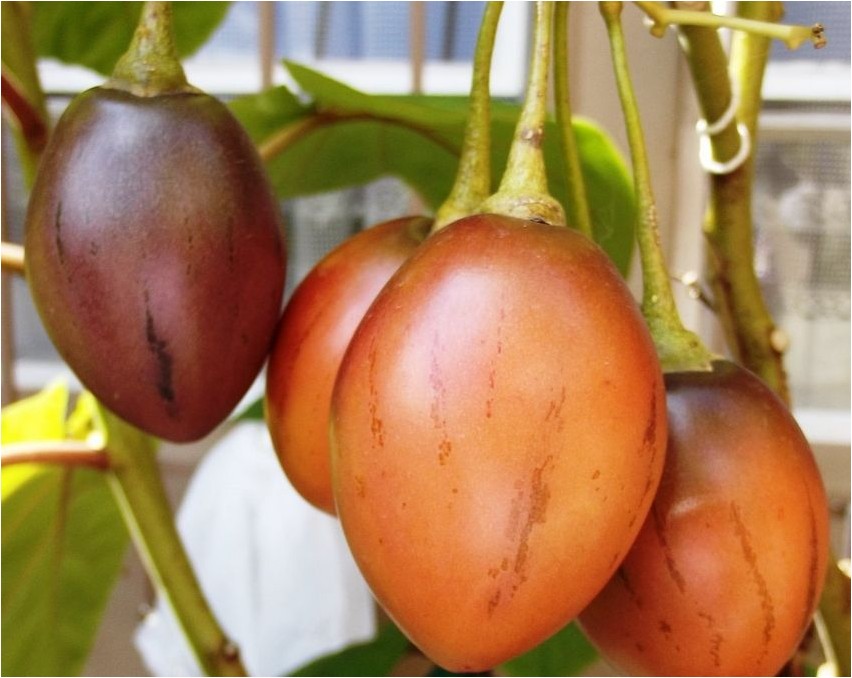
Tamarillo (lat. Cyphomandra betacea) is a fruit crop belonging to the Solanaceae family. This plant is also called tomato tree or beetroot cyphomandra.
Description
Tamarillo is a compact evergreen tree or bush that grows up to two to three meters in height. The leaves of this plant are shiny, oval and quite large. And the pinkish-white flowers are endowed with five-membered cups and exude a very pleasant aroma.
Tamarillo begins to bear fruit from the second year of life, and its total lifespan is about fifteen years.
Tamarillo fruits are egg-shaped berries reaching five to ten centimeters in length. As a rule, they grow on bushes in clusters, with each cluster containing from three to twelve fruits. The peel of tamarillo fruits is bitter, quite hard and very shiny, and their golden-pinkish flesh has a sweetish-sourish-salty taste. The color of the peel can be either yellow or orange-reddish, and occasionally you can find purple fruits. In each fruit you can find black, thin, round-shaped seeds. In appearance, tamarillo fruits resemble long-fruited tomatoes — this is why the Portuguese and Spaniards, who first visited the homeland of this fruit, began to call it a tomato tree.
Since the tomato tree is a subtropical plant, it loves warmth very much and is not at all adapted to frost. And the harvest of ripened fruits is usually harvested from June until the very end of August.
Where does it grow
The Andes of Bolivia, Ecuador, as well as Chile and Peru are considered to be the homeland of tamarillo. This culture is no less widespread in Colombia, Argentina and Brazil, as well as in Venezuela. Tamarillo can also be found in the mountains of Jamaica, Guatemala, Costa Rica, Haiti and Puerto Rico.

Outside of these countries, it is extremely rare to see tamarillo — this fruit does not tolerate long-term transportation very well and is extremely poorly stored.
Usage
Tamarillos are most often eaten fresh. To enjoy their distinctive flavor, it”s important to peel not only the skin but also the thin outer layer down to the flesh. Incidentally, tamarillo skin has a very unpleasant flavor. Peeling the fruit is much easier if you immerse the fruit in boiling water for a couple of minutes. Then, peel the skin off with a sharp knife. However, if you”re eating the tamarillo raw, you can simply cut the fruit in half and scoop out the flesh with a spoon, being careful not to damage the skin.
A small amount of the fruit”s flesh is often added to smoothies and cocktails, imparting a unique flavor and aroma. Tamarillos are also widely used for canning and other culinary preparations.
Fresh fruits can be easily stored in the refrigerator for seven to ten days. Unripe fruits ripen in just two to three days at room temperature.
Besides all this, tamarillos are incredibly healthy—they”re rich in vitamins and contain no sodium or cholesterol. They”re also recommended for anyone who suffers from regular migraines.
How to choose good tamarillos?
When purchasing tamarillos, it”s important to ensure that all the fruits have an even, vibrant color, and that the stems are tightly attached. High-quality fruits should be free of any defects—no dents or spots. When lightly pressed, the flesh of each tamarillo should yield slightly and then quickly return to its original shape.
Tamarillos produced in New Zealand are considered the best—currently, this country is the most reliable exporter of these unique fruits.