Voronets spica
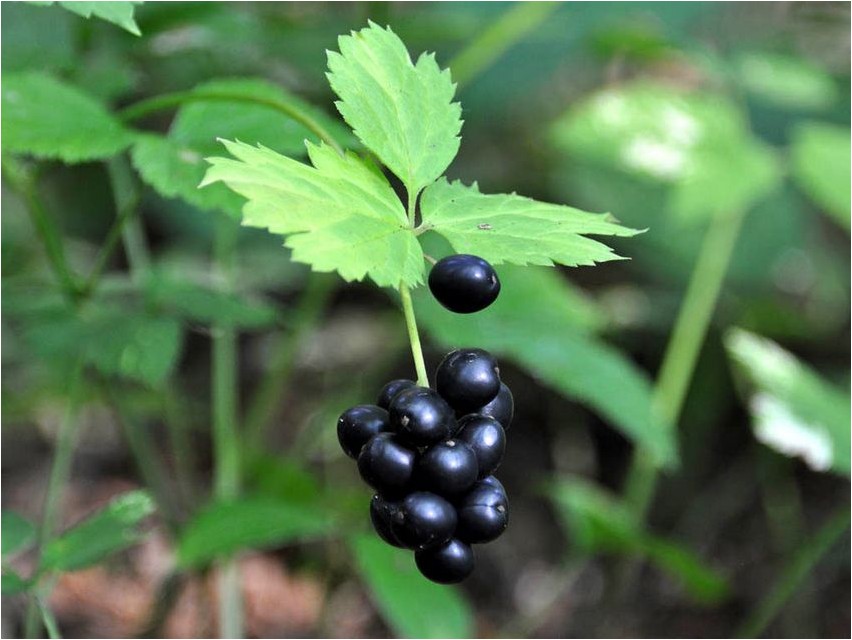
Voronets spica is one of the plants of the family called Ranunculaceae. In Latin, the name of this plant will be as follows: Actaea spicata L.
As for the name of the family itself, in Latin it will be: Ranunculaceae Juss.
Description of the spicate crow
Voronets spica is a perennial herbaceous plant whose height can range from thirty to eighty centimeters. This plant is endowed with a rather thick rhizome, as well as erect, slightly pubescent or smooth stems, which are covered with brown scales at the base. The leaves of Voronets spica are quite large and also double-triple. These leaves are endowed with either broadly oval, obtuse, or pointed, bare, or scattered-pubescent, jagged along the edge segments. The length of such segments will be about five centimeters, and their width will be equal to four centimeters. The crow’s raceme will be short and oval, and when fruiting it becomes cylindrical. The pedicels of the plant are very thin; when fruiting, they will be colored brownish or green. The petals are at the top with a filmy and chipped edge. The fruits are black berries, the length of which is one centimeter and the width is only half a centimeter. This plant blooms around the end of spring – beginning of summer.
Voronets spica is found throughout Ukraine, Belarus, the Caucasus, Altai, as well as in the European part of Russia. In addition, this plant can also be found in the following areas of Western Siberia: the Irtysh region and near Tyumen and Tobolsk. For growth, Voronets spica prefers broad-leaved birch and mixed forests, blueberry forests, oak-walnut bush thickets, as well as oak forests, watersheds and slopes of river valleys. This plant can be found both in small groups and individually.
Description of the medicinal properties of Voronets spica
For medicinal purposes, it is recommended to use rhizomes, roots, as well as the grass of Voronets spica. Alkaloids were found in the roots and rhizomes, and alkaloids, saponins, as well as transaconitic acid were found in the grass. It is noteworthy that the leaves of this plant contain vitamin C, while the seeds contain fatty oil and alkaloids.
Among other things, the fruits and seeds of the crowfoot contain substances that will have a fairly strong local irritant, as well as a general narcotic effect. Such substances will also affect the central nervous system. The roots of this plant are endowed with laxative and emetic effects.

It is noteworthy that when animals eat the black crow, diarrhea and vomiting occur, as well as very severe inflammation of the stomach and intestines. Actually, pharmacological studies have proven that an infusion prepared from the herb of this plant can delay the development of plasmodium in the blood.
In addition to all other advantages and valuable medicinal properties, an infusion or tincture prepared on the basis of the herb, Voronets spica, can be used to quite effectively cure various diseases of the heart, kidneys, and also for headaches and epilepsy.
For headaches, the following remedy seems to be especially effective: to prepare it you will need to take one teaspoon of dry crushed herb of this plant per glass of boiling water. After which the resulting mixture is infused for about half an hour, and then carefully filtered. This remedy is taken three to four times a day, one tablespoon before meals.





