Arizona cypress
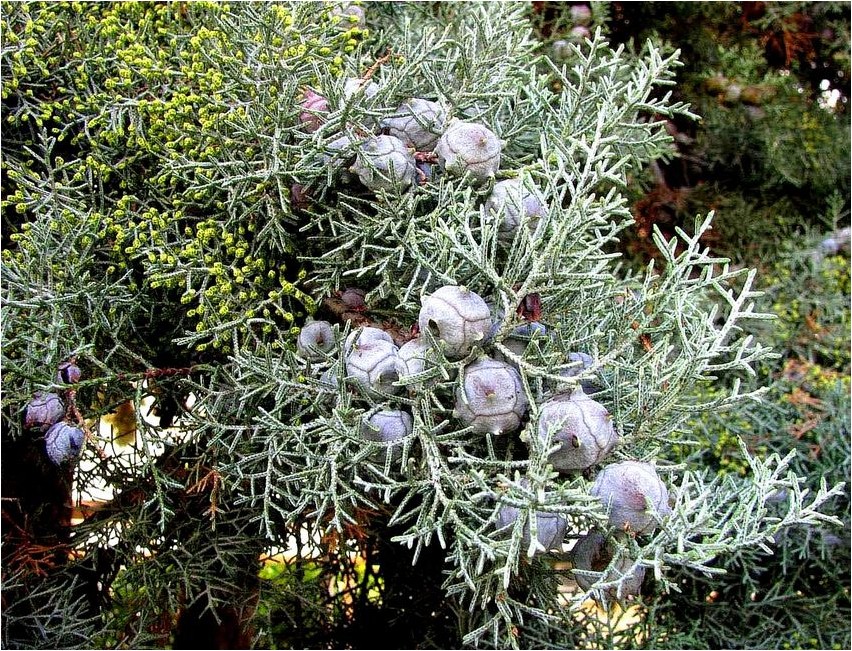
Arizona cypress (lat. Cupressus arizonica) is a medium-sized tree of the genus Cypress (lat. Cupressus) from the Cypress family (lat. Cupressaceae).
It grows in the wild in the southwestern lands of North America. It is grown in culture in many countries of the world, including Europe. Arizona cypress is grown in places where evergreen cypress refuses to grow. It is more unpretentious and can withstand low temperatures down to a thermometer mark of minus 25 degrees. Compared to other species of the genus, the wood of Arizona Cypress is stronger and heavier.
What”s in your name
The name of the genus Cypress has several variants of its origin. There are a number of ancient legends that connect the tree with the name of a man who was transformed by the gods into a slender tree. The prototype could be a man, a boy or a girl, distinguished by his slenderness and having some character trait that did not suit the gods, and therefore they turned such people into a tree, believing that this would be better for man and life.
Some believe that everything is much simpler, and the name Cypress is born from the name of the island of Cyprus, where Cypress trees have long grown in the wild.
Arizona cypress came to the attention of botanists in the second half of the 19th century. It was first described by the American botanist Edward Lee Green, who was studying the flora of the western territories of the United States of America, where the state of Arizona with this type of Cypress is located.
Description
Arizona cypress is not large in size, growing to a height of 10 to 25 meters and expanding its brown-reddish smooth trunk to half a meter in diameter. Often grows in pine-oak+

The crown of medium-sized evergreen conifers can be ovoid-conical or conical. The non-flattened branches are covered with a dense layer of scale-like leaves, the length of which varies from 0. 2 to 0. 5 cm, and the color from dull gray-green to bright bluish-green.
Oblong or spherical seed cones from 1. 5 to 3. 5 cm long have from 6 to 8 (less often from 4 to 10) protective scales. The green color of the seed cones changes to gray or grey-brown as they mature, which lasts from 20 to 24 months. The scales of the cones remain closed for many years. Only a fire that destroys the parent tree causes them to open up, releasing the seeds for Arizona Cypress to continue its life on the planet.
Five subspecies of Arizona Cypress
The plant world, trying to best adapt to changing living conditions, creates subspecies of the same species, differing in small details. Some botanists count 5 such subspecies of Arizona Cypress. Others consider them to be independent species of the Cypress genus.
* Arizona cypress is a variant of “arizonica”, or Arizona cypress — safe, that is, reliably protected.
* Arizona bald cypress, or Arizona smooth cypress, is also found in a reliable location in Arizona.
* Cypress Arizona version of Montana — grows in the pine-oak forests of Northern California, being a vulnerable plant.
* Arizona cypress nevadensis — grows in Southern California, causing the least concern among botanists for its presence on Earth.
* Arizona cypress stephensonii — endangered after a fire in San Diego (Southern California) in 2003. Most of the Cypresses were swept away from the face of the Earth by hellfire, although the seed cones that opened after the fire subsided gave good young shoots.
Usage
In parks and gardens around the world you can find Arizona Cypress, which is beautiful and green all year round.
In Spain, for example, it is used to make hedges between plots of land. Such borders are strong, dense and easy to trim to give them the desired look.
Cypress is propagated by sowing seeds or cuttings. In favorable conditions, when propagated through sowing seeds, already in one growing season the root system develops so successfully that the above-ground part rises to the heavens to a height of up to 40 cm.


