Akebia
Akebia (lat. Akebia) is a small genus of plants consisting of climbing vines, which are often called “climbers” in the literature.
Their decorative properties are used in gardens when vertical gardening is required. The inflorescences, collected from purple flowers, exude a light aroma of chocolate, and the fruits with jelly-like pulp were eaten with pleasure by Japanese children, not paying attention to the abundance of seeds inside.
Description
To count the species of plants of the genus Akebia, you do not need a calculator, since botanists have included only five species of fast-growing vines that easily climb a support. The support can be man-made pergolas, high fences, walls of all kinds of buildings, from residential to outbuildings. Moreover, the coolness of the walls does not frighten the heat-loving vine, which was born in the tropics of East Asia. It is only important that the temperature is above the “plus 5” mark on the street thermometer.
The simple leaves of the plant like to create a community of several pieces, forming a palmately compound leaf on a long common petiole. Moreover, each individual leaf has its own petiole, shorter in length. The dark green surface of the dense leaves is bare and leathery. The reverse side of the leaf is lighter green.
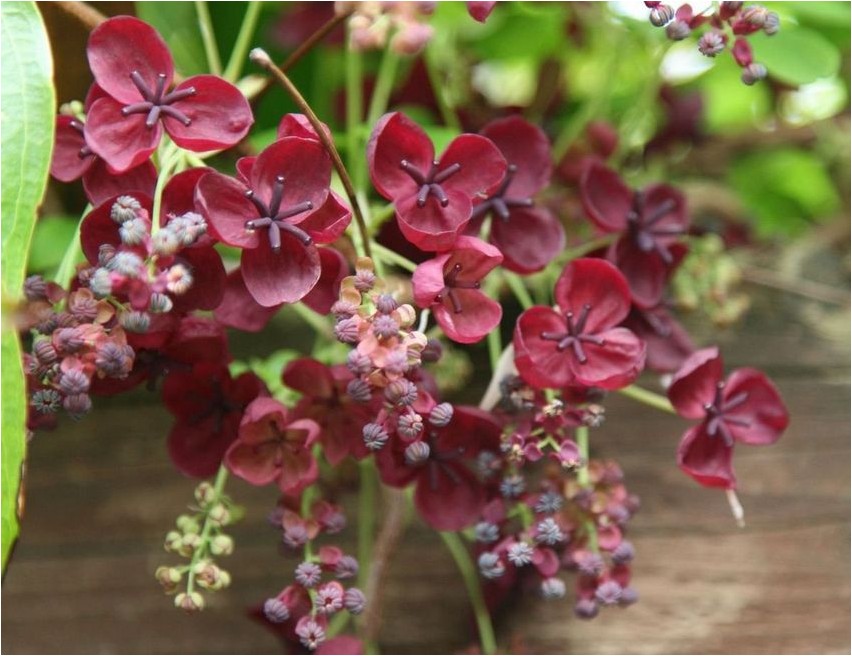
Violet, pink-brown, purple-brown flowers up to three cm in diameter form a fragrant raceme-like inflorescence. It contains male and female flowers, that is, Akebia is a monoecious plant, which makes the task of continuing the presence of beautiful vines on the planet much easier. Moreover, in some countries, Akebia feels like a full-fledged mistress, displacing other plants from the territory and forcing people to classify it as a malicious weed.
The ovoid-oblong edible fruits of Akebia, up to 8 cm long, are covered with a coating of wax on the outside. Numerous seeds are located in the translucent whitish pulp of the fruit in slender, dense rows. Although the flesh of the Akebia fruit is generally believed to have a sweetish taste, it is rather tasteless. Japanese adults remember with nostalgia how, as children, they feasted on the fruits of Akebia, because in those days there was little more traditional food. Maybe that’s why the fruits seemed sweet.

What”s in your name
Since Akebia was born in East Asia, including, it has long grown in Japan, the Japanese sound of the name of the plant was fixed in the Latin name, which today we pronounce as “Akebia”, marveling at the bizarre combination of letters.
Growing
The sunny East has brought up in Akebia a love for our Sun, which does not at all prevent the plant from feeling great near the cool shaded walls, which the owners are trying to hide behind a dense carpet of leaves and inflorescences with the aroma of delicious chocolate.
In the tropics, the liana is accustomed to fertile, loose and moist soils, and therefore on other soils it will grow sluggishly, and it may not reach fragrant flowering at all. When growing Akebia in flower pots in areas with cold winters, the pots are also filled with fertile soil with the addition of mineral fertilizer.
Although Akebia loves moist soil, experts recommend watering only young plants that have not yet matured, and also when drought has settled in your area for a long period.
In order for the appearance of the vine to always please the grower, it is necessary to rid the plant of damaged and dried shoots. In areas with a temperate climate, after the end of flowering, the plant is pruned at the root.
Loosening and mulching of the soil is encouraged.
The liana is propagated by cuttings or layering.
Akebia is resistant to pests, but succumbs to excess moisture and frost. Also, the vine grows very quickly, and therefore needs constant supervision so that it does not manage to displace other plants from the site.