Platycerium two-forked
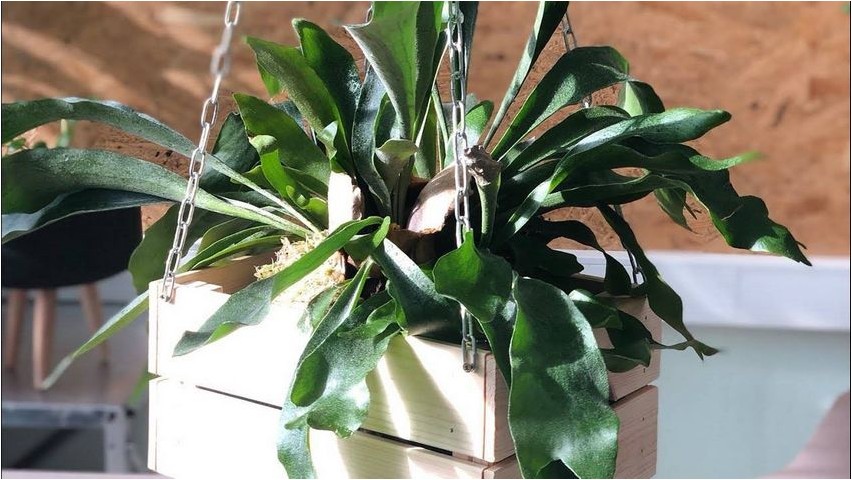
Platycerium bifurcatum is one of the plants of the family called millipedes; in Latin the name of this plant will be as follows: Platycerium bifurcatum.
As for the name of this family itself, in Latin it will be like this: Polypodiaceae.
Description of Platycerium two-forked
For the favorable development of this plant, it will be necessary to observe the light regime of partial shade. Throughout the summer, it is important to maintain moderate watering, and the air humidity should be kept at an average level. The life form of Platycerium double-forked is a herbaceous plant.
This plant will look great both in winter gardens and in various floral compositions. In addition, this plant can be found quite often in general purpose premises, as well as indoors. At the same time, for growing Platycerium double-forked, it is recommended to give preference to bright and warm rooms.
As for the maximum size in culture, the leaf length can reach about seventy centimeters. However, when growing double-forked Platycerium indoors, the length of this leaf will be about forty centimeters.
Description of the features of care and cultivation of Platycerium double-forked
As for replanting Platycerium double-forked, such measures are necessary for the plant only as rotting and compaction of the substrate occurs. When replanting, it is very important to try to avoid even the slightest damage to the roots as much as possible. When replanting, preference should be given to either hanging pots or epiphytic baskets.

As for the composition of the soil mixture itself, you will need to mix one part of sphagnum and two parts of fern roots, and also add a little more charcoal. It is noteworthy that it is quite acceptable to replace fern roots with pieces of pine bark. The acidity of such soil should be neutral.
It should be noted that under unfavorable conditions, namely improper watering and dry air, the tips of the leaves of this plant may dry out. In some cases, this plant can be affected by scale insects.
Throughout the entire dormant period, it is important to provide the double-forked platycerium with an optimal temperature, ranging from fifteen degrees Celsius and above. In this case, watering should remain moderate, and air humidity can be maintained at a standard level. When grown indoors, the dormant period is forced: it will begin in October and last until February. The reasons for the occurrence of such a period of rest will be both low illumination and insufficient air humidity.
Reproduction of Platycerium biforked can occur both through division and through sowing forms. As for dividing this plant, this should be done during transplantation. Platycerium double-forked can be propagated by sowing spores of all types, with the exception of garden forms.
This plant is recommended to be grown either in baskets or in hanging pots. It is noteworthy that for the favorable development of this plant, regular spraying is recommended. The leaves of Platycerium double-forked have decorative properties. Such leaves can be either spore-bearing or sterile. The covering leaves are rounded, they fit quite tightly to the support. Under natural conditions, such leaves of this plant will form a kind of shell. The spore-bearing leaves are very long and branched, and their color is light green.