Calathea striped
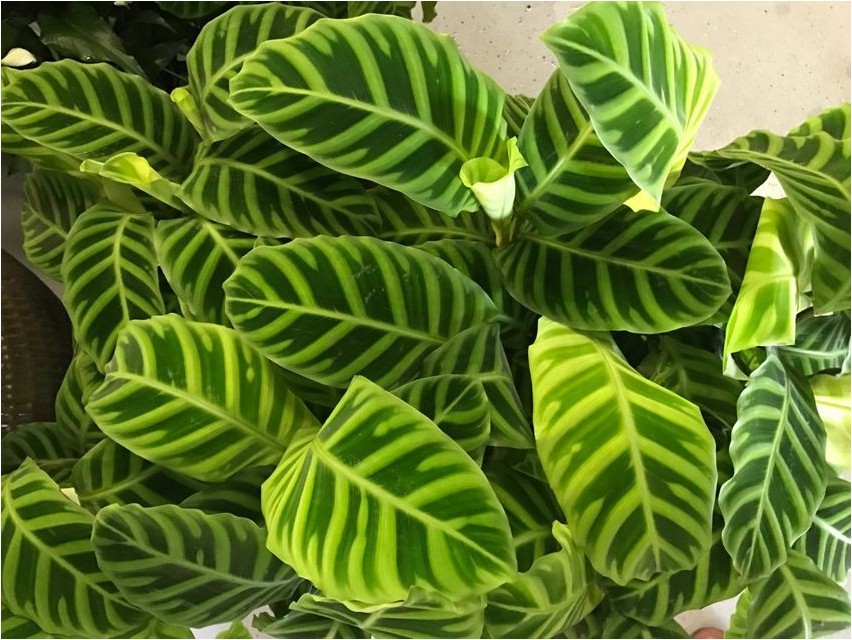
Calathea striped is one of the plants of the family called arrowroot, in Latin the name of this plant is as follows: Calathea zebrina.
As for the name of the family itself, in Latin it will be: Marantaceae.
Description of calathea striped
To successfully grow this plant, you will need to provide either a light regime of shade or partial shade. As for watering throughout the summer, it should be kept abundant. The air humidity should remain quite high. The life form of striped calathea is a herbaceous plant.
It is noteworthy that plants can be grown not only indoors, but also in display windows, in florariums, and also in winter gardens. As for growing at home, you will need to place pots with this plant at a distance of about one to two meters from the north or east window. Under natural conditions, this plant can reach a maximum height of about forty to eighty centimeters.
Description of the features of care and cultivation of striped calathea
In order for this plant to develop favorably, it will be necessary to replant striped calathea in the spring and summer. Such transplants should be performed either once a year or every two years. For transplanting calathea striped, it is recommended to choose wide pots, which is due to the fact that the root system of this plant is not deep, but it is superficial and also has tubers. The composition of the soil mixture for replanting should be as follows: one part sand, two parts leaf soil and three parts peat. The acidity of such soil should be kept at a slightly acidic level.
It is recommended to carefully protect this plant from direct sunlight: otherwise, burns may appear on the leaves of Calathea striped, which will be expressed in brown spots. If the air in the room where the plant is grown is very dry, the leaves will not only turn brown, but will also dry out and curl. In the case when the soil is excessively moist, and temperature fluctuations also occur, rotting of not only the root system, but also the calathea striped tubers can occur. In some cases, this plant can be affected by both scale insects and spider mites.

Throughout the entire dormant period, it is recommended to ensure an optimal growing temperature of sixteen to twenty degrees Celsius. Watering throughout this time should be moderate, and air humidity should remain average. When striped calathea is grown indoors, this dormant period is forced. A period of rest will occur as a result of insufficient light and air humidity.
Reproduction of striped calathea can occur by dividing the root ball during transplantation. To do this, you will need tubers with about two or three roots.
As for the specific requirements of this crop, it should be noted that the plant is quite sensitive to air humidity, and also categorically cannot tolerate tobacco smoke. Temperature changes can have an extremely negative impact on the development of striped calathea. In addition, a bright color will help reduce the color intensity of the plant’s leaves, and the size of the leaf blade itself will also decrease.
The leaves of striped calathea are endowed with decorative properties. The shape of the leaves will be oval, and the length can reach forty centimeters, while the width will be approximately fifteen centimeters. The leaves are bright green in color and have velvety stripes along the veins.