Dyer’s broom
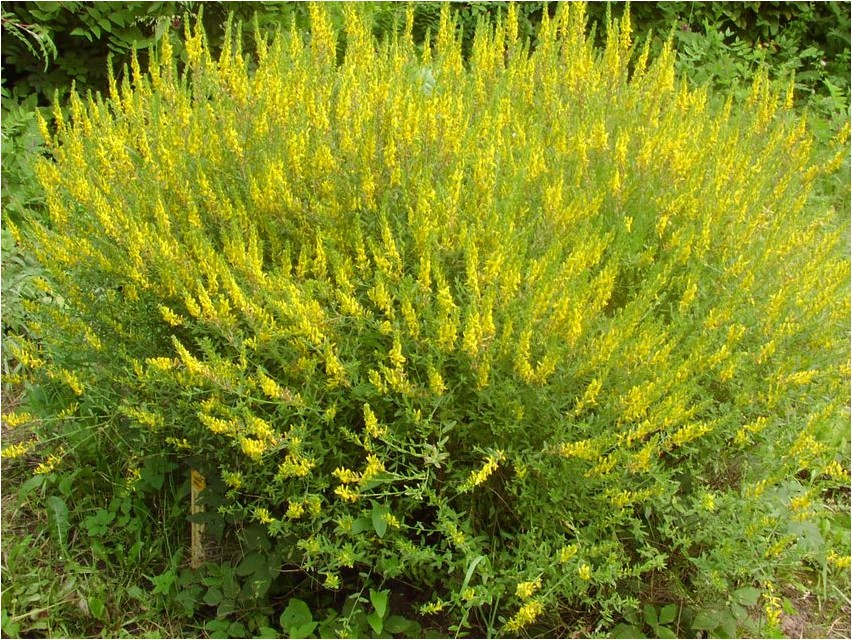
Dyer’s broom is a member of the Papilionaceae family. Its Latin name is Genista tinctoria L.
The family name of dyer’s broom is Papilionaceae.
Description of Dyer’s broom
Dyer’s broom is a small shrub with a sturdy, branched rhizome and stems. The stems are branched, sharply ribbed, and erect. Dyer’s broom leaves are short-petioled, simple, and alternate, as well as oblong and acute, with small, awl-shaped stipules. The upper leaf blade is dark green, while the lower blade is lighter. The flowers are golden-yellow, borne in long racemes at the ends of branches and stems. The bracts of this plant are longer than the calyx, and the calyx is bilabiate. The fruit of this plant is a pod, slightly curved and oblong.
In the wild, dyer’s broom can be found in the European part of Russia, Crimea, the North Caucasus, and Western Siberia. This plant prefers the edges of dry forests, open forests, flooded meadows, areas among shrubs, and grassy slopes on sandy and calcareous soil.
Description of the medicinal properties of dyer’s broom
Dyer’s broom has very valuable medicinal properties, and the herb is recommended for medicinal purposes. The herb should be dried in well-ventilated attics, with the tops of the stems, including the flowers and leaves, under eaves. This plant’s valuable medicinal properties are explained by its content of alkaloids, organic acids, flavonoid glycosides, the dye scoparin, bitter substances, triterpene saponins, wax, mucilage, and mineral salts.
Preparations made from this plant’s herb have diuretic, choleretic, analgesic, laxative, hemostatic, and metabolic-enhancing effects.

In folk medicine, an infusion of dyer’s broom herb is recommended for liver diseases, urinary tract stones, as well as all types of jaundice, dropsy, and various skin conditions, including lichen, allergic dermatitis, and furuncles. The infusion can also be used as a diuretic and laxative.
It’s worth noting that an infusion of the green parts of this plant is used for thyroid disorders. Its effects are similar to those of thyroidin. Positive results have also been noted with external application of both a decoction and an infusion of dyer’s broom for the treatment of diathesis, ringworm, and boils. For this purpose, it is recommended to prepare a decoction of four tablespoons per liter of water. Strain the decoction and then pour it into a full bathtub.
It’s worth noting that the plant is poisonous, so any remedies containing it should only be used under medical supervision and with extreme caution.
For the treatment of headaches, chronic bronchitis, bronchiectasis, kidney stones, hemorrhoids, and cholecystitis, the following remedy is recommended: take fifteen grams of dried herb and add two glasses of water. Boil the resulting mixture until no liquid remains, then strain thoroughly. Take this remedy three tablespoons every three hours until the illness subsides.
Medicinal plants of June “Dyer’s broom”





